
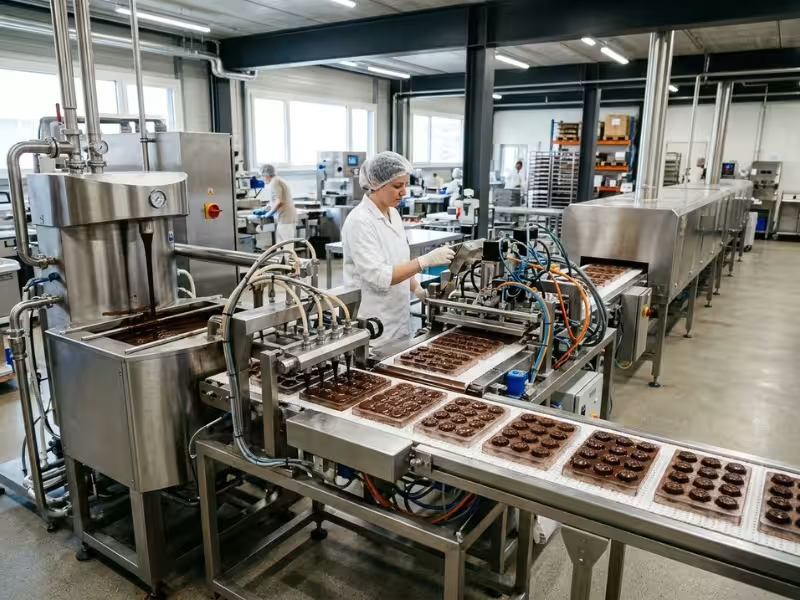
Many chocolate brands hit the same wall. Orders keep climbing, but floor space, cash, and staff stay tight.
A 100 kg/h line often looks like the answer. It sits between workshop machines and a full industrial plant.
I help growing brands plan their first real production lines. Most ask me if they can run 100 kg an hour. I ask something else.
Does the line fit your products, your weekly volume, and your stage of growth? Buy too small, and you stall. Buy too big, and idle machines drain your cash. That fit matters far more than an impressive capacity number.
Why 100 kg/h Often Marks the Next Real Growth Step
Most brands I work with don’t jump straight from a workshop to a factory. They go through a middle stage first, and 100 kg/h usually fits it.
Think of chocolate capacity as three bands. Craft and pilot equipment runs about 5 to 30 kg/h, which gives you a few hundred kilos a day at most. Industrial lines start around 500 kg/h. They often run multiple shifts and need a dedicated maintenance crew. At 100 kg/h, you sit in between. You get commercial volume without a plant-sized budget or staff.
On paper, the math looks simple. One 8-hour shift at 100 kg/h gives you 800 kg. Over 22 working days, that’s about 17.6 tons a month. Add a second shift, and you double it.
That’s the nameplate number, not what you’ll sell. Warm-up, changeovers, cleaning, and short stops all eat into each shift. On well-run lines I review, sellable output usually lands at 60% to 75% of rated capacity. So plan around 500 to 600 kg per shift. That works out to roughly 5,000 to 6,000 bars at 100 g each, or 11 to 13 tons a month on one shift.
That volume matches a specific stage of growth. It suits brands that win regional retail shelves, sign a private-label contract, or ramp up for holiday gifting. Craft equipment can’t keep up with those orders. An industrial line would sit idle most of the week.
Capacity is only half the story. Buyers at this stage care just as much about reliability. A retail chain won’t accept “we’ll ship when the batch is ready.” They want the same product, on the same date, every order.
Small machines run by hand often drift from batch to batch. A connected 100 kg/h line holds temper, weight, and cooling steady, so you can commit to firm delivery dates. Those commitments win larger accounts.
What 100 kg/h Actually Means in Real Production
The number on a quote shows what a machine can push through under ideal conditions. It doesn’t show what lands in your shipping cartons. I see that gap on every line I audit, and buyers who plan around the nameplate figure usually come up short in their first busy season.
Here’s how a typical 8-hour shift really breaks down:
- Warm-up and temper stabilization: about 30 minutes
- Two product changeovers at 40 minutes each: 80 minutes
- End-of-shift cleaning: about 30 minutes
- Short stops for jams, mold swaps, and refills: about 20 minutes
That’s 160 minutes gone before anyone makes a mistake. The line actually runs about 5 hours and 20 minutes, so you get roughly 530 kg, not 800.
Product mix moves the number even more. Suppliers usually rate a line on plain solid bars, the easiest product it will ever make. When you change the product, the real speed changes with it.
|
Product |
Real output vs. rating (while running) |
What slows it down |
|---|---|---|
|
Plain solid bars |
85–95% |
Mold cooling time |
|
Bars with inclusions |
70–85% |
Dosing, uneven flow, extra cleaning |
|
Filled shells / bonbons |
40–60% |
Shell, fill, and cap steps; longer mold cycles |
|
Enrobed centers |
Varies widely |
Center feeding, coating weight, cooling tunnel length |
Enrobed products confuse many buyers. On a coating line, the rating may describe chocolate throughput, not finished pieces. Your real pace then depends on how fast you can make and feed centers. Always ask your supplier what the 100 kg/h figure actually measures, and on which product.
Labor sets the last limit. One operator can watch a depositor. That same person can’t also demold, inspect, and pack 500 bars an hour. When packing falls behind, the whole line slows to match it.
I tell clients to plan around three numbers: real run hours per shift, their actual SKU mix, and how many hands work at the end of the line. Those three figures predict your output far better than any brochure.
What a Compact 100 kg/h Chocolate Line Usually Includes
When a client sends me a quote to review, I sort every machine into two piles. One holds the modules the line can’t run without. The other holds modules that depend on what you make. That split shows you where your money actually goes.
The Core Modules Every Line Needs
No matter what you produce, four modules do the heavy lifting.
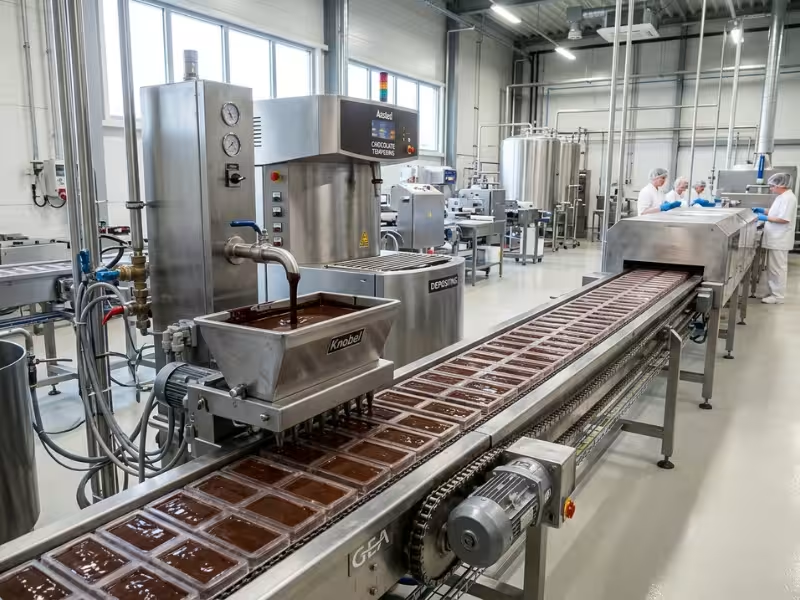
A continuous chocolate tempering machine sits at the heart of the line. At this scale, it must hold temper steady for hours, not just for one batch. Its output should exceed your depositor’s draw by about 10–20%. If it falls short, the whole line slows to its pace.
A chocolate depositor or molding unit fills each mold to a set weight. A mold heater and vibration table usually come with it. Warm molds prevent dull surfaces, and vibration removes air before the chocolate sets.
A cooling tunnel limits your real speed more than most buyers expect. Bars need time to set. If the tunnel runs too short, you must slow the belt, and your 100 kg/h drops fast.
Holding tanks and a chocolate pump feed the temperer a steady supply. Skip them, and your operators end up carrying buckets all shift.
Modules That Depend on Your Products
Once the core is set, your product list decides the rest. Every extra module adds cost, floor space, and changeover time.
A chocolate enrober with its own cooling tunnel suits wafers, biscuits, and protein bars. A one-shot depositor places shell and filling in a single stroke. It replaces the slow shell, fill, and cap routine for bonbons and filled bars. A decorator adds stripes or drizzle for premium lines.
I tell clients to buy for the products that bring in most of their revenue. Add the rest once those sales prove themselves.
Bean-to-Bar vs. Couverture-Only Setups
This choice changes your project more than any single machine.
A couverture-only line starts with ready-made chocolate. You melt, temper, deposit, and cool. It usually fits in a smaller room, starts up quickly, and needs fewer specialized skills.
A bean to bar line adds a roaster, cracker-winnower, grinder, and refiner-conche or ball mill. Refining and conching alone can take 12 to 24 hours or more per batch. Husk dust also means you need a separate processing room away from your molding area.
In my projects, bean-to-bar often doubles the investment and adds 50% or more to floor space. It also asks more of your team. You gain flavor control and a stronger brand story. You also take on far more work before a single bar reaches the mold.
How Much Space, Utility, and Labor This Capacity Really Needs
“Compact” sounds like the line will slide into any spare corner. It won’t. Before any project, I measure the room, open the electrical panel, and walk the path a pallet will take.
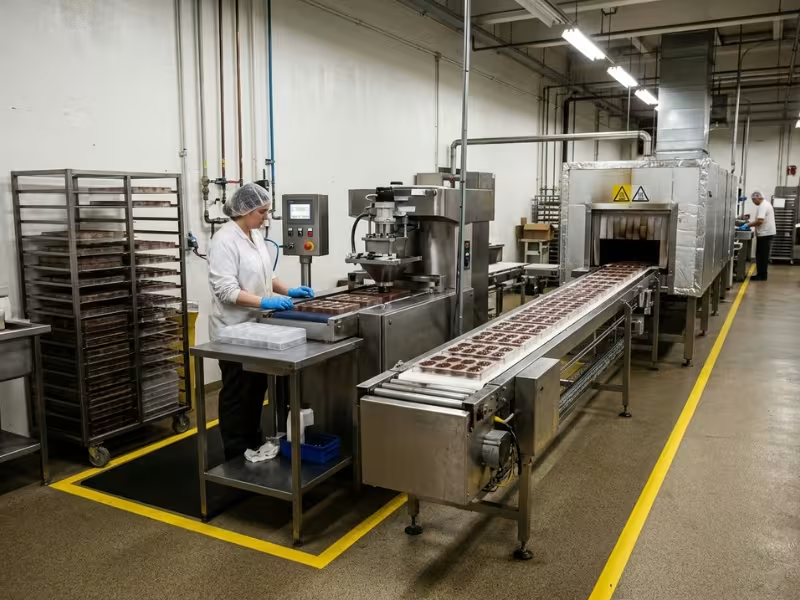
Plan for the room, not just the machines. A couverture molding line rated at 100 kg/h usually takes up 25 to 40 m² of equipment. The full working room it needs runs closer to 60 to 100 m². Add an enrober or a longer cooling tunnel, and you can pass 120 m².
That extra space does real work:
- Leave at least 1 m of clear aisle on both sides of the line, and 1.2 m where operators push carts.
- Set a staging area for chocolate blocks or callets near the melting tank.
- Give mold racks their own corner. One product can rotate 150 to 300 molds.
- Keep side access to the cooling tunnel for cleaning and belt changes.
- Move finished goods out the far end, without crossing the raw material path.
One brand I advised squeezed its line into 45 m². Operators stacked molds on the floor and walked around the tunnel to reach packing. Output dropped by almost a quarter.
Check utilities before you sign. Most delays I see come from the building, not the machines.
- Power: Three-phase supply, usually 380–415 V at 50 Hz or 208/480 V at 60 Hz. A molding line with a cooling tunnel often draws 40 to 70 kW in total. Have an electrician confirm your panel has spare capacity.
- Compressed air: Clean, dry, oil-free air at about 6 to 8 bar for depositor valves and demolding.
- Cooling: Many tunnels and temperers need chilled water at roughly 8–12°C. Others use built-in refrigeration that needs room to vent heat.
- Climate control: Hold the room near 18–22°C with humidity below 55%. Warm, damp air causes bloom and sticky molds.
- Drainage: Sloped floors and drains near tanks and the depositor speed up washdowns.
Also check ceiling height. Holding tanks and tunnel hoods often need 3 m or more.
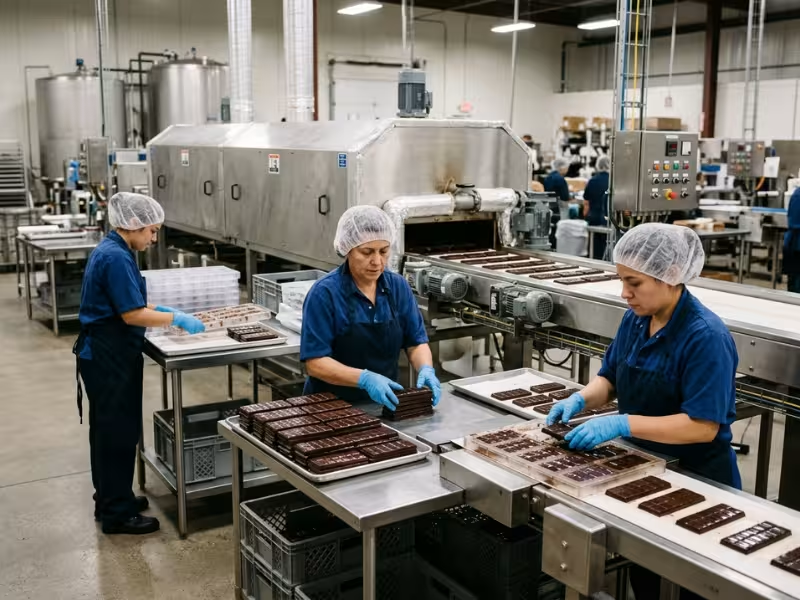
Staff for the end of the line. One trained operator can run the temperer, depositor, and tunnel controls. A second person can demold, inspect, and stack bars. Hand-wrapping 5,000 bars a shift needs two or three more people, or a flow wrapper.
A compact line saves space. It doesn’t save you from planning. Ask your supplier for a scaled layout drawing and a full utility list. Then walk your room with a tape measure before you commit.
What It Costs to Buy and Run a 100 kg/h Line
Founders usually ask me for one price. I can’t give a useful one until I know what the line has to make. Two lines with the same 100 kg/h rating can differ in cost by two or three times. Configuration, installation, and daily use explain most of that gap.
What Drives the Price on Your Quote
The equipment list sets your starting point. Hidden project costs then build on top of it.
An entry molding-only line sits at the low end. It covers a temperer, depositor, mold heater, vibration table, and cooling tunnel. A full enrobing line adds a second tunnel, a center feeder, and often a decorator. In my projects, that pushes the equipment bill to about 1.5 to 2 times the molding-only price.
Within any setup, a few choices move the number most:
- Cooling tunnel length. A longer tunnel costs more, but it lets thick bars run at full speed.
- Depositor type. A one-shot head costs far more than a standard depositor.
- Controls. Touchscreen PLCs with stored recipes cost more than manual dials, but they cut changeover errors.
- Mold sets. Each SKU needs 150 to 300 molds. Five SKUs add up quickly.
Then add the costs many quotes leave out. These include freight, crating, and import duty. You also pay for electrical work, chilled water piping, and air lines. Engineer travel and on-site days add more, and so do recipe trials with your own chocolate. On projects I review, installation and commissioning often add 10% to 25% to the equipment price. The share climbs higher when your building needs a power upgrade.
What It Costs to Keep the Line Running
Once production starts, five costs show up every month:
- Labor: Usually the largest. Count operators plus packing staff.
- Energy: Tunnels and chillers draw most of it. Track kWh per kilo, not just the monthly bill.
- Maintenance: Belts, seals, pump parts, and depositor pistons wear out. I budget roughly 2% to 4% of equipment value each year.
- Consumables: Molds scratch, filters clog, and cleaning chemicals run out.
- Downtime: A missing spare part can idle the whole line for a week.
Utilization decides your real cost per kilo. A line running 30 hours a week carries the same loan payment and service contract as one running 80. At half capacity, your fixed cost per kilo roughly doubles.
SKU complexity hits just as hard. Each changeover burns labor, purge chocolate, and cleaning time with zero output. Ten SKUs in short runs cost more per kilo than three SKUs in long ones.
Ask your supplier for power draw, air use, and a priced spare parts list. Then model your cost per kilo at 50%, 70%, and 90% utilization before you compare quotes.
When a 100 kg/h Line Beats Outsourcing — and When It Doesn’t
Some of my most useful advice to founders is “don’t buy a line yet.” Owning equipment pays off only when it solves a problem your co-manufacturer can’t.
Margin is the first test. A co-manufacturer charges a conversion fee on every kilo, plus its own profit. On simple molded bars, that fee often takes a large share of your wholesale price. When you produce in-house, that share becomes yours, but only if the line runs enough hours to cover its loan, labor, and upkeep. Compare your current price per kilo with your modeled in-house cost at 60% utilization. If the gap looks thin, keep outsourcing.
Recipe control matters more than many founders expect. A co-manufacturer may swap your couverture for its house chocolate or thin a filling to suit its depositor. If your brand story rests on a specific origin or texture, you need to own the process that protects it.
MOQs quietly shape your product list. Many co-manufacturers want 1 to 5 tons per SKU per run. That ties up cash in inventory and pushes you to drop slow SKUs you’d like to test. On your own line, you can run 300 kg of a new flavor on a Tuesday.
Lead times often decide it. Co-manufacturing slots fill weeks or months ahead, especially before the holidays. When a retailer wants a reorder in ten days, in-house production lets you say yes.
Consistency improves when you hold the controls. You set the temper curve, the cooling profile, and the inspection standard. Nobody rushes your batch to catch up on another client’s order.
Still, outsourcing wins in a few clear cases:
- You’re early. Below roughly 2 to 3 tons a month, a line sits idle most of the week.
- Your volume is seasonal. If 70% of your sales land in Q4, a co-manufacturer absorbs the peak, and you avoid a full year of fixed costs.
- Your SKUs are unproven. Test demand on someone else’s equipment, then buy once a product sells steadily.
My rule is simple. Buy when two things are true. First, outsourcing limits your margin, speed, or product. Second, your steady volume can keep a line busy. Until then, your co-manufacturer remains the cheaper option.
100 kg/h Line vs. Scaling With Smaller Machines
Many brands I visit have already tried the other path. They bought a second tabletop temperer, then a third, and lined them up along one wall. It feels cheaper and safer, but it often costs more.
Labor multiplies with every machine. Three 25 kg/h temperers each need someone to feed, watch, and adjust them. Add people to fill molds, carry trays, and demold. You can end up with six or seven staff making what a connected line makes with three. At an $18 loaded rate, four extra workers on one shift cost about $144,000 a year.
Disconnected stations break the flow. Operators carry molds from the depositor to a cooling cabinet, then to a demolding bench. Trays wait on carts while chocolate cools unevenly. One station runs ahead, another falls behind, and output swings from shift to shift. Each temperer also holds its own curve, so three machines can give you three slightly different bars.
Small machines do have real strengths. When one breaks, the others keep running. You can service one unit while production continues. You can also run two SKUs at once without a full changeover. A connected line stops completely when its tunnel or depositor fails.
Cost per kilo usually favors the line. In the setups I compare, patched-together equipment often runs 20% to 40% higher per kilo. That gap comes from extra labor, handling scrap, and floor space for carts and cabinets. It widens as your volume grows.
Small-machine scaling still makes sense when:
- You produce under about 300 kg a day.
- You run many short SKUs that change daily.
- Your volume swings heavily by season.
- You need backup capacity more than speed, such as for a key retail contract.
My quick test: count the people who touch product between machines. If that number beats the crew a line would need, the line will likely cost you less per kilo.
Common Reasons Buyers Choose the Wrong 100 kg/h Setup
When a client calls me six months after installation, the machines rarely cause the trouble. The choices made before the order usually do. I see five mistakes most often.
Buying the number, not the product mix. A founder sees “100 kg/h” on a quote and assumes it covers everything. Then filled bonbons turn out to drive 40% of sales, and they run at half that pace on a standard depositor. Match each SKU to the module it needs before you compare ratings.
Treating changeovers as a footnote. One brand I advised ran eight SKUs a day. Each switch took 35 minutes of purging, mold swaps, and cleaning, so the line sat idle for nearly half the shift. Group SKUs into longer runs. Choose quick-release molds and stored recipes that cut each switch to about 15 minutes.
Finding utility limits after delivery. The crates arrive, and the electrician finds 25 kW of spare panel capacity for a 60 kW line. Or the chiller has nowhere to vent heat. A transformer upgrade can delay startup by two to three months. Get the full utility list and a site check before you pay the deposit.
Skipping the spare parts question. A depositor seal costs a few dollars. Waiting six weeks for one to ship can cost you a month of orders. Ask which wear parts the supplier stocks, how fast they ship, and whether a technician can join a video call within 24 hours. Keep seals, belts, and sensors on site.
Building for the volume you hope to have. A brand selling 3 tons a month buys a full enrobing line for a contract still in talks. The deal slips, and the line runs two days a week while loan payments continue. Size for proven demand plus about 30% headroom. Leave floor space to add modules later.
Each mistake looks small on a quote. On the production floor, it decides whether your line pays for itself.
What to Check Before You Buy
When a founder sends me three quotes and asks which one to sign, I set the quotes aside. First, I ask for six things. Skip any of them, and the cheapest quote can become the most expensive line you ever buy.
- Audit weekly demand and SKU mix. Pull 12 months of sales and list the kilos per week for each SKU. Mark your top three products and your peak weeks. Then add a 12- to 24-month forecast. Base it on signed or near-signed accounts, not hopes.
- Model realistic utilization. Divide your weekly kilos by real output. That’s about 500 to 600 kg per shift on plain bars, and less on filled products. If the line runs fewer than three shifts a week, payback stretches out. If you need more than five, plan for a second shift. Past ten, look at a larger setup.
- Trial your own recipes on the actual model. Ship your couverture, fillings, and inclusions to the supplier. Watch the run in person or on a live video call. Keep the samples and check gloss, snap, and bloom at two, four, and eight weeks.
- Check layout and utility drawings. Ask for a scaled layout that marks aisles, mold storage, and service access. Give the utility list to your electrician and building owner before you pay a deposit.
- Verify food safety and support. Confirm that food-contact parts meet FDA, EU, or local rules and fit your HACCP plan. Ask which spare parts ship within days and how training works. Find out who answers when the line stops at 6 a.m.
- Judge the supplier’s answers, not just the price. Send every supplier the same detailed questions. Notice who asks about your products and who just repeats the brochure. Fast, specific replies before the sale usually mean better help after it.
A line that passes all six checks rarely surprises you later.
FAQs
How many chocolate bars can a 100 kg/h line produce per day?
On one 8-hour shift, plan for about 500 to 600 kg of sellable output, not 800. At 100 g per bar, that’s roughly 5,000 to 6,000 bars. Bars with inclusions run slower, and filled bars can drop to half that pace. Add a second shift to roughly double the total.
What floor space does a compact 100 kg/h chocolate line need?
The equipment itself often covers 25 to 40 m². The working room usually needs 60 to 100 m² once you add aisles, mold racks, staging, and tunnel access. An enrober or longer cooling tunnel can push you past 120 m². A bean-to-bar setup also needs a separate processing room.
Can one person run a 100 kg/h chocolate line?
One trained operator can run the temperer, depositor, and tunnel controls. But that person can’t also demold, inspect, and pack hundreds of bars an hour. Most lines I set up need two people on the line, plus packing staff or a flow wrapper.
Is 100 kg/h enough for private-label or regional retail supply?
Usually, yes. One shift produces about 11 to 13 tons a month, which covers most regional retail accounts and many private-label contracts. Check the contract volume per SKU against your real output, not the nameplate rating. Leave room for holiday peaks.
Is a 100 kg/h line suitable for bean-to-bar production?
It can be, but the upstream side sets your pace. Refining and conching take 12 to 24 hours or more per batch, so you need enough melangers, ball mills, or conches to keep the molding side fed. Many brands run bean-to-bar for flagship bars and couverture for the rest.
Should I buy a line or keep using a co-manufacturer?
Buy when outsourcing limits your margin, lead times, or recipe control, and your steady volume can keep a line busy. Below roughly 2 to 3 tons a month, or with mostly seasonal sales, your co-manufacturer usually stays cheaper. Model your in-house cost at 60% utilization before you decide.
Conclusion
A 100 kg/h line makes sense when it matches your real product mix and proven demand, not your growth ambitions. Plan around sellable output, not the nameplate number. Plain bars, filled shells, and enrobed centers all run at different speeds.
A compact line still needs real planning. Check power, cooling, air, and floor space before you pay a deposit. Then compare the line honestly against your co-manufacturer and your current small machines.
Before you compare quotes, pull your weekly kilos by SKU. Then ask each supplier to run your own recipes on the exact model. Those two steps will tell you more than any brochure.