
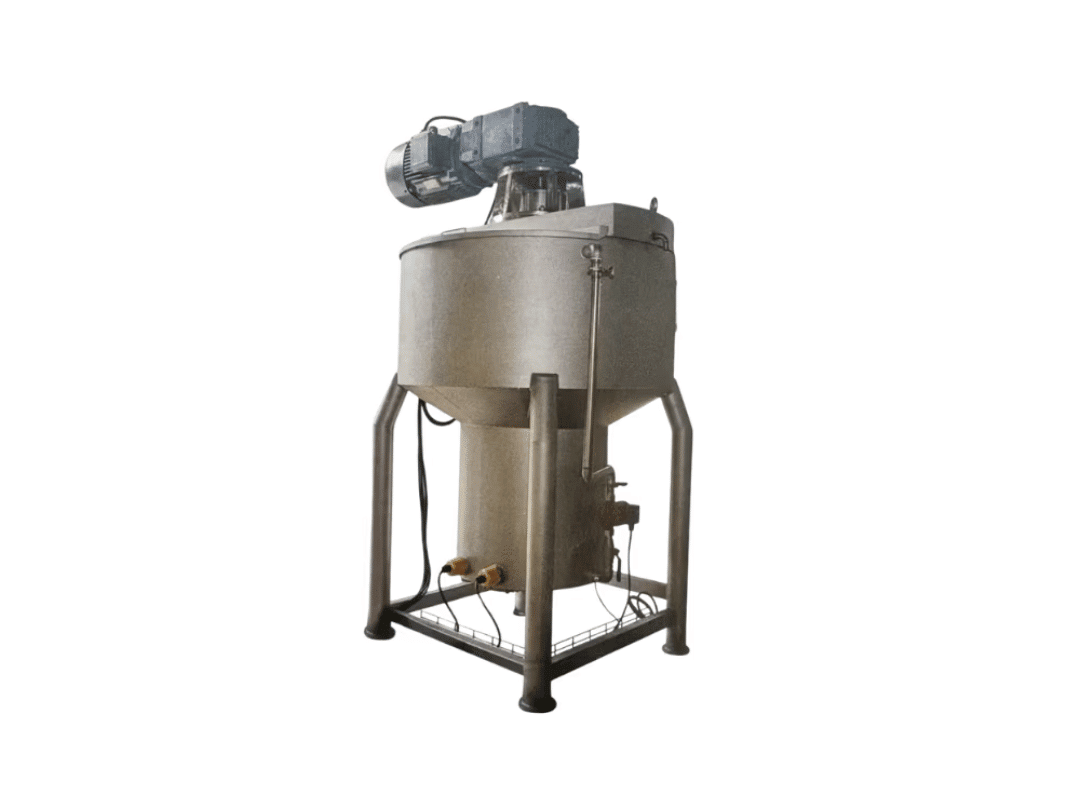
Anyone comparing chocolate refining equipment eventually runs into the ball mill. It grinds sugar and cocoa solids down to a size the tongue can no longer detect, and it does this while mixing everything into one smooth, flowable mass. That combination of grinding and blending in a single machine is why so many small and mid-sized producers reach for it instead of a traditional five-roll refiner.
This piece walks through how the machine actually works, which settings decide whether your chocolate turns out silky or gritty, where a ball mill ends and a conche begins, and how to match a machine to your own production line.
What a Chocolate Ball Mill Actually Does
A chocolate ball mill is a refining machine that uses thousands of small steel or ceramic balls to grind cocoa liquor, sugar, milk powder, and fat into a fine, uniform paste. The chocolate ball mill working principle comes down to one thing: a rotating chamber tumbles the balls through the chocolate mass, and the constant impact and shear between them break the solid particles down toward 20–30 microns, the threshold where chocolate starts to feel smooth rather than sandy.
It sits in the middle of the line. Ingredients come in as a rough pre-mixed paste, the mill refines and homogenizes them, and the output moves on to tempering and then molding or enrobing. In many compact setups, the mill also handles the mixing that a separate conche or blender would otherwise do, which is a big part of its appeal for producers who want fewer machines on the floor.
It isn’t limited to dark chocolate either. Milk and white chocolate, compound coatings built on vegetable fat, and nut spreads like hazelnut or peanut paste all run through a ball mill. The one variable that changes everything is fat content, because fat controls how freely the mass flows around the grinding media. A high-fat recipe grinds faster and cooler; a lean one fights you the whole way.
How the Grinding Actually Happens
Load the chamber with grinding balls and pre-mixed chocolate, start the drive, and the cylinder turns at roughly 20–30 rpm. At that speed, the balls and chocolate climb the wall through friction, then break into two motions that do the real work.
Some balls rise partway and roll back down against each other. That sliding, rolling action produces shear, and shear is what drags particles down to micron size. Other balls, especially at the higher end of the speed range, get carried further up and drop, delivering sharp impact that fractures the brittle sugar and cocoa particles. You need both. Impact cracks the coarse solids open; shear polishes them down to the fineness that defines mouthfeel.
As this repeats, the whole chamber behaves like a slow, heavy mixer. Cocoa butter, lecithin, and solids fold into each other until there are no coarse pockets left. On circulating systems, a pump keeps moving chocolate between the chamber and a holding tank, and each pass tightens the particle size distribution a little more.
Heat comes with the territory. All that friction warms the mass, and that heat cuts two ways. A little of it lowers viscosity and helps grinding along. Too much of it separates fat and dulls flavor. That’s why the chamber runs inside a water jacket holding the mass somewhere around 40–50 °C. When grinding hits the target fineness, the drum stops, and the chocolate discharges through a port where a screen holds the balls back so they can be reused.
The Parameters That Decide Whether It Works
This is where good chocolate separates from mediocre chocolate. The settings below aren’t just specs on a datasheet; each one has a failure mode attached, and knowing the failure mode is what lets you diagnose a bad batch.
|
Parameter |
Typical Range |
Why it matters |
|---|---|---|
|
Rotation speed |
20–30 rpm |
Sets how the balls move and how hard they grind |
|
Ball diameter |
5–15 mm |
Smaller balls grind finer; larger balls attack coarse solids |
|
Temperature |
~40–50 °C |
Holds viscosity steady and protects fat and flavor |
|
Grinding time |
Hours to dozens of hours |
Drives final fineness |
|
Target particle size |
<20–30 microns |
Defines smoothness and mouthfeel |
Rotation speed. Run it too slow and the balls barely tumble, so grinding stalls and you burn hours getting nowhere. Push it too fast and centrifugal force pins the balls to the wall instead of letting them fall, which kills the impact you need and wastes energy. The useful window is narrow, and the right point inside it depends on how full the chamber is and how thick the recipe runs.
Ball size. This is really a trade-off, not a single “best” answer. Small balls create more contact points and grind finer, but they lack the mass to crack coarse starting material quickly. Larger balls hit harder and chew through a rough pre-mix, but they leave you short of the fineness premium chocolate needs. Many operators lean toward the smaller end once the mass is already refined, or run a size mix to cover both jobs.
Temperature. Cooling water’s real job is to stabilize viscosity across a long grinding cycle, not simply to keep the machine cold. If the mass overheats, cocoa butter behavior shifts, flavor flattens, and in bad cases the fat starts to separate. If it runs too cold, viscosity climbs, the balls stop moving cleanly through the mass, and grinding efficiency drops. Steady temperature is what keeps a multi-hour run predictable.
Viscosity. Fat content, temperature, and lecithin all pull on viscosity, and viscosity decides how the whole batch behaves. Too thick and the media can’t circulate, so heat builds and fineness stalls. Too thin and the balls slide through without gripping the solids. This is why a recipe change often forces you to re-tune everything else.
Time. Longer grinding gives finer chocolate, but it also raises energy cost and heat load. The goal isn’t maximum time, it’s the shortest run that reliably hits your target micron count while temperature stays in band. Chasing extra fineness past the point your product needs just wastes money and risks flavor.
Chocolate Conche vs Ball Mill: Two Different Jobs
These two machines get confused constantly, and buying the wrong one is an expensive mistake. The short version: a ball mill reduces particle size, while a conche develops flavor and texture. They solve different problems.
A ball mill is a mechanical grinder. It’s fast, it’s compact, and it drives solids down to micron fineness efficiently. What it does not do well is drive off the volatile acids that make raw chocolate taste sharp. A conche does exactly that, kneading and aerating the mass over long hours to round out aroma and smooth the body. It’s slower and takes more space, but for flavor development there’s no shortcut around it.
|
Ball Mill |
Conche |
|
|---|---|---|
|
Primary job |
Particle size reduction |
Flavor and texture development |
|
Method |
Steel ball impact and shear |
Prolonged kneading and aeration |
|
Speed |
Faster |
Slower |
|
Volatile acid removal |
Limited |
Significant |
|
Footprint |
Compact |
Larger |
Here’s the judgment part. If you’re making compound coatings, or your line is price-sensitive and flavor complexity isn’t the selling point, a ball mill on its own usually does the job. Compound chocolate is built on vegetable fats and doesn’t rely on the same acid-driven flavor development, so the conching step adds cost without much return. But if you’re producing fine dark or origin chocolate where taste is the whole pitch, a ball mill alone will give you smoothness without the flavor maturity buyers expect. In that case you run the ball mill for refining and follow it with a conche. Many established producers use both in sequence for exactly this reason.
When Something Goes Wrong
Most ball mill problems trace back to three things: temperature, timing, or worn media. The table covers the common ones, and a few deserve a closer look because the surface symptom often points to a deeper cause.
|
Problem |
Likely cause |
Fix |
|---|---|---|
|
Chocolate too thick |
Low fat, low temperature |
Adjust recipe, raise controlled temp |
|
Fineness not reached |
Short grinding time, worn balls |
Extend time, replace media |
|
Overheating |
Cooling failure, long runtime |
Check jacket flow, monitor sensors |
|
Abnormal noise |
Loose load, bearing wear |
Inspect load and mechanical parts |
|
Slow or uneven discharge |
Clogged screen, high viscosity |
Clean filter, adjust temperature |
|
Rapid ball wear |
Wrong media grade |
Use correct-hardness steel or ceramic |
Chocolate that stays too thick is usually read as a temperature problem, and sometimes it is. But before you keep raising the heat, check the fat. A recipe running lean on cocoa butter will resist flowing no matter how warm the jacket gets, and pushing temperature to compensate risks the fat and flavor instead. Thick chocolate is often a formulation signal, not just a heating one.
Fineness that won’t drop to target points at either time or the media. Balls wear down over months of grinding, and worn balls carry less mass and fewer sharp contact points, so grinding slows even though everything looks normal. If you’ve extended the run and still can’t hit your micron count, the media is often the real culprit, not the recipe.
Overheating shows up as flavor and fat problems long before it triggers an alarm. Because the damage is gradual, it’s easy to miss until a batch tastes flat or the fat separates. Watching jacket flow and temperature trends across the run catches it early, while there’s still time to correct.
How to Choose a Chocolate Ball Mill for Your Line
The right machine depends far more on your situation than on any single spec. Work through it as a set of conditions rather than a feature checklist.
If you run small batches and change recipes often, a batch mill with easy chamber access matters more than raw throughput. You’ll be cleaning between dark, milk, and white runs regularly, so fast media recovery and simple washdown save real hours every week. Oversizing here just leaves you cleaning a bigger machine.
If your target is fine chocolate below 25 microns, prioritize a machine with reliable temperature control and the ability to run longer cycles without heat creep. Fineness at that level is unforgiving; a mill that can’t hold temperature over a long run will fight you on every batch.
If you’re producing compound coatings rather than real chocolate, you can weigh the decision toward throughput and simplicity, since you likely won’t pair it with a conche. The grinding demands are more forgiving, so capacity and uptime become the deciding factors.
If cleaning time is eating into your line efficiency, look hard at discharge and filtration design. How easily the balls separate from the batch, and how quickly you can open and flush the chamber, will affect your daily output more than most buyers expect going in.
If this mill has to slot into an existing line, confirm it feeds cleanly from your pre-mixing stage and hands off smoothly to tempering. A mill that grinds beautifully but bottlenecks the flow around it isn’t the right choice.
And regardless of which situation fits you, weigh the supplier as heavily as the machine. Grinding media and liners wear, and a supplier who can turn around spare parts and technical support quickly is worth more over the machine’s life than a small difference in purchase price.
Frequently Asked Questions
Is a chocolate ball mill the same as a conche?
No. A ball mill reduces particle size through steel ball grinding, while a conche develops flavor and smooths texture through prolonged kneading. Many production lines use both, in that order.
What particle size should chocolate reach?
Fine chocolate generally needs to get below 20–30 microns. That’s the point where the tongue stops detecting individual particles and the chocolate reads as smooth and creamy.
How long does ball milling take?
Anywhere from a few hours to dozens of hours. Batch size, recipe fat content, ball size, and your target fineness all move that number.
Can a ball mill produce compound chocolate?
Yes. Ball mills handle real chocolate, compound coatings, and nut spreads. Since fat content drives grinding speed and viscosity, a compound recipe will behave differently from a high-cocoa-butter one.
What is the role of the cooling water?
It keeps viscosity stable across a long grinding cycle and protects cocoa butter and flavor from the heat that friction generates. Keeping the machine cool is the mechanism; keeping the chocolate workable and flavor intact is the point.
What ball size should I use?
5–15 mm covers most work. Smaller balls give you finer particles, larger balls handle coarse initial grinding, and a mix of sizes covers both if your mass starts rough.
Does a ball mill replace a refiner?
For many operations, yes. It combines refining and mixing in one compact step, which makes it a practical alternative to a traditional five-roll refiner, especially at small and mid-scale.
Talk Through Your Setup Before You Buy
Choosing a chocolate ball mill is easier once you’re clear on three things: your batch size, the fineness your product needs, and whether you’re running real chocolate or compound. With those in hand, matching a machine to your line is straightforward.
If you’d like a second opinion on the fit, share those details and our technical team will point you toward the right model, with honest pricing and no pressure. And if you’re building out the rest of the line, we can walk you through how the mill pairs with a tempering machine, an enrober, and your full production setup so everything runs together cleanly.