
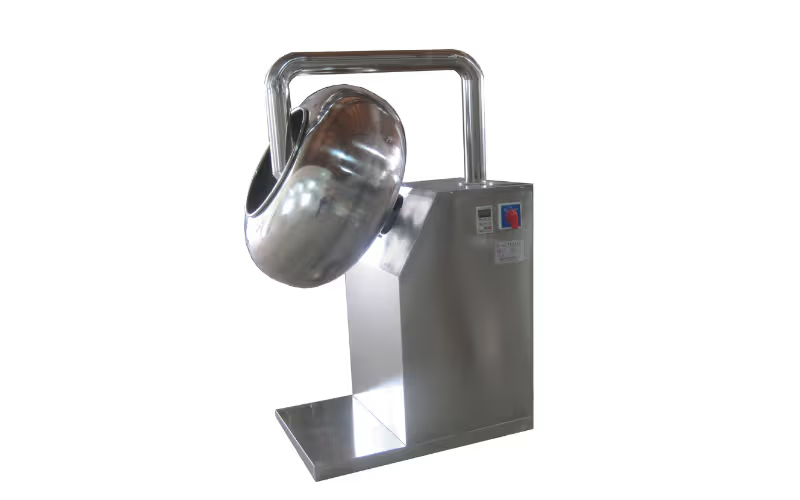
A chocolate coating pan machine is a rotating drum that builds even layers of chocolate or sugar onto free-flowing centers—nuts, raisins, coffee beans, candy cores—through repeated tumbling. Success depends on three things: controlled drum speed, cool dehumidified process air, and disciplined layer timing. Coating pans suit round, loose centers; enrobers handle bars and flat products. Choose your machine based on batch size, center type, room conditions, and whether you run chocolate, sugar, or both.
Chocolate-covered almonds look effortless—smooth, glossy, uniform. But that finish hides a demanding mechanical process, and when it goes wrong, it shows on every single piece. Sticky shells, dull surfaces, clumped centers, and bloom are the daily headaches we hear about from producers who bought the wrong pan or ran it in the wrong conditions.
This guide is written for confectionery manufacturers, production managers, and equipment buyers who need practical answers—not a history lesson. You’ll learn how a chocolate coating pan machine actually works, how it differs from an enrober, how to match a machine to your production, and how to avoid the panning problems that quietly ruin batches.
By the end, you’ll be able to specify the right coating equipment for your product, your volume, and your facility.
What Is a Chocolate Coating Pan?
A chocolate coating pan—also called a confectionery panning machine, tumbling pan, or dragee coating pan—is a rotating vessel that applies chocolate or sugar layers to free-flowing centers. The drum turns continuously, keeping the pieces in motion. As chocolate or syrup enters, the tumbling spreads it evenly across every surface of every piece.
The goal is simple to state and hard to master: a smooth, even, glossy shell on each individual center, batch after batch.
The one thing a coating pan can’t do is coat flat or fixed-shape products. Slabs, bars, filled squares, and biscuits won’t tumble freely, so they need an enrober instead. The pan only works when the centers roll independently inside the drum. That single distinction drives most equipment decisions in a coating line—more on it shortly.
How a Chocolate Coating Pan Works
Understanding the mechanics helps you achieve better results and troubleshoot more quickly.
As the drum rotates, centers tumble in a continuous rolling motion. That motion does two jobs at once: it distributes the coating evenly, and it keeps pieces from fusing together as the chocolate sets. Chocolate enters through a spray nozzle for precise, repeatable dosing—standard on production equipment—or is hand-ladled onto smaller pans.
Temperature control is where most problems begin. Chocolate panning depends on cocoa butter crystallization. Each layer must be set before the next is added, and that requires cool, dehumidified process air to be blown into the drum. Skip it; shells stay tacky, centers clump, and the coating builds unevenly. Warm or humid room air is the single most common cause of failed panning runs we see.
As layers build, friction between pieces gently buffs the surface. That’s what gives panned chocolate its natural, uniform sheen—no hand polishing required. What starts as a rough-coated center gradually develops a tight, even shell.
Chocolate Coating Pan vs Enrober: Key Differences
This is the first decision most buyers get wrong, so it’s worth settling early. The choice between a coating pan and an enrober comes down to product shape and how you apply the coating.
A coating pan builds shells layer by layer through tumbling. It’s ideal for round, loose, free-flowing centers.
An enrober coats products by passing them under a continuous curtain of flowing chocolate on a moving belt. It suits fixed-shape items that hold their form.
|
Factor |
Chocolate Coating Pan |
Enrober |
|---|---|---|
|
Coating method |
Layered build-up via tumbling |
Single-pass chocolate curtain |
|
Best for |
Nuts, raisins, coffee beans, dragees |
Bars, biscuits, pralines, filled centers |
|
Product shape |
Round, free-flowing |
Flat or fixed-shape |
|
Coating thickness |
Adjustable through added layers |
Set by curtain and airflow |
|
Output style |
Batch |
Continuous line |
Rule of thumb: if your centers roll, use a pan. If they hold a shape, use an enrober. Many manufacturers eventually run both, because their product range spans both categories.
Types of Coating Pans
Not all coating pans are built for the same job. Matching the type to your operation saves money and rework.
Open-Mouth Pans vs Enclosed Systems
Boutique chocolatiers often use smaller, open-mouth panning kettles that give direct visual access to the product during coating. They’re well-suited to artisan production, small batches, and recipe development. Enclosed industrial systems, by contrast, are automated and built for high-volume throughput with minimal operator intervention—better once consistency and scale matter more than hands-on control.
Manual vs Automated Pans
Manual pans rely on an operator to add chocolate, monitor the batch, and discharge product by hand. Automated systems use programmed dosing, timed air cycles, and reversible-belt or tilting discharge—valuable when one operator runs several machines at once. For most small- to mid-scale producers, a manual or semi-automated pan is the practical starting point, with room to automate as volume grows.
Interior Design and Perforated Drums
Interior geometry matters more than buyers expect. Ribbed or baffled interiors lift and tumble centers instead of letting them slide along the wall, and pieces that slide coat unevenly. Smooth walls work better for very small, lightweight centers that could snag in ribs. Perforated drums let process air pass directly through the product bed, speeding drying between layers. That’s especially useful in sugar panning, where moisture removal between syrup applications is critical.
The 3 Stages of Panning
Professional panning follows a defined sequence. Rush or skip a stage, and it shows in the finished shell.
Stage 1: Grossing (Chocolate Application)
This is the main coating phase. Chocolate goes on in repeated small portions while cool, dehumidified air flows into the drum, and each portion must crystallize before the next. Add too much at once—or cut the cooling time short—and you get a sticky mass that clumps rather than builds cleanly. For nut centers, add a preglazing step first: a thin syrup layer, often with gum arabic, that seals the surface and limits oil migration from the nut into the chocolate. Skip it, and fat bloom risk climbs sharply.
Stage 2: Smoothing (Engrossing)
Once the bulk of the chocolate is on and set, the drum keeps rotating without new chocolate. Friction between pieces refines the surface, filling small irregularities and evening out the shell. This stage largely decides how smooth the product looks before polishing, so don’t cut it short to save time.
Stage 3: Polishing and Glazing
The final stage applies the surface finish. A syrup-based glaze usually goes on first in several thin layers, with reduced-humidity air drying each one. After a controlled resting period in a stable environment, the finishing glaze follows—carnauba wax for a protective, moderate sheen, or shellac for high gloss. Skip the rest period, and you’ll see uneven gloss and surface defects.
How to Choose the Right Coating Pan
Specs matter, but the right pan is the one that fits your product, volume, and facility. Work through these five questions before you buy.
- What’s your batch size and monthly volume? Match drum capacity to current output plus realistic growth. Buy too small, and you’ll stagger batches endlessly; too large and you’ll run half-empty drums that tumble poorly.
- What centers do you coat? Hard-roasted nuts tolerate faster tumbling; soft dried fruit and fragile centers need gentler rotation. Variable drum speed is essential if your product range is broad.
- Chocolate, sugar, or both? Chocolate panning needs cool dehumidified air. Sugar hard panning needs warm, dry air. A dual-use setup must let you cleanly switch airflow and temperature.
- What are your room conditions? If your facility isn’t climate-controlled, choose a pan with integrated heating and cooling air systems. Assuming ambient air will do the job is a costly mistake in humid climates.
- Manual or automated? Low-volume, multi-recipe operations benefit from manual flexibility. Higher-volume single-product lines gain more from automated dosing and discharge.
Feature checklist worth insisting on: variable drum speed, adjustable temperature process air, interchangeable or removable drums for fast changeover, tilt-angle and tilting discharge on larger machines, and a stable base with a quiet motor that won’t vibrate the coating unevenly.
Common Products and Applications
The range of products a coating pan handles is wider than most buyers expect—which is exactly why it’s such a versatile investment.
- Chocolate-panned staples: roasted almonds, peanuts, hazelnuts, malt balls, coffee and espresso beans, raisins, and dried cranberries. These are the highest-volume applications in commercial confectionery.
- Gourmet lines: champagne truffle shells, salted-caramel bites, and single-origin chocolate-covered nuts for premium retail.
- Sugar panning: jelly beans (soft panning), hard-shell candies, jawbreakers, and gold or silver dragees for cake decorating.
- Pharmaceutical coating: tablets and pills use nearly identical mechanisms, though coating materials and regulatory requirements differ sharply from those for food.
The takeaway: one well-specified pan can open several product categories at once, which strengthens the return on your equipment investment.
Common Panning Problems and How to Avoid Them
Most panning failures trace back to a handful of causes. Here’s how to spot and fix them.
- Centers sticking together: usually too much chocolate per portion or too little cooling. Reduce dosing, extend crystallization time, and increase cool airflow.
- Dull, cloudy finish (bloom): fat bloom comes from poor cooling or temperature swings during crystallization; sugar bloom from surface moisture. Stabilize your process air and hold a consistent temperature throughout the run.
- Uneven coating thickness: often a drum-speed or interior-design issue. If pieces slide instead of tumoring, check the baffle design and adjust the speed.
- Broken fragile centers: too-fast tumbling on brittle products like freeze-dried fruit. Slow the drum, apply thinner layers, and preglaze to seal the surface.
- Slow drying between layers: clogged air filters or humid process air. Clean filters, verify dehumidification, and confirm airflow reaches the product bed—perforated drums help here.
- Poor final gloss: almost always a skipped or shortened resting period before the finishing glaze. Don’t rush the polishing sequence.
Contrast worth remembering: many producers blame the chocolate when a batch fails. In most cases, the real culprit is airflow and temperature, not the recipe.
Cleaning and Maintenance
Neglected maintenance ruins batches and shortens machine life. Build these into your routine.
- Daily cleaning: remove all residual chocolate from the drum before it hardens—buildup changes interior geometry and harbors bacteria. Use warm water and food-safe detergent, and avoid abrasive tools on polished stainless steel.
- Sanitizing: use approved food-contact sanitizers and rinse thoroughly. Any residue carries straight into the next batch’s flavor.
- Motor and drive belts: check belt tension and wear on a schedule. A slipping belt shifts the drum speed mid-batch, creating uneven shells.
- Air filters: clean or replace regularly. A clogged filter slows crystallization and can introduce particulate contamination—small airflow drops have outsized effects on shell quality.
Well-maintained AISI 304 stainless steel construction is the industry standard for good reason: it’s hygienic, retains temperature, and withstands daily cleaning chemicals.
Frequently Asked Questions
What is the difference between a chocolate melter and a coating pan?
A chocolate melter heats and holds chocolate at a stable temperature for dipping or feeding a line. A coating pan is a rotating drum that coats moving centers with chocolate. The melter is a preparation tool; the pan is production equipment. Many lines pair a melter or melanger feeding refined chocolate to the coating pan.
Can I use a coating pan for both chocolate and sugar candies?
Yes. The same drum runs both, but the process conditions differ. Chocolate panning requires cool, dehumidified air for cocoa butter crystallization, while sugar hard panning requires warm, dry air to drive evaporation. What changes is your airflow and temperature setup, not the machine itself.
How long does it take to coat a standard batch of nuts?
A typical chocolate-panned almond batch with four to six layers takes one to three hours from start to finished shell, before final glazing. Thicker coatings and inadequate cooling both extend that timeline considerably.
Why is my chocolate coating blooming in the pan?
Bloom signals a temperature or moisture problem. Fat bloom comes from insufficient or fluctuating cooling during crystallization; sugar bloom comes from surface condensation. Both are preventable with stable process air management and consistent temperature throughout the cycle—often supported by a cooling tunnel downstream.
Do I need a specific type of chocolate for panning?
Compound coatings are more forgiving of temperature variation and easier for beginners. Real couverture delivers better flavor and finish but demands precise temperature control. Either way, the chocolate must be properly tempered to crystallize layer by layer.
Can I coat fragile centers like freeze-dried fruit?
Yes, with care. Reduce drum speed, apply thinner chocolate portions, and preglaze to seal the porous surface and limit moisture transfer. Gentle handling protects the brittle centers during tumbling.
Choosing the Right Coating Pan for Your Production
A well-chosen chocolate coating pan machine changes what your business can produce—and how consistently. The layering that takes a chocolatier hours to do by hand becomes a repeatable, scalable operation with uniform results, batch after batch. That consistency is the entire point, whether you’re building an artisan line or a high-volume commercial one.
Start with the right machine for your batch size and facility conditions, get your temperature and airflow dialed in before experimenting with new centers, and maintain the equipment properly. The rest follows.
If you’re coating nuts, raisins, coffee beans, or dragees—or deciding between chocolate and sugar panning, manual and automated systems, or a complete coating line—YUCHO can help. With 35+ years of chocolate machinery experience and installations in over 100 countries, our engineers can match a coating pan to your product, volume, and room conditions, with custom sizing and global after-sales support.
Contact YUCHO for a coating pan consultation—tell us your product, batch size, and facility setup, and we’ll recommend the right configuration. Explore our full range of chocolate machinery to build a coating line that grows with you.