
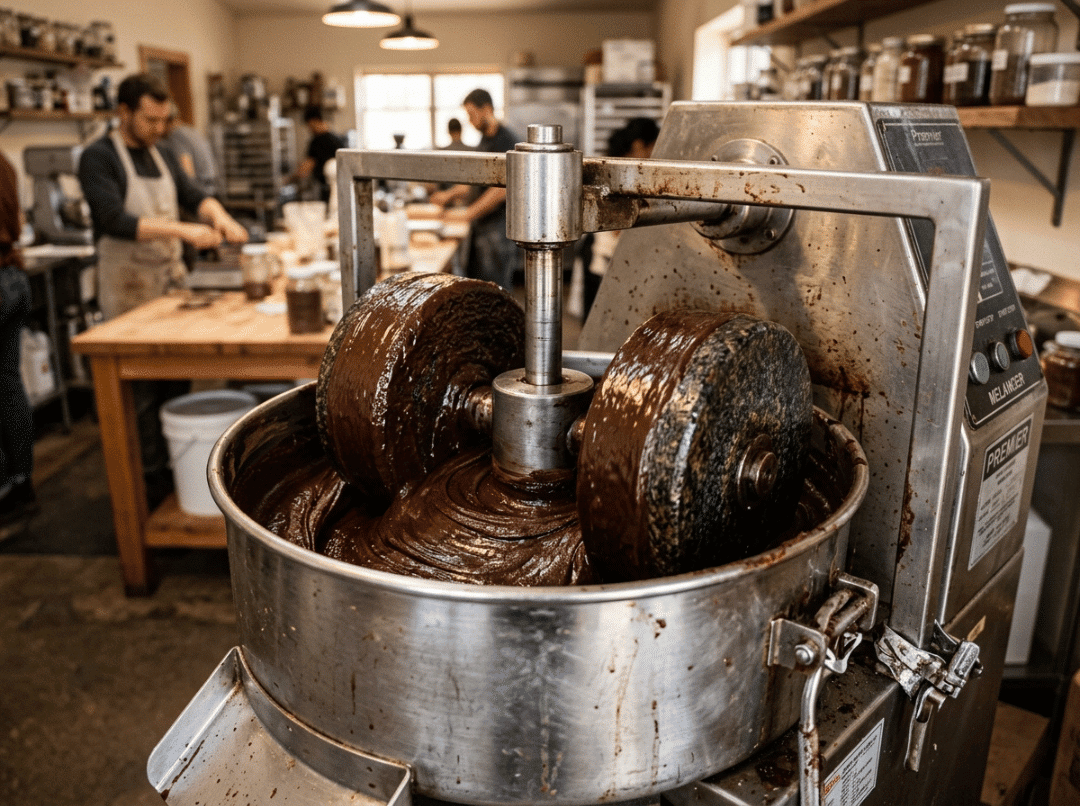
A melanger purchased for chocolate and used only for chocolate is leaving production capacity on the table. The stone grinding mechanism that refines cocoa nibs into a stable, fine-textured liquor operates on the same physical principles when processing any other high-fat, grindable ingredient. The machine does not know the difference between a cocoa nib and an almond — but the operator needs to.
That distinction matters because melangers are often described as broadly versatile without much qualification. They are versatile, within a defined range. Outside that range, the result is not simply a mediocre batch — it is accelerated stone wear, excess heat generation, and a ruined product. Knowing where that boundary sits, and why it sits there, determines whether extended product use is a productive expansion of capacity or an expensive lesson in equipment limits.
This article covers the non-chocolate products that genuinely suit a melanger, the operating conditions each one requires, where production problems commonly appear, and how to think about machine selection as a product line grows.
Why a Melanger Works for Non-Chocolate Products
The mechanism is worth understanding before getting to specific products. Heavy granite stones rotate continuously against a drum surface, applying sustained shear and compression to the material between them. Unlike a cutting blade, the stones do not chop. They grind progressively over time, reducing particle size while simultaneously applying enough pressure to rupture cell walls in nuts and seeds.
That cell wall rupture is what makes non-chocolate applications viable. When stone pressure breaks down nut or seed cells, the oils stored inside are released. Those oils convert what starts as a dry, granular mass into a flowing paste that the stones can then refine. Without sufficient fat release, there is no continuous phase for the stones to work with. The material stays dry, friction climbs, and the machine is working against itself rather than refining anything.
This is why fat content is the first variable to evaluate when considering a new product for melanger processing.
A working threshold: ingredients above approximately 45–50% fat by weight will typically flow and refine without supplemental oil. Between 30% and 45%, most products refine adequately with a small addition of neutral oil or cocoa butter to establish flow. Below 30%, the grinding process becomes counterproductive — paste viscosity stays high, stone wear accelerates, and the texture improvement rarely justifies the mechanical stress on the equipment.
That threshold is a planning tool, not a guarantee. Batch-specific testing is always necessary. But fat content gives a reliable first-pass assessment before committing production time and material to an untested ingredient.
Nut Butters
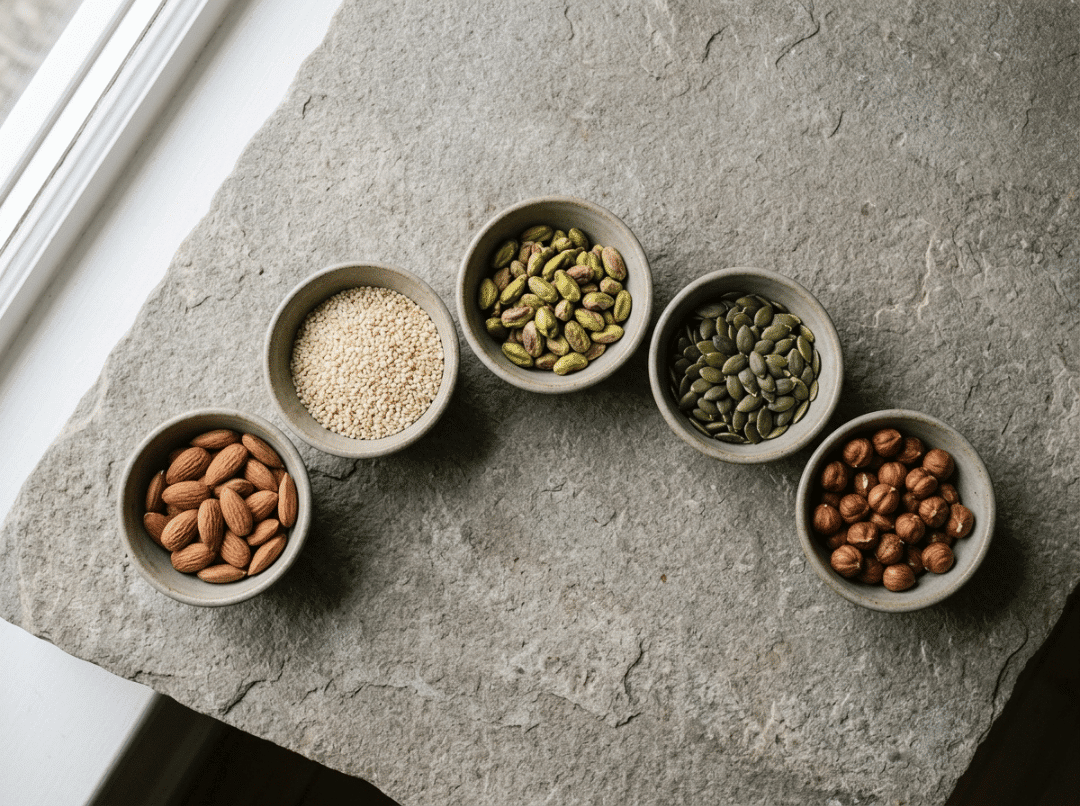
Nut butters are the most operationally straightforward non-chocolate application for a melanger. Most tree nuts and peanuts carry 45–60% fat, placing them well within the range where the machine operates efficiently without modification.
Almonds, peanuts, hazelnuts, and cashews all refine into smooth, shelf-stable butter without supplemental oil. Pre-processing matters: light roasting reduces surface moisture, softens cell structure, and begins the oil-release process before the nuts enter the drum. Load them warm — around 40–50°C — not hot. Starting a batch with overheated nuts adds unnecessary thermal load before meaningful grinding has begun.
Run time varies significantly between nut types and should not be treated as fixed. Peanuts and cashews reach a smooth, pourable consistency in roughly 20–30 minutes because their oils release quickly. Almonds and hazelnuts are denser, require more mechanical work to break down, and typically need 40–60 minutes. Time is an unreliable quality indicator across different products; rubbing a small sample between two fingers at intervals and stopping when no grit is detectable is more reliable than watching a clock.
Two failure modes appear consistently in nut butter production. Adding dry ingredients mid-run — sweeteners, proteins, or starches — sharply increases viscosity and can cause a flowing batch to seize. If sweetening is required, dissolve sugar into a liquid first or incorporate it early rather than mid-process. The second issue is thermal management on longer runs. Extended grinding generates heat, and if drum temperature rises enough to affect volatile flavor compounds, the finished product will taste flat. If the outer drum becomes uncomfortable to hold, pause the run.
Tahini
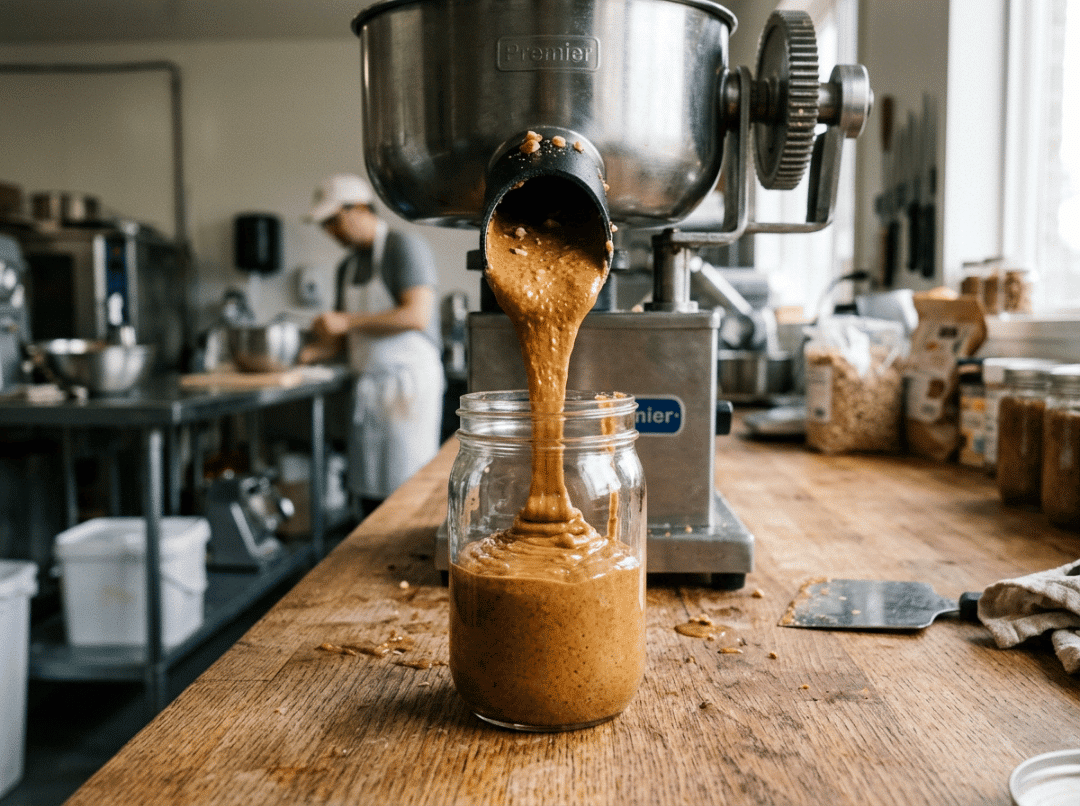
Sesame paste is a well-suited melanger product. Sesame seeds carry approximately 50% fat — sufficient to produce the loose, pourable consistency that commercial and artisan tahini requires.
Light toasting before grinding serves two functions: it deepens flavor and begins softening the seed hull, which reduces initial grind resistance. Toasting sesame requires close attention. The seeds brown and scorch quickly, and any burned seeds carry bitterness through the entire finished batch.
One operational detail specific to sesame: start the machine at reduced speed when loading. Sesame seeds are light and small; at full speed before oils have released and the paste has thickened, seeds can be thrown clear of the drum. Once the batch begins to darken and flow — typically within the first few minutes — normal operating speed is appropriate. Most tahini batches complete in 30–45 minutes.
Finished tahini should ribbon off a spoon and settle level within a few seconds. A paste that holds peaks has either not run long enough or the seeds were over-toasted and partially defatted before grinding began. Oil separation in jarred tahini after production is not a quality defect; it reflects the natural behavior of an unemulsified product and resolves with stirring.
Pistachio and Specialty Nut Pastes
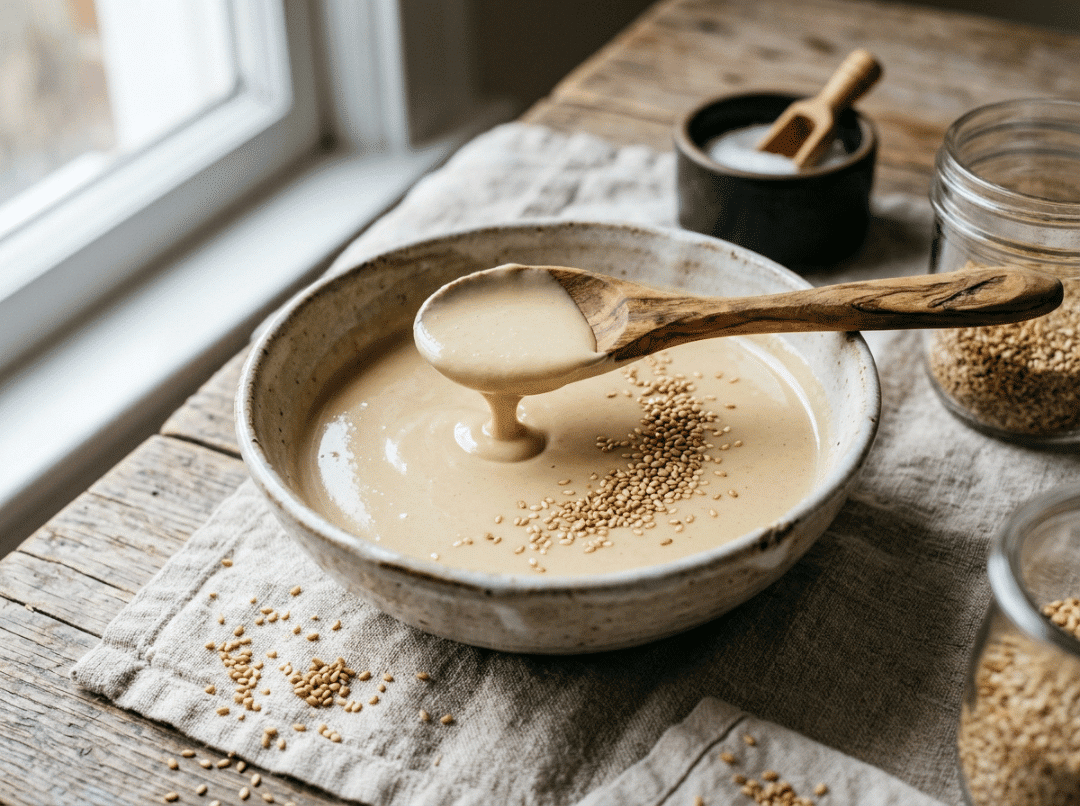
Pistachio paste illustrates clearly what stone grinding contributes that blade equipment cannot. Mechanical chopping leaves detectable grain in the finished paste — acceptable for some uses, but not for pastry creams, gelato bases, or confectionery fillings where texture is a direct quality marker. Stone grinding produces the fine, cohesive paste those applications require.
Pistachios carry adequate fat for melanger processing, but the ingredient cost makes careful batch management worth the effort. Run a small test batch to establish timing for your specific machine and batch size before scaling up. Most pistachio paste reaches usable smoothness in 45–90 minutes — longer than almond butter because the target particle size is finer and the raw ingredient is denser.
Grind time has a direct effect on color, which matters commercially for pistachio. Extended runs generate friction heat that oxidizes chlorophyll and dulls the green that pastry buyers expect. If color retention is a specification, keep the batch temperature low, monitor closely after 45 minutes, and stop as soon as the target texture is reached. Additional run time past that point costs color without improving texture.
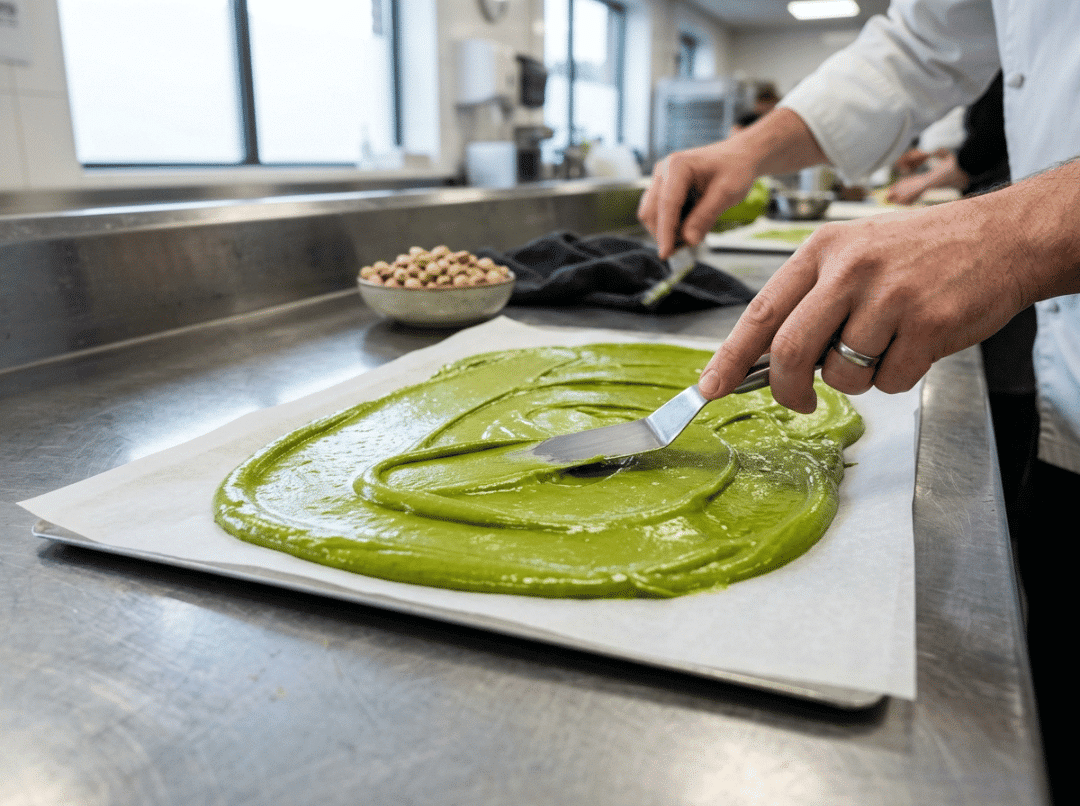
The same discipline applies to hazelnut and cashew pastes intended for high-end confectionery: refine to specification, then stop. Extended grinding past the target texture does not improve the product.
Praline
A melanger handles praline well because it refines both the caramelized sugar and the nut fraction simultaneously into a uniform paste — smoother and more cohesive than most other processing methods achieve.
Preparation is the critical step. The caramelized nut mass must cool and harden completely before loading into the drum. Warm caramel is adhesive; loaded while still plastic, it coats the stones and impedes grinding rather than enabling it. A fully set, brittle slab breaks cleanly under stone pressure, and the nut oils released during grinding carry the sugar fraction into a refinable paste.
Plan for 30–60 minutes from slab to smooth, flowing praline. The higher sugar content makes this product stickier throughout the run and particularly during cleaning afterward — sugar residue sets firmly and requires more thorough cleaning than an oil-based product. Budget cleaning time accordingly when scheduling production runs that include praline.
A consistent error in praline production is under-caramelizing to limit bitterness, which produces a flat paste without depth. Praline’s flavor comes from the Maillard reaction in the caramel. The melanger will refine the texture, but it cannot develop flavor that the caramelization step did not produce.
Seed Pastes and Urbech
Traditional seed pastes — urbech from flax, hemp, pumpkin seed, or apricot kernel — are natural melanger applications. The dense, smooth texture characteristic of quality urbech is difficult to achieve with blade equipment and comes reliably from extended stone grinding.
Fat content varies far more widely across seed types than it does across common tree nuts, which makes ingredient evaluation more important here. Flax and hemp seed carry enough oil to refine without supplemental fat. Pumpkin seed is lower and often benefits from a small addition of neutral oil to sustain flow through the run. Apricot kernels are dense with moderate fat content and require longer processing — expect the upper end of the 30–90 minute range and assess texture at intervals rather than relying on a fixed end time.
With kernel-based pastes specifically, taste throughout the run. Some apricot kernel varieties carry natural bitterness from amygdalin compounds, and that bitterness intensifies as the paste concentrates. Identifying the issue early costs minutes; discovering it at the end of a full production batch costs significantly more.
Products That Are Not Well Suited to a Melanger
Knowing what a melanger does not handle well is as operationally important as knowing what it does.
Low-fat and dry ingredients do not refine productively in a melanger. Without released oil to form a continuous phase, material clumps, distributes unevenly across the stones, and generates friction without meaningful refinement. Stone wear under these conditions accelerates faster than any useful processing occurs.
Fibrous or coarse-structured ingredients — materials with significant fiber length or irregular form — tend to distribute unevenly in the drum and resist particle size reduction. The result is inconsistent texture and mechanical stress on the grinding assembly without a corresponding improvement in product quality.
High-volume or rapid-throughput requirements are not suited to batch melangers. Stone grinding takes hours. Producing at speed or in large continuous volumes requires colloid mills, roller refiners, or purpose-built industrial refining equipment. A melanger is well-suited to small-batch and artisan production. It is not a substitute for dedicated refining lines at production scale.
Equipment Selection Considerations
Choosing a melanger for expanded product use follows the same logic as choosing one for chocolate: match machine capacity to realistic batch size, not to theoretical maximum load.
Stones grind evenly only when the drum is loaded within its designed operating range. An under-loaded drum grinds inefficiently; an over-loaded drum distributes stone pressure unevenly and extends run times unpredictably. If primary production volume is small, a lower-capacity machine will deliver more consistent results than a larger one running under-filled.
As volume grows, the calculation shifts. Larger machines reduce per-batch time but require full loads to operate at their intended efficiency. Evaluate equipment options against actual current production volume and realistic near-term projections, not against peak theoretical capacity.
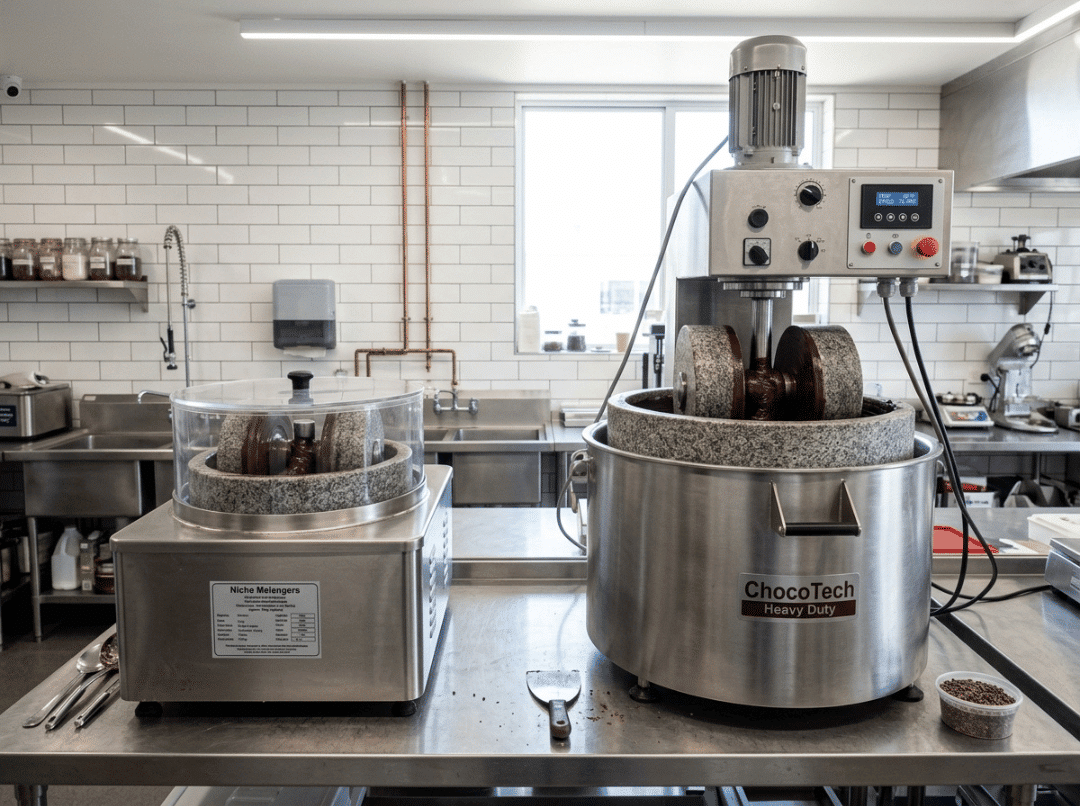
Cleaning and product changeover is a practical constraint that affects scheduling more than most producers anticipate before experiencing it. Moving between distinct flavors or colors — from tahini to pistachio paste, for example — requires a complete cleaning cycle. Most changeovers take 20–30 minutes done correctly. Shortening that cycle to compress a production schedule introduces flavor and color contamination that is difficult to detect until it has already reached finished product.
Frequently Asked Questions
Can a melanger make nut butter?
Yes. Almonds, peanuts, hazelnuts, and cashews all carry sufficient fat to refine into smooth, spreadable butter without supplemental oil. Light roasting before grinding is recommended for most nut types. Most batches complete in 20–60 minutes depending on the nut; assess readiness by texture rather than time.
What fat content is needed for melanger processing?
Above approximately 45–50% fat by weight, most ingredients refine well without supplemental oil. Between 30% and 45%, a small addition of neutral oil or cocoa butter typically establishes adequate flow. Below 30%, stone wear accelerates, and meaningful texture improvement is unlikely.
How long does a typical batch take?
Most high-fat ingredients refine in 20 to 90 minutes. Quick-releasing materials like peanuts and cashews fall at the lower end. Dense ingredients like pistachio and apricot kernel require longer runs. Batch size and target particle fineness both extend time; plan accordingly rather than applying fixed timing across different products.
Can a melanger handle dry or low-fat ingredients?
Not effectively on their own. Dry, low-fat materials lack the continuous oil phase needed to flow and refine, which results in clumping, uneven processing, and accelerated stone wear. When these ingredients are required in a formulation, incorporate them into a fatty base rather than processing them alone.
How does a melanger compare to a food processor for nut paste?
A melanger produces significantly finer particle size — a distinction that matters in applications where texture is a direct quality requirement, such as pastry fillings or confectionery centers. A food processor is faster and adequate for coarser results. The right choice depends on the texture the product actually requires, not on processing time alone.
Can a melanger produce vegan or plant-based spreads?
Yes. Coconut butter, seed-based pastes, and nut-based spreads fall within the fat content range the machine processes well. Temperature management is more critical with coconut-based products, which are prone to separation during extended runs if the batch overheats.
Production Takeaways
Extending a melanger’s role beyond chocolate is a sound production decision when the additional products are selected based on what the equipment actually does well. The fat content threshold is the most useful single filter for evaluating new ingredients before committing to a run. Ingredients that meet it will generally refine efficiently; those that do not will create problems that are difficult to work around in production.
Machine selection, cleaning discipline, and batch sizing are the practical variables that determine whether expanded product use adds genuine value or simply adds operational complexity. Handled correctly, a single well-specified melanger can support nut butter production, specialty paste work, and chocolate processing from the same piece of equipment — a meaningful return on a single capital investment for a small-batch producer.