
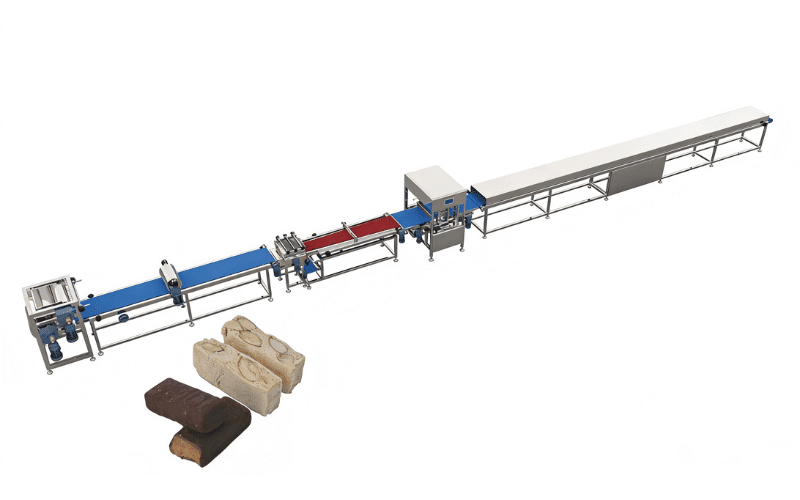
A candy bar production line is a fully automated system that mixes, forms, cools, cuts, and packages confectionery bars at a commercial scale. Lines fall into three main categories—slab forming, extrusion, and molding—each suited to different recipes. Choosing the right system depends on your ingredients, output targets, bar format, and whether you need chocolate enrobing.
Selecting the wrong candy bar manufacturing line costs more than money. It costs production hours, product consistency, and often, market position. A system optimized for a smooth nougat slab will struggle with whole almonds. A line built for single-flavor runs becomes a bottleneck the moment you need to switch SKUs. These mismatches happen more often than manufacturers expect, usually because the decision was made on price or availability rather than product fit.
This guide walks through how modern candy bar production lines work, which line types suit which products, and what technical factors matter most when comparing systems. The goal is straightforward: help you make a better-informed equipment decision before committing to a configuration that could limit your production for years.
What Is a Candy Bar Production Line?
A candy bar production line is an automated processing system designed to form, shape, and cut confectionery masses into consistent, ready-to-pack bars at high volume. Unlike small-batch or manual production, a fully automatic candy bar line integrates all stages—mixing, forming, cooling, cutting, and optional enrobing—into one continuous, synchronized workflow.
These systems are built to handle a wide range of viscous and sticky materials: nougat, caramel, peanut butter, cereal blends, protein matrices, and chocolate-coated combinations. What separates a well-engineered line from a basic one is how precisely it controls thickness uniformity, temperature stability, and cut accuracy across every bar—at 50 to 100 cuts per minute, over a full production shift.
Modern candy bar-making machines are constructed entirely from food-grade 304 stainless steel, controlled through PLC (programmable logic controller) cabinets, and designed for modular expansion as your product range grows.
How Does a Candy Bar Production Line Work, Step by Step?
Understanding the production sequence helps you identify where your recipe creates process risk—and where automation adds the most value.
Step 1: Feeding and Mixing
Production begins at the feed hopper, where pre-mixed confectionery mass—typically delivered warm from a cooking or mixing vessel—is loaded into an insulated container. The insulation maintains precise ingredient temperature throughout the forming phase, which is critical for materials like caramel or chocolate that change viscosity rapidly with temperature shifts. A consistent, gap-free flow onto the conveyor belt at this stage prevents downstream density variations.
Step 2: Slab Forming
The candy mass passes through a series of heavy-duty precision rollers that press it into a uniform slab of the target thickness. For multi-layer bars—a nougat base with caramel applied on top, for example—secondary rollers deposit and integrate each additional layer with controlled pressure. This is the stage where fragile inclusions, such as whole nuts or puffed grains, are most at risk of being crushed, which is why the forming roller geometry and pressure settings matter significantly for textured products.
Step 3: Cooling Tunnel
The formed slab passes through an enclosed, refrigerated cooling tunnel to solidify before being cut. In industrial candy bar lines, cooling tunnels typically operate between 0–10°C, with tunnel lengths reaching 10 meters or more. Rapid, controlled cooling sets the sugars and fats in the bar, ensuring it holds its shape cleanly through the cutting phase. Inadequate cooling at this stage is one of the most common causes of ragged or deformed bar edges.
Step 4: Longitudinal Slitting and Transverse Cutting
After cooling, the hardened slab moves into a two-stage cutting system. First, circular slitting blades divide the wide slab lengthwise into parallel strips of equal width. Then, a servo-driven guillotine or reciprocating cutter chops the strips transversally into individual bars of the specified length. Dual-servo cutting systems enable length adjustment without stopping the line, supporting flexible production runs across different bar formats.
Step 5: Enrobing (Optional)
Bars that require chocolate or compound coating pass through an enrobing station, where a curtain of tempered chocolate flows over and under the bar to create a full coating. The enrobed bars then enter a secondary cooling tunnel to set the chocolate shell before packaging.
Step 6: Packaging
Finished bars transfer to high-speed flow wrappers or pillow-pack machines that seal each bar in protective film. From there, bars are cartonized and prepared for distribution.
What Are the Main Types of Candy Bar Production Lines?
There is no universal candy bar line. The three primary configurations each have distinct strengths—and clear limits.
Slab Forming Lines
Slab-forming lines press confectionery mass through calibrating rollers to produce a flat, uniform sheet, which is then slit and cut into bars. This approach handles the broadest range of materials, including recipes with whole nuts, seeds, dried fruit, or other fragile inclusions that extrusion would damage.
According to Mike Sherd, Managing Partner at Egan Food Technologies, “recipes with whole nuts, seeds, or fragile ingredients are better suited for a slab forming process, because they are more gently pressed into bars by a series of forming rolls.” For energy bars, protein bars, granola bars, and Snickers-style nougat products, slab forming is typically the most reliable method.
Extrusion Lines
Extrusion forces a homogenous mass through a shaped die to produce long, continuous ropes that are then cut to length. This works well for recipes that blend into a uniform slurry—smooth chocolate or fudge centers, uniform caramel masses—but is unsuitable for recipes with inclusions that would block or fragment at the die. Extrusion lines tend to offer higher speeds for simple formulations but less flexibility for complex or multi-ingredient products.
Molding Lines
Molding lines deposit liquid chocolate or compound into shaped cavities, allow it to set, and then demold the finished product. This process is specific to solid chocolate bars and shell-molded products with filled centers. It is not applicable to formed slab products and requires entirely different equipment—including a tempering unit, a molding carousel, and a vibration table.
Semi-Automatic vs. Fully Automatic Lines
Semi-automatic candy bar lines require manual intervention at one or more stages—typically at the feeding, stacking, or packaging step. They carry a lower capital cost but introduce labor dependence and variability in consistency over long shifts. Fully automatic candy bar manufacturing lines integrate all stages under PLC control, delivering consistent output, improved hygiene, and lower long-term labor costs. For commercial-scale production, a fully automatic line almost always offers a faster return on investment.
How Do You Choose the Right Candy Bar Production Line for Your Product?
The correct line configuration is determined first by your product formulation, then by your output targets. Here is how to think through the key product-to-line match decisions.
- Layered bars (nougat + caramel, protein base + coating): Require a slab-forming line with multi-roller capability. Each layer needs individual thickness control and proper inter-layer adhesion pressure.
- Center-filled bars: Require a co-extrusion setup or a depositing system that injects a fill into the outer shell during forming. Standard slab forming lines do not handle this without modification.
- Solid chocolate bars: Use a molding line with a tempering machine. Slab forming is not applicable.
- Enrobed bars with inclusions (cereal + nuts + chocolate coating): Start with a slab forming line and add an enrobing station downstream. The gentleness of roller forming protects inclusions; the enrober applies the chocolate shell after cutting.
- Multi-SKU production: Prioritize modular design, quick-change tooling, and PLC recipe management. A line that takes four hours to change over between flavors quickly becomes a production constraint. Servo-driven cutting systems that allow length adjustment without line stoppage are essential for flexible manufacturing.
- Output volume: Standard candy bar lines such as the YUCHO YC-8001-RNR operate at 50–100 cuts per minute, producing between 3,000 and 6,000 bars per hour, depending on bar length. Match your target daily output to shift hours to determine whether a single line meets your capacity or whether a dual-lane or wider-slab configuration is needed. The YC-8001-RNR supports slab widths from 200 mm to 800 mm, which directly affects how many parallel strips—and thus bars—the system produces per cut cycle.
What Technical Specifications Matter Most When Comparing Candy Bar Lines?
Beyond the product-to-line match, these are the technical parameters that most directly affect production performance:
- Slab width: Wider slabs mean more strips per cut cycle, increasing output without increasing line speed. Available widths on commercial lines typically range from 200 mm to 800 mm.
- Cooling tunnel length and temperature range: A 10-meter tunnel operating at 0–10°C is standard for most confectionery applications. Shorter tunnels may cause cutting defects in heat-sensitive formulations.
- Cutting method: Dual-servo reciprocating cutters offer superior length accuracy and allow on-the-fly adjustment. Wire cutters work for softer products but wear faster and require more frequent replacement.
- Chocolate coating integration: Enrobing stations need a matched tempering unit and a downstream cooling tunnel. Ensure the enrober belt width matches your slab output width.
- Hygiene design: Food-grade 304 stainless steel throughout, minimal flat surfaces where residue can accumulate, and tool-free access for cleaning are non-negotiable for facilities under HACCP or SQF standards.
- Automation level and control interface: PLC-controlled lines with touchscreen HMIs allow operators to store and recall recipes, reducing changeover errors. Centralized control from one or two cabinets significantly reduces operational complexity.
- Changeover time: For multi-SKU operations, ask for demonstrated changeover times between recipes, not estimated figures. Modular lines with quick-release tooling and stored PLC recipes will consistently outperform manually configured systems.
What Are the Most Common Production Challenges on Candy Bar Lines—and How Are They Solved?
Even well-specified lines encounter recurring operational issues. Here are the four that most frequently affect output quality and uptime:
- Temperature and humidity variation: Confectionery masses are highly sensitive to ambient conditions. Humidity above 60% or temperature swings of even a few degrees can alter viscosity, affect adhesion between layers, and cause surface bloom on chocolate coatings. The solution is climate-controlled production zones and insulated ingredient containers that maintain mass temperature independently of ambient conditions.
- Ingredient variation and feed clogs: Natural ingredients—nut butters, honey, syrups—vary in viscosity from batch to batch. Feed hoppers that lack agitation or insulation are prone to bridging and clogging, which interrupts flow and creates voids in the slab. Heated hoppers with active agitation and sensor-based flow monitoring address this at the source.
- Allergen cleaning and cross-contamination: Shared candy bar lines that run nut-containing and nut-free products in sequence require validated allergen cleaning protocols between runs. Lines with accessible open-frame designs, removable contact parts, and CIP (clean-in-place) compatibility substantially reduce cleaning time and the risk of residue.
- Blade wear and cut quality degradation: Circular slitting blades and guillotine cutters wear with use. As edges dull, cut faces become ragged, and bar weight consistency drops. Servo-driven cutting systems can compensate for minor wear by adjusting speed, but scheduled blade replacement intervals should be built into preventive maintenance planning from day one.
Ready to Specify Your Candy Bar Production Line?
Choosing the right candy bar manufacturing line is an engineering decision, not just a procurement one. Product formulation, output targets, available floor space, SKU flexibility, and long-term maintenance capability all feed into a configuration that either supports your production goals or quietly limits them.
YUCHO has designed and delivered candy bar production lines for manufacturers across global markets for over 35 years, from single-layer nougat lines to fully modular multi-SKU systems with integrated chocolate enrobing. Every system is built to ISO and CE standards, manufactured across a 10,000-square-meter facility, and supported by a dedicated team of after-sales engineers who handle overseas installation, staff training, and process optimization.
If you have a bar recipe, a target output, and an available floor plan, that’s enough to start a conversation about specifications. Contact the YUCHO team at topchocomachine.com to request a line consultation or technical quotation.
Frequently Asked Questions About Candy Bar Production Lines
What is the output capacity of a standard candy bar production line?
A standard commercial candy bar line, such as the YUCHO YC-8001-RNR, operates at 50–100 cuts per minute, producing between 3,000 and 6,000 cuts per hour depending on bar format and length settings. Actual output per hour in finished bars depends on how many parallel strips the slab width produces per cut cycle.
What is the difference between slab forming and extrusion for candy bar manufacturing?
Slab forming presses confectionery mass through calibrating rollers into a flat sheet, then slits and cuts it into bars. Extrusion pushes mass through a shaped die to create continuous ropes. Slab forming is better for recipes containing whole nuts, seeds, or fragile inclusions; extrusion suits homogenous masses that can flow cleanly through a die. The two processes are not interchangeable for most complex bar recipes.
How long does it take to switch between different candy bar recipes on the same line?
On a fully automated line with PLC recipe management and modular tooling, changeovers between flavors or formats can be completed in under an hour. Manual lines without stored recipes or quick-release tooling can require several hours of adjustment, making multi-SKU production significantly less efficient.
Do candy bar production lines support chocolate enrobing?
Yes. Enrobing stations can be integrated into a candy bar line downstream of the cutting section. The enrober applies a curtain of tempered chocolate over and under each bar, followed by a secondary cooling tunnel to set the coating. Enrobing integration requires a matched tempering unit and correct belt-width alignment with the upstream line.
What hygiene standards should a candy bar line meet?
At a minimum, a commercial candy bar-making machine should be constructed from food-grade 304 stainless steel, hold CE certification, and comply with HACCP design principles—meaning minimal horizontal surfaces, accessible contact points for cleaning, and no dead zones where residue can accumulate. Lines intended for allergen-sensitive production should also support validated allergen cleaning protocols between runs.
Can a candy bar production line handle protein bar and energy bar formulations?
Yes. Modern slab-forming lines are engineered to process high-protein matrices, fiber-dense cereal blends, and high-fat nut butter bases in addition to traditional sugar-based confectionery masses. The key requirements are adequate hopper heating for viscous materials and forming rollers calibrated to the target slab density. YUCHO’s YC-8001-RNR line handles protein bars, cereal bars, nougat, caramel, and granola bar formulations in a single modular system.
What after-sales support should I expect from a candy bar line manufacturer?
A credible manufacturer should provide overseas installation and commissioning, operator training, spare parts supply, and long-term process optimization support. YUCHO’s after-sales team comprises five dedicated engineers who provide on-site installation guidance and ongoing technical support to global customers.