
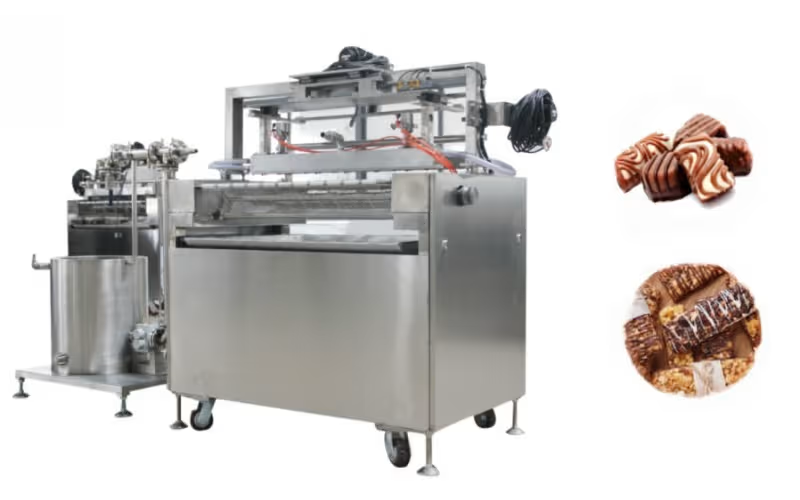
A chocolate decoration machine applies controlled drizzles, strings, zigzags, or deposited patterns onto confectionery and bakery products. Core types include drizzling/stringing machines, spinning disk decorators, CNC/robotic decorators, and piston depositors. Choosing the right model depends on your production volume, working belt width, product variety, and downstream equipment integration.
Chocolate decoration is often the detail that separates a premium-looking product from a commodity one. A precisely drizzled protein bar, a zigzag-decorated cookie, or a loop-patterned truffle communicates quality before the customer ever takes a bite. For manufacturers running continuous production lines, achieving that visual consistency manually is neither practical nor profitable.
That is exactly where chocolate decoration machines enter the picture. These specialized units handle everything from simple parallel drizzles to complex multi-pass patterns at belt speeds that no hand-decorating team could match. They integrate directly into existing enrobing and cooling lines, require minimal operator intervention, and significantly reduce chocolate waste compared to manual application methods.
This guide covers the complete picture: how chocolate decoration machines work, which types suit which operations, the key specifications to compare, and how to match the right machine to your production environment. Whether you are equipping a large confectionery factory, a bakery line, or an artisan studio looking to scale up, you will find clear and practical guidance below.
At topchocomachine.com, we supply configurable chocolate decoration machines tailored to a range of production scales and product types. Our team works directly with buyers to recommend the right configuration and integration approach — from standalone drizzlers to full decoration modules built into larger production lines.
What Is a Chocolate Decoration Machine and How Does It Work?
A chocolate decoration machine is a purpose-built confectionery equipment unit that applies liquid chocolate in repeatable decorative patterns onto product surfaces. It sits between a chocolate enrober and a cooling tunnel on a standard production line, though many models can also operate as standalone units or be mounted directly onto cooling tunnel entry frames.
The core mechanism involves four interconnected systems working in sequence.
Heated Reservoir and Temperature Maintenance
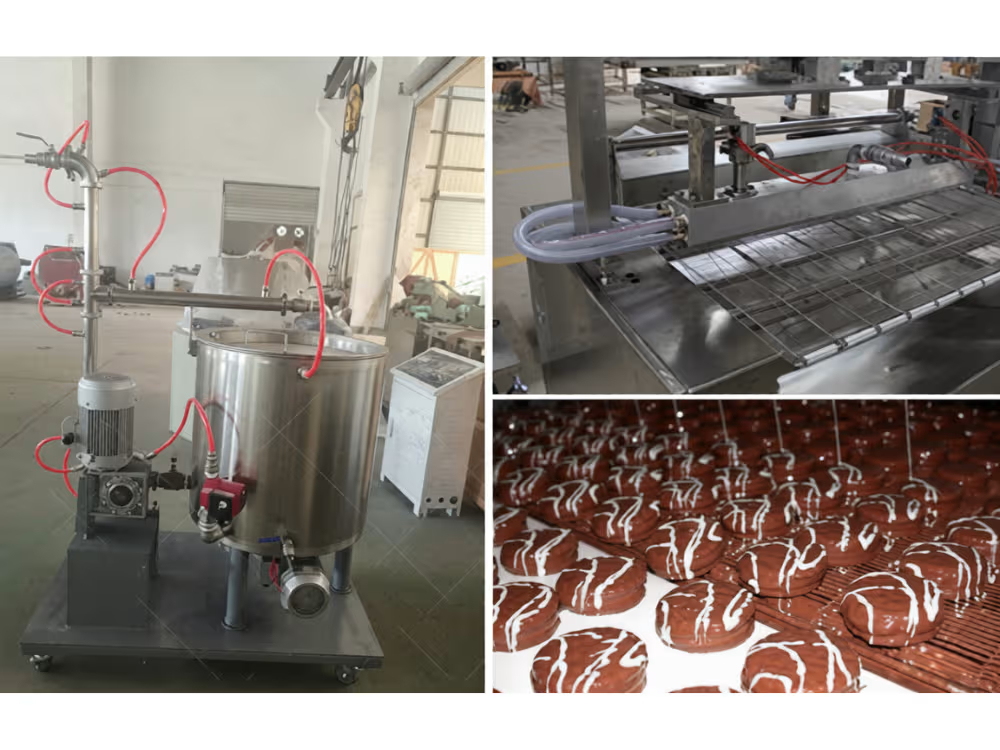
Tempered chocolate is held in a jacketed storage tank, typically maintained at a controlled working temperature. Modern units equipped with PLC (programmable logic controller) systems achieve temperature control accuracy of ±0.1°C — a critical specification, since even minor temperature drift causes viscosity changes that directly affect pattern definition and chocolate appearance.
The tank is insulated and, in most cases, hot-water-jacketed to ensure stable heat distribution without scorching. Volume capacity varies by machine model, from compact tanks suited for artisan runs to large-capacity reservoirs for 24-hour continuous production.
Motorized Pump and Nozzle or Spinning Disk Systems
A variable-speed pump — commonly a rotary or gear-type pump — delivers chocolate from the reservoir to the decorating head. The flow rate is adjustable and synchronized with conveyor belt speed, ensuring consistent deposit volume regardless of line throughput.
At the decorating head, two primary mechanisms create patterns:
- Nozzle-based systems: Multiple nozzles oscillate back and forth across the conveyor width. By adjusting oscillation speed, nozzle spacing, and pump output, operators can produce parallel lines, zigzags, oval loops, single loops, double loops, and more. Nozzles are typically interchangeable, allowing pattern changes without major reconfiguration.
- Spinning disk systems: A rotating disk flings tempered chocolate outward in a fine spray or heavier streak pattern. Disk speed controls the dispersion radius and coverage density. Spinning disk decorators are well-suited for coarser, high-coverage finishes and for applications where nozzle clogging is a concern with thicker or particulate-containing chocolates.
Conveyor Belt Movement and Synchronization
Products travel on a stainless-steel wire-mesh conveyor beneath the decorating head. Belt speed is adjustable and, on modern machines, electronically synchronized with nozzle oscillation or disk rotation speed. This synchronization is what produces repeatable, geometrically consistent patterns across every unit — not just every batch.
Belt width is a core specification. Standard options typically range from 400 mm to 1,200 mm, and the effective working width of the decoration machine must match the enrober and cooling tunnel belt width used upstream and downstream.
Operator Controls and PLC Panel
Entry-level and semi-automatic machines use manual dials and switches to independently set nozzle speed, belt speed, and pump output. Fully automatic machines with PLC panels allow operators to store multiple product recipes digitally, recall settings instantly between changeovers, and monitor temperature and flow rate in real time. Some advanced systems support remote monitoring, fault diagnostics, and integration with upstream production control software.
Who Is This Machine For?
Chocolate decoration machines are relevant across a broader range of operations than many buyers initially realize. The key question is not whether you need one — if you produce chocolate-coated or chocolate-topped products at any meaningful scale, you likely do. The real question is which type and configuration fits your operation.
- Chocolate confectionery manufacturers running molding or enrobing lines use decoration machines to finish pralines, truffles, bars, and filled chocolates with a professional visual identity.
- Biscuit, cookie, and wafer producers rely on drizzling and stringing machines to differentiate products on retail shelves through consistent pattern decoration that holds up through packaging and distribution.
- Cake and pastry manufacturers use decoration machines to apply chocolate glazes, drizzles, and swirls to portioned cakes and slices, as well as on bakery lines where hand decoration would create inconsistencies and labor bottlenecks.
- Protein bar and snack bar producers use chocolate decoration to add both visual appeal and a secondary chocolate flavor layer onto enrobed bars, often as part of a fully automated production line.
- Contract confectionery producers benefit from the flexibility of machines with fast pattern changeover capability, allowing them to switch between client product specifications without lengthy downtime.
- Artisan chocolatiers and food startups looking to scale up from bench production often invest in compact, standalone decoration units to bridge handcraft and industrial output, maintaining a handmade visual aesthetic while dramatically increasing throughput.
Typical Application Products
Chocolate decoration machines are used across a wide range of product types, including:
- Chocolate-enrobed cookies, biscuits, and wafers
- Protein and energy bars
- Chocolate-coated marshmallows
- Cake slices, brownies, and portioned pastries
- Pralines, truffles, and shell-molded chocolates
- Compound and white chocolate-decorated products
- Chocolate-drizzled dried fruits and nuts
- Donuts and filled pastry products
Main Types of Chocolate Decorating Equipment
Not all chocolate decoration machines use the same mechanism, and the differences between types have meaningful implications for output quality, maintenance requirements, and production flexibility.
|
Machine Type |
Mechanism |
Typical Pattern Output |
Best For |
|---|---|---|---|
|
Drizzling / Stringing Machine |
Oscillating nozzles over conveyor |
Lines, zigzags, loops, ovals |
Cookies, bars, pastry, general use |
|
Spinning Disk Decorator |
Rotating disk flinging chocolate |
Fine spray, streaks, fan patterns |
High-speed lines, coarser finishes |
|
CNC / Robotic Decorator |
Servo-controlled multi-axis head |
Complex custom patterns, logos |
Premium products, low-volume specialty |
|
Piston Depositor |
Piston-driven precise volume drops |
Dots, puddles, shaped drops |
Molded chocolates, filled products |
|
Enrober Decoration Module |
Built-in attachment to enrobing line |
Lines and drizzle over enrobed product |
Integrated lines without standalone units |
Drizzling and Stringing Machines
These are the most widely used chocolate decoration machines in confectionery and bakery production. Multiple nozzles oscillate across the belt, creating fine thread-like patterns with consistent repeat. Pattern style is adjusted by changing oscillation frequency and nozzle configuration. Models are available in independent (standalone) configurations or as mounted attachments on cooling tunnel entry frames.
Spinning Disk Decorators
Disk decorators work well for products that require a less structured, more organic-looking decoration pattern. The disk speed controls pattern density and the radius of the chocolate projection. These machines generally handle high-throughput applications well and are less prone to nozzle clogging when working with chocolate containing finely ground inclusions.
CNC and Robotic Decorators
Servo-motor-driven heads allow fully programmable, multi-directional decoration. Some high-end European systems in this category support logo application, pixel-level dot patterns, and custom-shape deposition. These machines carry higher price points and are primarily suited to premium product lines where visual differentiation justifies the investment.
Piston-Driven Depositors
Rather than creating surface patterns, piston depositors apply precise volumes of chocolate in defined positions — drops, buttons, or shaped mounds — directly onto molds or products. These machines are especially common in molded confectionery and praline production.
Enrober Decoration Modules
Some manufacturers offer decoration nozzle assemblies as add-on modules built directly into chocolate enrobing machines. These are space-efficient and work without a separate conveyor, but offer less independent speed and pattern adjustment than standalone units.
Key Specifications to Compare
When evaluating chocolate decoration machines, focus on the following technical parameters:
Working Belt Width
Match the machine’s effective working width exactly to the width of your enrober and cooling tunnel conveyor. Mismatches result in uneven coverage or wasted machine capacity. Standard options typically range from 400 mm to 1,200 mm.
Temperature Control System
Look for PLC-controlled heating with a minimum accuracy of ±0.5°C. Leading models achieve ±0.1°C. Poor temperature stability causes chocolate to either run too thin (losing pattern definition) or too thick (causing nozzle blockages).
Interchangeable Nozzles
Machines that support quick nozzle changeover give operators flexibility to shift between pattern styles without tools or lengthy downtime. Check the range of nozzle diameters and shapes available for a given model before purchasing.
Adjustable Speed Settings
Both belt speed and pump/nozzle oscillation speed should be independently adjustable. Independent control allows fine-tuning of pattern density and repeat length to match different product sizes and decoration specifications.
Ease of Cleaning and CIP Compatibility
Food-grade hygiene is non-negotiable. Look for machines built from SUS304 or SUS316L stainless steel with accessible internal surfaces. Clean-in-place (CIP) systems that automate flushing between product runs significantly reduce changeover time and cross-contamination risk.
Quick Selection Checklist
Before contacting a supplier, work through this checklist to define your requirements:
- ☐ Product type: What are you decorating? (cookie, bar, cake, molded chocolate, etc.)
- ☐ Pattern style: Lines, zigzags, loops, dots, custom shapes?
- ☐ Required capacity: Units per hour or kg per hour
- ☐ Belt width: What does your enrober or cooling tunnel use?
- ☐ Chocolate type: Dark, milk, white, compound, or colored coating?
- ☐ Integration: Standalone unit, enrober addon, or cooling tunnel mount?
- ☐ Cleaning frequency: How often will pattern/product changes occur?
- ☐ Budget range: Startup investment vs. ROI from throughput gains
Benefits of Automating Chocolate Decoration
Consistency at Scale
Manual decoration introduces natural variation that becomes a liability at scale. A machine trained on defined settings produces the same pattern on unit 1 and unit 10,000. For retail products, visual uniformity directly affects perceived quality and brand consistency.
Higher Production Speed
Even a compact automated drizzler significantly outpaces manual decoration teams. Fully automatic systems synchronize with upstream and downstream equipment, eliminating the bottlenecks that hand-finishing creates in otherwise continuous lines.
Chocolate Waste Reduction
Pump-controlled chocolate delivery limits overapplication. Excess chocolate not deposited on products is typically recirculated through the heated system rather than discarded — a meaningful cost saving on high-volume lines where ingredient costs accumulate rapidly.
Worker Safety and Ergonomics
Eliminating repetitive hand-decoration tasks reduces strain-related injuries and frees skilled workers to focus on quality monitoring, machine operation, and higher-value activities. In high-temperature environments near enrobers and tunnels, reduced operator exposure time is an additional safety benefit.
How to Choose the Right Machine for Your Operation
Match Machine to Production Volume
A compact, standalone drizzler suits artisan and startup operations that run single shifts or limited SKUs. Mid-range machines with PLC controls are appropriate for multi-shift confectionery production with moderate product variety. High-capacity, fully integrated decoration modules are the right choice for 24-hour automated lines where downtime is measured in minutes, not hours.
Consider Product Variety
Operations running a single product type can optimize for one machine configuration and rarely change settings. Operations with high SKU counts need machines with rapid recipe recall, fast nozzle changeover, and reliable pattern repeatability after restart.
Account for Space Constraints
Standalone decoration machines require floor space between the enrober and the cooling tunnel entry. Machines mounted directly onto cooling tunnel frames eliminate this footprint requirement. Compact models also exist for artisan shops where full production-line infrastructure is lacking.
Integration with Tempering, Enrobing, and Cooling Equipment
A decoration machine performs best when the chocolate it receives is correctly tempered upstream. If your existing setup does not include a continuous tempering unit, factor that investment into your planning. Similarly, confirm that the decoration machine’s belt speed range is compatible with your cooling tunnel’s throughput capacity to avoid creating a line bottleneck.
Budget Considerations
Decoration machine pricing varies significantly based on automation level, working width, build quality, and included features such as PLC control, CIP systems, and recipe storage. Entry-level standalone drizzlers offer a lower initial investment, making them suitable for startups and smaller operations. Fully automatic, wide-belt decoration systems integrated into larger production lines sit at the higher end of the range. Rather than anchoring to a specific price point early, define your production requirements first — then identify the machine tier that meets them and evaluate supplier quotes against that specification.
Our Chocolate Decoration Solutions
At topchocomachine.com, we supply chocolate decoration machines across multiple configurations — from compact standalone drizzlers for artisan operations to wide-belt PLC-controlled decoration systems for high-volume production lines. Our machines are built from food-grade stainless steel, support interchangeable nozzle systems, and are designed for straightforward integration into existing enrobing and cooling tunnel setups.
We work directly with buyers to understand production requirements before recommending a machine type. That means you receive a configuration recommendation based on your actual product type, belt width, throughput target, and integration constraints — not a catalog listing.
If you are evaluating options, the most efficient starting point is to share your product specifications, required output, and existing line equipment. Our technical team will respond with a tailored machine recommendation and, where relevant, integration guidance.
Frequently Asked Questions
Can a chocolate decoration machine handle white, milk, and dark chocolate?
Yes. Most decoration machines work with all standard chocolate types — dark, milk, white, and compound coatings. The critical variable is temperature: white and compound chocolates often require different working temperatures than dark chocolate. Machines with independently controlled heating systems and precise temperature regulation handle multiple types of operations without separate equipment.
Do I need a separate tempering machine to use a chocolate decoration machine?
For real chocolate (couverture), yes — correctly tempered chocolate is required upstream to achieve good gloss, snap, and pattern definition in the final decoration. The decoration machine itself maintains temperature during application, but does not perform full tempering. If your line already includes a tempering unit feeding your enrober, the decoration machine can draw from the same tempered supply. For compound coatings, tempering is typically not required.
How difficult is it to change patterns between production batches?
On manually controlled machines, pattern changes require adjusting speed dials and swapping nozzle components — a process that typically takes 10–20 minutes. On PLC-equipped machines with stored product recipes, operators can recall a saved pattern profile in under a minute and be running within the machine’s warmup time. If frequent pattern changes are part of your operation, a PLC-controlled machine with recipe memory is worth the additional investment.
Can a chocolate decoration machine apply caramel or colored icing?
Many drizzling and stringing machines are designed primarily for chocolate and compound coatings. Some models can handle other fluid products — including caramel, fondant, and colored icing — depending on viscosity, working temperature, and compatibility of the material with the pump and nozzle components. Confirm material compatibility with the supplier before purchasing if a non-chocolate application is a requirement.
What maintenance do nozzles require?
Nozzles should be cleaned after every production run to prevent chocolate from solidifying and clogging. On machines with CIP systems, automated flushing handles most routine cleaning. For manual cleaning, nozzles are typically removable without tools and can be soaked and flushed separately. A regular preventive maintenance schedule — including nozzle inspection, pump seal checks, and belt tension verification — extends machine life and prevents unplanned downtime.
Are there smaller versions suitable for artisan chocolate shops?
Yes. Compact standalone drizzlers with working widths of 400–600 mm and smaller chocolate reservoir volumes are available for artisan producers and food startups. These machines provide the same pattern consistency as industrial units but are scaled appropriately for lower throughput, smaller footprints, and simpler installation requirements.
Ready to Find the Right Decoration Machine?
Choosing the right chocolate decoration machine comes down to three things: knowing your products, understanding your production environment, and working with a supplier who will give you honest guidance rather than just a catalog quote.
A machine that is correctly matched to your belt width, product type, and throughput target pays for itself through gains in consistency, reduced waste, and labor savings — often faster than buyers initially expect.
If you are ready to move forward, the next step is straightforward. Send us your product specifications, current line setup, and output target, and our technical team will get back to you with a machine recommendation tailored to your operation. No obligation — just clear, practical advice.
[Contact topchocomachine.com to request a machine recommendation →]