
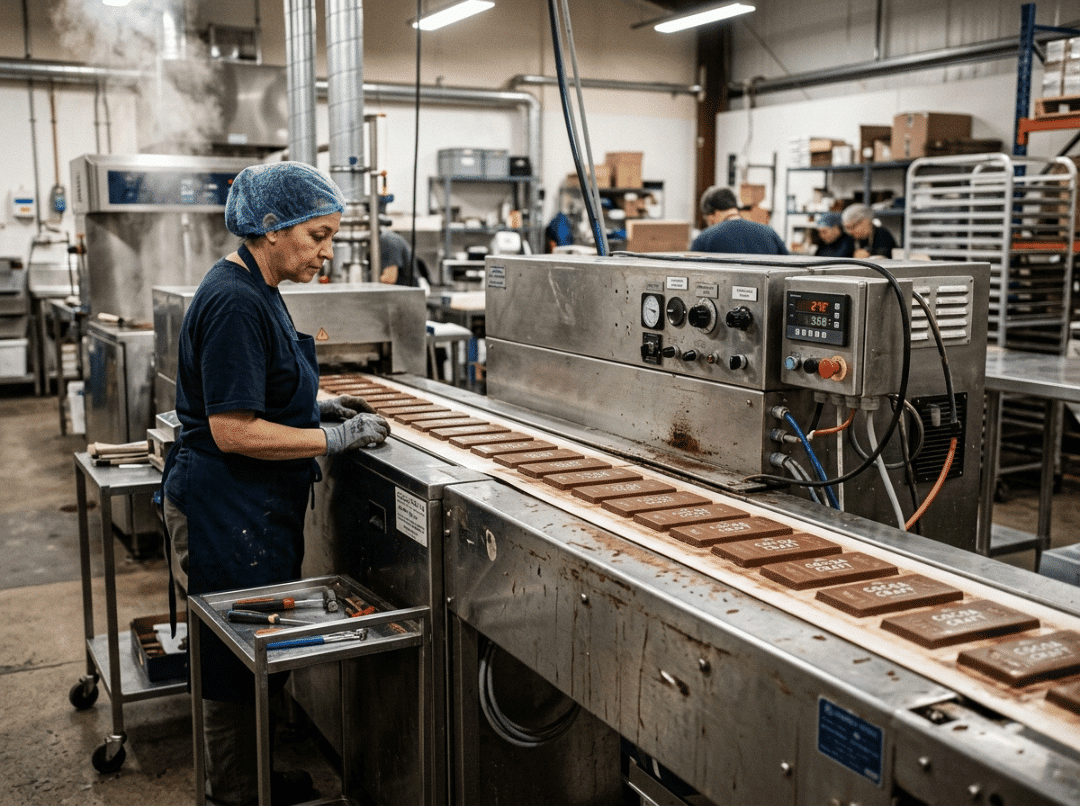
Most production-line pages describe the machine in detail and never help you decide whether it’s the right one for you. You get a process walkthrough, a gallery of finished shapes, and a quote button. What you don’t get is an answer to the question you actually came with: do I even need this, and if so, how should it be built for what I make?
Buying a line is a purchase decision, not a feature comparison. The right configuration depends on your product mix, your sustained output, and how often you switch between products — not on how many modules a supplier can string together. Working from the machinery side, we’ve watched some setups run smoothly for years, and others fight their owners from day one. That gap almost always traces back to decisions made before the purchase, not after.
Who Actually Needs an Automatic Chocolate Production Line?
This is the decision that saves or wastes the most money, so it belongs first. Buying automatic when semi-automatic fits your reality is the costliest early mistake in this trade. An underused automatic line ties up capital, floor space, and energy while producing no more than a right-sized semi-auto setup would have.
Think of it as a spectrum. On one end: manual and semi-automatic work — flexible, modest in cost, limited by hands and hours. On the other: a fully integrated line built for steady, repeatable volume. The question isn’t which is better. It’s which matches where your demand actually sits.
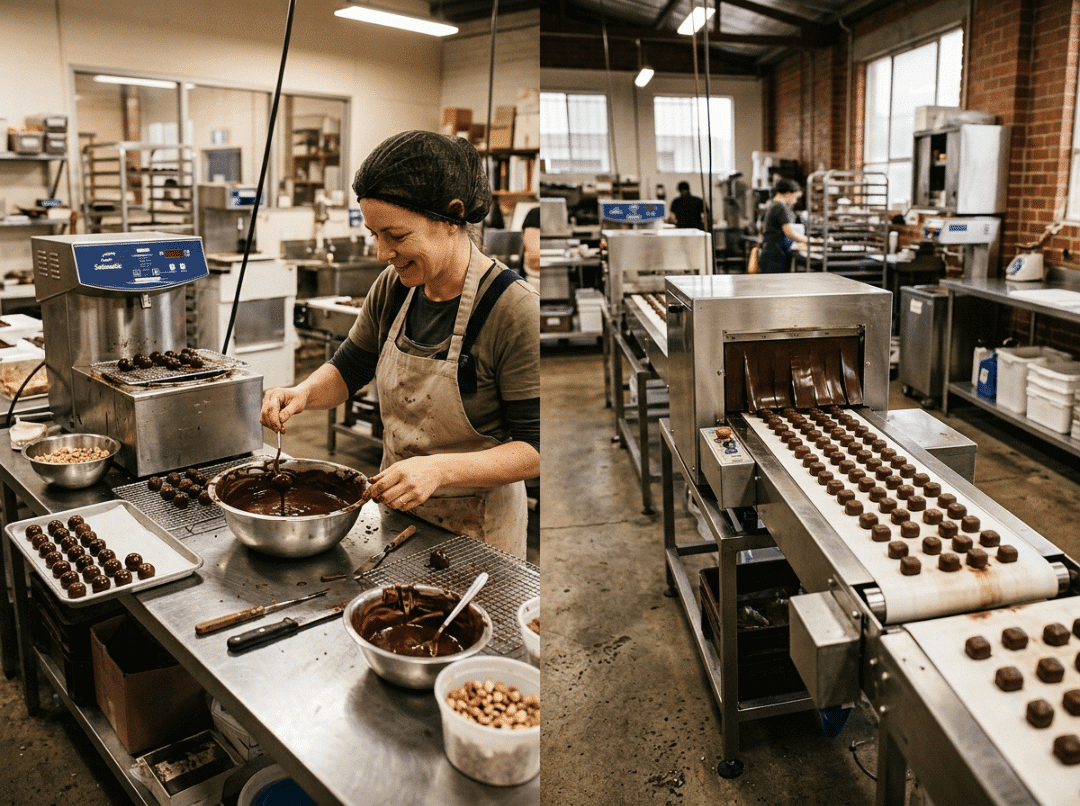
The Signs You’ve Outgrown Semi-Automatic
The upgrade makes sense when demand consistently outruns your hands and semi-auto equipment, labor cost is eating your margin because skilled time goes into hand tempering and coating, quality drifts batch to batch under volume pressure in ways customers notice, or wholesale accounts demand consistency you can’t guarantee manually across long runs.
When two or three of those are true at once, the line stops being a luxury.
When Semi-Automatic Is Still the Right Call
Automatic is premature when demand isn’t proven yet, your SKU count is high and volume per product is low, your budget would be better spent on packaging and sales, or you’re still experimenting with recipes and formats. A well-chosen semi-auto setup running close to its capacity will consistently outperform an automatic line running at one-third of its. Volume you don’t yet have is not a reason to buy.
Which Profile Are You?
Most buyers fit one of four categories.
Growing artisan brand. Demand is climbing and hand work is the bottleneck. A compact modular configuration makes more sense than a full line right now.
Mid-scale factory. Steady volume across a handful of core products. A full automatic line sized to sustained output, not peak, is the right call.
Wholesale-focused producer. Consistency and reliable supply matter most. Prioritize tempering precision and cooling stability over sheer throughput.
Multi-SKU manufacturer. Wide product range, frequent switching. A flexible line with changeover-friendly design beats a faster but rigid one.
Find yourself here before looking at a single spec sheet.
What Actually Determines Stable, High-Quality Chocolate Output?
“Stable, high quality” appears on every production-line page and usually gets explained in two sentences about temperature. The phrase means nothing until you break it into the specific stages where quality is won or lost.
A fully automatic line can still turn out dull, streaky, inconsistent chocolate if these control points aren’t right. Full automation is not the same thing as stable quality.
Chocolate Viscosity
If viscosity swings during a run, everything downstream suffers. Chocolate that’s too thick in one hour and too thin the next causes uneven molding, inconsistent dosing weights, and patchy coating. A stable holding and flow system keeps the mass at one working consistency from the first piece to the last. It’s unglamorous, but it’s the foundation every other stage sits on.
Tempering Precision
This is where an automatic line earns its price. Gloss, snap, and shelf stability all depend on stable cocoa butter crystals, and those form within a narrow window — often less than one degree wide. Hold that window across a full shift, and every piece looks and breaks the same. Drift out of it, and you get bloom, soft set, and dull surfaces that no downstream step can recover. If there’s one stage worth specifying carefully, this is it. A reliable chocolate tempering machine is the difference between repeatable quality and a daily gamble.
Depositing and Molding Accuracy
Dosing accuracy decides weight consistency; mold precision decides appearance and clean demolding. A small dosing variance looks trivial on paper and shows up as rejected pieces across thousands of units. Filled and two-color products raise the stakes here because they demand coordinated timing and placement that solid bars don’t require.
Staged Cooling
Cooling is a quality stage, not a hardening step. Rushed or uneven cooling causes bloom, cracking, dull surfaces, and molds that release poorly. Staged airflow and temperature let the chocolate follow a proper cooling curve instead of a cold shock. This lever is underestimated often enough that it gets its own section below.
Line Speed Synchronization
Every module has to run in step. When tempering output, depositing rate, and cooling capacity don’t match, you get bottlenecks and defects — chocolate backing up before the tunnel, or pieces entering cooling before they’re properly set. A line is only as stable as its worst-matched stage.
Cleanability
On any multi-SKU operation, cleanability directly affects quality. Residue in tanks, pipes, or depositing heads causes flavor carryover and slows changeovers. Equipment with accessible parts and quick-disassembly components sounds like a maintenance concern, but in daily use it protects both output quality and effective capacity. The factories that lose the most unplanned production hours are usually the ones that treated cleaning as an afterthought when they bought the line.
Which Products Match Which Configuration?
A supplier saying the line “can make” bars, filled pieces, two-color chocolates, and coated products is answering the wrong question. Can produce is not the same as runs consistently at volume without excessive changeover cost. Each product type places different demands on the hardware.
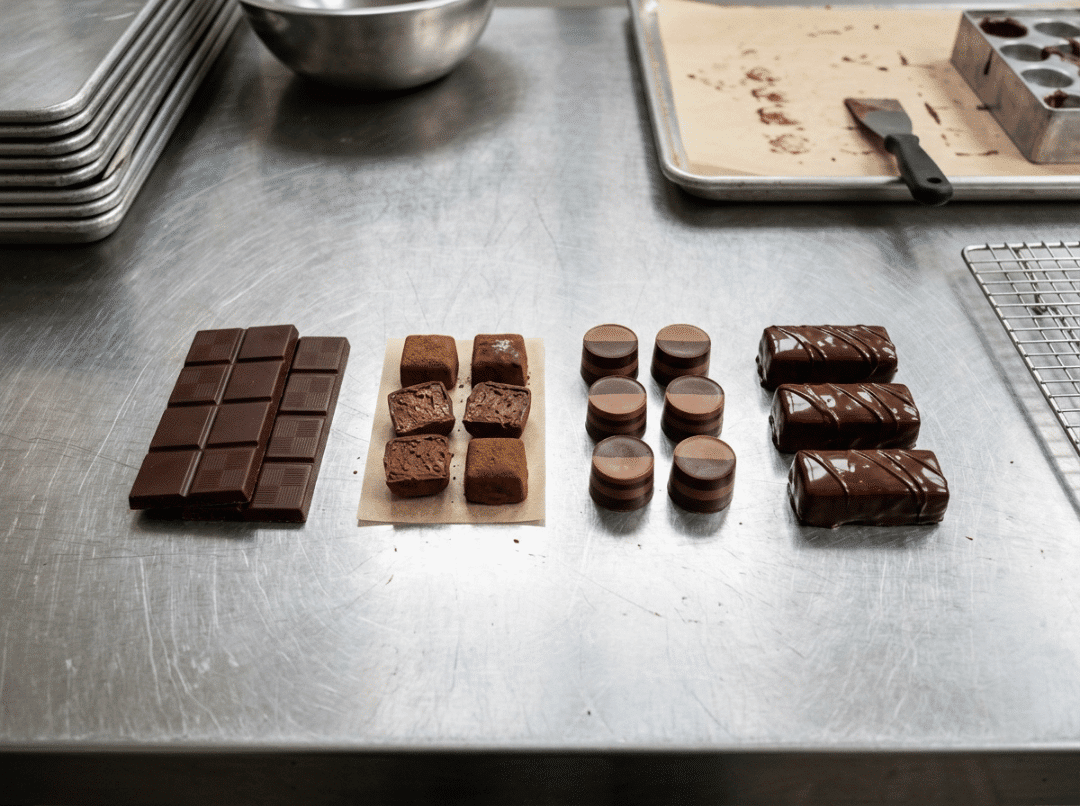
Product-to-Configuration Reference
|
Product Type |
Key Equipment Demand |
Changeover Difficulty |
Notes |
|---|---|---|---|
|
Molded bars |
Standard depositing + molding |
Low |
Most forgiving baseline product |
|
Filled chocolates |
Multi-dosing depositor, precise timing |
High |
Shell and filling require coordination |
|
Two-color chocolates |
Dual dosing, tight temperature control |
High |
Color separation demands precision |
|
Enrobed snacks / bars |
Enrober + curtain coating |
Medium |
Different line type from molding |
|
Products with inclusions |
Robust dosing, adjusted flow parameters |
Medium–High |
Particles affect accuracy and component wear |
Use this to check any proposed configuration against what you actually plan to run.
Molded Bars
Solid bars are the most forgiving product on any line. Standard depositing and molding handle them well; tolerances are generous, and most of the budget can go into tempering and cooling quality rather than complex dosing. If bars are your core product, this is the right starting configuration.
Filled and Two-Color Products
Both change the equipment math significantly. Filled pieces need coordinated shell-then-filling dosing with precise timing. Two-color work needs dual dosing with tight temperature control so the colors set without bleeding. Both raise cost and changeover complexity. They justify the specification when those products carry your margin — not when they’re a quarterly promotional item.
Enrobed Products
Enrobing and molding are different jobs that call for different lines. Coating biscuits, wafers, or centers requires a chocolate enrober that passes products under a continuous chocolate curtain — not a depositor that fills molds. Buyers sometimes assume one setup handles both well. It rarely does. The decision between a molding line and an enrobing line should happen before any other configuration choice.
Products With Inclusions
Adding nuts, dried fruit, or cereal changes how the chocolate flows and deposits. Particles affect dosing accuracy, increase component wear, and alter how cleanly molds fill and release. A line built to handle inclusions needs adjusted parameters and more robust handling through the depositing stage. “We sometimes add almonds” is a configuration decision, not a footnote.
How to Configure by Capacity and Product Mix
Every supplier says they can customize. That’s true and almost useless without the logic behind it.
Size to Sustained Demand, Not Peak
Configure for the output you actually sustain month after month, not the volume you might hit during a holiday rush. An oversized line running half-empty wastes energy, heats unevenly, and ties up capital. A right-sized line runs closer to designed efficiency and holds quality more predictably. Most buyers quote their best week to size the line, then run it at a fraction of rated capacity most of the year.
Single-Product vs Multi-SKU
A dedicated single-product line runs one item beautifully with minimal changeover. A flexible multi-SKU line handles variety but adds cleaning and setup time between runs. Neither is abstractly better. The choice follows your product strategy: one high-volume hero product points toward a dedicated line; a wide, frequently shifting range points toward built-in flexibility and a realistic accounting of changeover hours.
What’s Actually Worth Customizing
Legitimate customization covers capacity, mold formats, automation level, and floor layout. These reflect real operational needs. When a buyer wants to customize almost everything before they can describe their product mix clearly, that usually signals an operation that hasn’t mapped its own process yet. The clearer your product and output picture, the less custom work you’ll actually need — and the more predictable the result.
Build for Expansion Later
Specify the stages that are hard to change after installation — tempering and core depositing — with room to grow. Leave capacity headroom where it’s likely to be needed: cooling length, depositing heads. A chocolate production line designed with expansion in mind costs more forethought now and saves a full rebuild when volume climbs.
Do You Need a Cooling Tunnel?
For continuous production, yes. For small or manual batches, often not. The conditions matter.
When Racks Are Enough
Cooling racks and ambient air handle small-batch or manual production where you’re setting dozens of pieces per run, not thousands. The ceiling arrives when volume climbs to the point where pieces enter the next stage before they’ve set properly, or when ambient temperature variation makes results inconsistent from one session to the next.
Why Continuous Lines Need Staged Cooling
Once you’re running continuously, uncontrolled cooling becomes a defect source. Chocolate cooled too fast cracks and blooms. Cooled unevenly, it sets dull and sticks in the mold. A tunnel moves the chocolate through a controlled temperature curve across zones rather than hitting it with a single cold environment. That staged approach protects gloss, ensures clean demolding, and lets the line hold a steady speed.
How Tunnel Length and Zoning Are Decided
Tunnel design follows the line’s requirements, not a standard catalog size. Required cooling time depends on line speed and product thickness — a thick filled bar needs significantly more time than a thin molded piece. That dwell time, set against belt speed, determines the tunnel length. Zone temperatures are set for a staged curve that avoids surface condensation while reaching the target set temperature before demolding. Different product profiles genuinely need different tunnel configurations, which is why a single tunnel specification rarely suits a varied line well.
What Inadequate Cooling Actually Costs
Poor cooling means rejected batches, stuck molds, lost gloss, and a line you have to slow down to compensate. A chocolate cooling tunnel sized to your actual throughput protects the quality that every upstream stage worked to create. Skimping on it undoes good tempering and good depositing in the final meters.
Common Mistakes Before You Sign
Most regrettable purchases trace to the same small set of errors.
- Sizing to peak output, not sustained demand. An oversized line costs more to run, heats unevenly at low load, and delivers a slower payback. Peak weeks are a scheduling problem, not a machine-sizing reason.
- Underestimating changeover time. Multi-SKU lines lose hours between runs to cleaning and setup. Buyers plan around rated run speed and rarely account for what happens between products. Map your switch frequency before you buy and factor that time into real capacity.
- Counting modules instead of evaluating process stability. A longer line with more automation can still turn out inconsistent chocolate if the six control points above aren’t right. A proposal should be judged on how well it holds viscosity, tempering, dosing, and cooling — not on module count.
- Ignoring cleaning access. Hard-to-clean equipment gets cleaned less thoroughly or more slowly, both of which cost quality and production hours. Check cleaning access during the equipment review, not during installation.
- Assuming one configuration runs every product efficiently. A line specified too broadly often runs nothing well. Product mix must drive the configuration. The factory that tries to make everything on one generic setup usually makes nothing particularly well.
Frequently Asked Questions
What is an automatic chocolate production line?
A continuous, integrated system that connects tempering, depositing or enrobing, cooling, and packaging into a single automated flow. Unlike semi-automatic setups where operators manage transfers and intervene at certain stages, an automatic line moves product through each stage with minimal manual handling.
How do I know if I need automatic or semi-automatic?
Look at sustained demand, labor cost, and whether manual methods can hold quality across long runs. If demand is proven, volume is consistent, and hand or semi-auto work is the clear bottleneck, an automatic line will pay back. If demand is still building, SKU variety is high, or the budget is constrained, a right-sized semi-auto setup is the more sensible choice.
What actually determines stable, high-quality output?
Six things: consistent viscosity, tempering precision, depositing and molding accuracy, staged cooling, line speed synchronization, and cleanable design. Automation level alone doesn’t decide quality — these six control points do.
Do I need a cooling tunnel?
For any continuous production, yes. Natural cooling on racks is adequate only for small or manual batches where the setting time and ambient conditions are manageable. A tunnel protects gloss, prevents defects, and keeps the line running at a steady pace.
Can one line make bars, filled chocolates, and two-color pieces?
Often yes, but filled and two-color products add depositing complexity and meaningful changeover time. The configuration should reflect what you actually make most, not a theoretical maximum of what the line could handle.
How should I think about space and capacity planning?
Plan around sustained monthly output and your floor layout. Leave room to expand — cooling length and depositing capacity in particular — rather than buying exactly to current demand.
What’s the difference between enrobing and dipping?
Enrobing is automated: products pass under a continuous chocolate curtain on a conveyor for a consistent, even shell. Dipping is manual or semi-automatic — more flexible for small batches, but less consistent in shell thickness and harder to scale.
Choosing the Right Line
The decision comes back to the same sequence. Confirm you actually need an automatic line rather than a better semi-auto setup. Then evaluate proposals against the six quality control points, not against module counts. Match the configuration to what you make most, size it to what you actually produce month after month, and plan cooling and changeover before anything is ordered.
The best line isn’t the most automated one. It’s the one that fits your products, your volume, and the realities of your operation — and keeps fitting as you grow.
When you’re ready to work through a configuration, start from your product mix and your sustained capacity target. Browse the tempering, enrobing, cooling, and full-line equipment at topchocomachine.com, and tell us what you make and what you’re targeting — we’ll help you land on something that fits your operation rather than one you’ll spend years working around.