

Choosing the right chocolate machinery is key to running an efficient confectionery operation. Whether you process dark, milk, or white chocolate, understanding the different types of chocolate machines and the stages of production can help you select the right equipment for your facility. Doing so will save time and money while ensuring a superior final product. Chocolate machines form the heart of any modern confectionery plant, converting raw ingredients into high-quality treats for retail, bakery, and commercial applications.
From primary cocoa bean processing to tempering and final enrobing, each machine type performs a unique role in the overall manufacturing operation. Investing in the right technology ensures your chocolate retains the perfect snap, shine, and texture consumers expect. This comprehensive guide will walk you through the various types of chocolate equipment, their specific functions, and how they integrate seamlessly to optimize your entire production line for maximum efficiency and scalability.
What is a Chocolate Machine?
Before we explore the different types of chocolate equipment, we need to understand what a chocolate machine is and what it is used for. A chocolate machine is a specialized piece of equipment designed to process raw cocoa ingredients and refined chocolate masses into finished edible products. This processing allows confectioners to turn raw material into usable chocolate, which is critical for creating bars, truffles, coatings, and baked goods. Chocolate machines achieve this by applying precise mechanical force and thermal regulation—through melting, cooling, mixing, or coating—within a highly controlled manufacturing environment. These machines handle the delicate nature of cocoa butter crystallization, ensuring the final product remains stable.
The chocolate-making process involves a sequence of precise thermal and mechanical steps, and these machines fit seamlessly into every stage of that journey. From the moment roasted cocoa nibs are ground into a thick paste to the final glossy finish applied to a delicate truffle, machinery dictates the speed, quality, and consistency of the output. Without these automated and semi-automated systems, achieving the uniform texture and stable shelf life required for commercial distribution would be nearly impossible. They bridge the gap between artisanal craftsmanship and high-volume commercial production, allowing businesses to scale their operations while maintaining strict quality standards across thousands of identical product batches.
Every chocolate machine is built with meticulously engineered components that withstand continuous use while meeting strict food safety standards. Key components often include food-grade stainless steel parts, sophisticated temperature control systems, and automated agitation mechanisms. Stainless steel ensures that the equipment remains sanitary, easy to clean, and resistant to the natural acidity found in cocoa products. Advanced temperature controls, often managed by programmable logic controllers (PLCs), continuously monitor the chocolate’s thermal state to prevent burning or improper crystallization. Additionally, heavy-duty motors and gearboxes drive the continuous motion required to mix and pump viscous chocolate through pipelines.
What are Chocolate Machines Used For?
Chocolate machines are primarily used in the commercial confectionery and bakery industries, where they transform large quantities of raw chocolate into finely crafted consumer goods. These machines are also commonly used in large-scale food production operations, such as creating chocolate coatings for ice cream bars, manufacturing chocolate chips for cookie dough, and producing bulk chocolate blocks for secondary manufacturers. In specialized dessert manufacturing, chocolate equipment prepares the base material for subsequent stages of flavoring, molding, or decorating. Whether operating in a massive global candy factory or a medium-sized regional bakery, these machines handle the heavy lifting of continuously melting, mixing, and shaping chocolate.
The benefits of using these specialized machines extend far beyond basic convenience, offering significant improvements in efficiency, consistency, and operational scalability. Machine-driven production guarantees that every single batch of chocolate experiences the exact same thermal curve, resulting in a perfectly consistent flavor, snap, and glossy appearance that manual labor simply cannot replicate at scale. Furthermore, automated systems drastically reduce the physical strain on workers and minimize the potential for human error or contamination during the manufacturing process. This level of automation allows growing chocolate brands to scale their output exponentially, transitioning from producing a few hundred bars a day to manufacturing thousands of units per hour without sacrificing product quality.
Specifically, these machines handle highly technical tasks that require absolute precision, such as tempering, molding, and enrobing. Tempering machines carefully raise and lower the temperature of liquid chocolate to align cocoa butter crystals, preventing an unappealing white powdery appearance known as fat bloom. Molding machines inject this perfectly tempered chocolate into polycarbonate trays with exact volumetric precision to form solid bars or hollow figures. Enrobing machines create a continuous waterfall of liquid chocolate to coat passing centers, such as nuts, nougat, or baked cookies, providing a uniform outer layer. Each of these specific tasks requires dedicated machinery to ensure the final product meets exacting consumer expectations.
Brief History of Chocolate Machines
The history of chocolate production stretches back centuries, long before the invention of automated machinery. Early methods of chocolate processing relied entirely on intensive manual labor. Indigenous peoples in Mesoamerica ground roasted cacao beans by hand using heated stones called metates to create a coarse, gritty paste used primarily for drinking. When chocolate reached Europe, this labor-intensive grinding process continued for centuries, making chocolate an expensive luxury reserved exclusively for the wealthy elite. The lack of mechanical assistance made achieving a smooth texture virtually impossible, and even producing small quantities required hours of strenuous physical effort.
The transition from manual grinding to mechanical processing began during the Industrial Revolution, marking the invention of the first true chocolate machines. In the late 18th century, a French inventor named Pelletier conceived of using a steam engine to power cocoa bean grinding, thereby vastly accelerating the initial processing stage. However, the most revolutionary breakthrough occurred in 1828 when Dutch chemist Coenraad Johannes van Houten invented the cocoa press. This hydraulic machine squeezed the natural fat, or cocoa butter, out of the roasted beans, leaving behind a fine powder that could be easily mixed with liquids. This invention fundamentally changed chocolate from a gritty beverage into a moldable, solid confection.
Following van Houten’s hydraulic press, the evolution of modern chocolate machines accelerated rapidly throughout the 19th and 20th centuries. In 1879, Swiss chocolatier Rodolphe Lindt invented the conching machine, a device that continuously scraped and kneaded chocolate for days to eliminate acidic flavors and create a phenomenally smooth, velvety texture. As electricity became widely available, heavy iron and wooden machines were replaced by automated stainless steel equipment capable of continuous operation. Engineers began developing complex pumping and piping systems to move liquid chocolate throughout large factories, laying the groundwork for the highly automated, fast-paced production facilities that dominate the modern confectionery landscape.
Key milestones in chocolate machinery innovation continue to shape how we produce sweets today. The mid-20th century saw the introduction of continuous tempering machines, which enabled factories to rapidly stabilize chocolate without relying on slow, batch-by-batch marble-slab methods. Following this, the invention of the enrobing machine revolutionized the candy bar industry by enabling manufacturers to automatically coat hundreds of candy centers per minute. In recent years, the integration of programmable logic controllers (PLCs) and robotic arms has further refined the process. These digital innovations allow operators to monitor temperatures, adjust flow rates, and package finished goods with unprecedented speed and microscopic precision.
Basic Processes in Chocolate Production
Chocolate production is the process of reducing raw cocoa beans and combining them with sugar and dairy into a smooth, stable edible product. There are several fundamental stages in chocolate processing: roasting, grinding, conching, tempering, molding, and enrobing. Each method corresponds to a different machine design and determines how efficiently the equipment handles cocoa butter’s delicate chemical properties. Understanding these core processes is essential for grasping exactly how raw agricultural ingredients are transformed into luxurious confections. Modern chocolate production relies on a highly synchronized sequence of mechanical actions to develop flavor, refine texture, and ensure the chocolate’s structural integrity.
Tempering is arguably the most critical and chemically complex process in the entire chocolate production cycle. Cocoa butter contains multiple types of fat crystals that solidify at different temperatures. If chocolate is simply melted and allowed to cool naturally, it forms unstable crystals, resulting in a dull, crumbly product prone to blooming. Tempering is the controlled process of heating, cooling, and gently reheating liquid chocolate while maintaining constant agitation. This precise thermal manipulation encourages the formation of stable Beta V crystals. When executed correctly using dedicated tempering machines, the resulting chocolate possesses a brilliant, glossy finish, a firm, satisfying snap when broken, and a smooth melting profile on the palate.
Molding is the mechanical process of shaping this perfectly tempered liquid chocolate into a solid, recognizable form. During this stage, automated depositing machines pump exact volumes of liquid chocolate into rigid, food-safe polycarbonate molds. Once deposited, the molds travel over vibrating tables. This aggressive vibration forces any trapped air bubbles to the surface, preventing unsightly holes or weak spots in the finished bars or truffles. The molds then pass through extensive cooling tunnels, where the chocolate gently contracts as it solidifies, allowing it to release easily from the mold with a flawless, mirror-like surface. This stage determines the final weight, shape, and visual appeal of the consumer product.
Enrobing is a specialized coating process used primarily for complex confections that feature a distinct center, such as caramels, nuts, or biscuit layers. Instead of using molds, an enrobing machine transports the candy centers along a continuous wire-mesh conveyor belt. As the centers pass through the machine, they move under a precise curtain, or waterfall, of continuously flowing tempered chocolate. Simultaneously, a bottom roller coats the underside of the confection. High-pressure air blowers then gently remove any excess chocolate, ensuring a perfectly even, thin layer of coating. This continuous process allows manufacturers to produce thousands of coated candies per hour with absolute uniformity and minimal product waste.
Understanding Chocolate Production Stages
Chocolate operations are typically divided into very distinct stages, each serving a specific purpose in transforming raw materials into finished goods. The primary stage of production focuses entirely on the initial processing of the raw agricultural ingredient: the cocoa bean. This stage includes cleaning, roasting, and winnowing the beans to remove the outer shell, leaving behind the pure cocoa nibs. Specialized grinding machinery then crushes these nibs under immense pressure, utilizing the friction and heat to melt the natural cocoa butter. This transforms the solid nibs into a thick, dark, and highly aromatic liquid known as chocolate liquor, which serves as the foundational ingredient for all subsequent chocolate manufacturing.
The secondary stage of production is dedicated entirely to refining the texture and developing the chocolate’s final flavor profile. During this phase, the chocolate liquor is mixed with sugar, extra cocoa butter, and milk powder (if making milk chocolate). This coarse paste is fed through heavy steel refining rollers that crush the sugar and cocoa particles down to a microscopic size, typically around 20 microns, ensuring the chocolate feels perfectly smooth on the tongue. Following refinement, the chocolate enters the conching machine. Here, it is continuously kneaded and aerated at elevated temperatures for several hours or even days, driving off bitter volatile acids and harmonizing the complex flavor compounds.
The tertiary stage involves taking this fully developed liquid chocolate and preparing it for its final physical form. This encompasses the critical tempering process, followed immediately by either molding or enrobing applications. Because the chocolate is now chemically stable and perfectly smooth, the focus shifts to volumetric precision and rapid cooling. Automated depositors ensure that exact amounts of chocolate flow into packaging lines, while industrial cooling tunnels quickly but gently solidify the mass. This tertiary stage is where the product transitions from a raw liquid ingredient into a recognizable, consumer-ready candy bar, truffle, or coated biscuit, ready for the final wrapping and distribution phases.
Modern chocolate plants integrate advanced technology seamlessly at every stage of production to ensure continuous throughput and uncompromising quality control. The integration of automation and the Internet of Things (IoT) allows plant managers to monitor the entire production line from centralized digital dashboards. Sensors track the exact viscosity, temperature, and flow rate of the chocolate in real-time, automatically adjusting machine parameters without human intervention. This connectivity ensures that energy use is optimized, material waste is heavily minimized, and every batch meets stringent quality specifications. These smart systems represent the cutting edge of modern food manufacturing, merging traditional culinary arts with precision engineering.
Types of Chocolate Machines
There are many types of chocolate machines, from compact continuous temperers to massive industrial enrobing lines. Chocolate manufacturing is a versatile process, and the type of machine you need depends entirely on the specific production stage and your desired final product. The three main categories of finishing equipment are tempering machines, molding machines, and enrobing machines, each offering unique operational benefits. Let’s find out why each of these machines is important and how they function within a commercial setting.
Tempering Machines
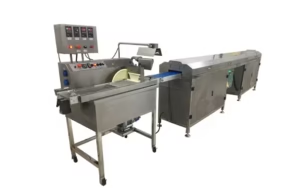
Tempering machines are specialized thermal-regulation units designed to precisely control the crystallization of cocoa butter in liquid chocolate. Their primary purpose is to take melted, untempered chocolate and process it through a specific heating-and-cooling curve while maintaining constant agitation. By holding the chocolate at exact temperatures, these machines force the fat molecules to align into the stable Beta V crystal structure. This ensures the chocolate will set properly at room temperature, maintain a glossy aesthetic, and resist fat bloom over time.
The key features of modern tempering machines include continuous flow capabilities, highly precise digital thermostats, and internal scraping mechanisms. Unlike manual tempering on a marble slab, these machines provide continuous output, meaning a steady stream of perfect chocolate is always available for production. The benefits are immense: they eliminate the guesswork and inconsistency of manual tempering, drastically reduce production time, and lower labor costs. Operators simply load melted chocolate into the holding tank, and the internal auger and cooling systems automatically maintain the perfect temper all day long.
In commercial chocolate production, tempering machines serve as the critical gateway between raw liquid chocolate and the final forming stages. They are utilized immediately before molding bars, creating hollow figures, or feeding an enrobing line. Whether it is a small batch wheel-type temperer used by boutique chocolatiers or a massive continuous tempering unit in a high-volume factory, these machines are absolutely indispensable. Without them, large-scale production of high-quality, shelf-stable chocolate products would be fundamentally impossible.
Molding Machines
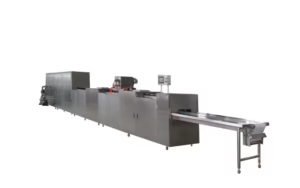
Molding machines, often referred to as depositors, are precision-engineered systems designed to inject precise volumes of tempered liquid chocolate into rigid molds. Their primary purpose is to automate the shaping process, ensuring that every single chocolate bar, praline, or baking chip weighs exactly the same and features perfect structural integrity. These machines use advanced pneumatic or servo-driven piston heads to draw chocolate from a heated hopper and push it smoothly into passing polycarbonate trays without spilling or forming irregular shapes.
Key features of high-quality molding machines include heated depositing heads to prevent blockages, programmable recipe screens for quick product changeovers, and integrated vibration stations. The vibration function is critical, as it rapidly shakes the filled molds to dislodge trapped air bubbles and evenly distribute the chocolate into complex mold cavities. The primary benefit of using an automated molding machine is the significant increase in production speed and volumetric consistency, which are crucial for meeting strict packaging weight regulations and maintaining profit margins.
These machines handle a wide range of applications in the chocolate industry. They are used to produce classic solid chocolate bars, intricate filled pralines using “one-shot” depositing technology, and hollow seasonal figures such as Easter bunnies. By swapping out the mold plates and adjusting the depositing program, a single molding line can produce dozens of different product variations. This flexibility makes them a cornerstone piece of equipment for both mid-sized artisanal brands and massive multinational confectionery corporations.
Enrobing Machines
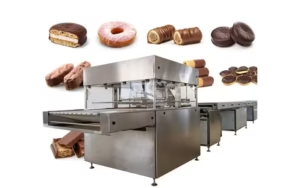
Enrobing machines are continuous coating systems designed to cover various confectionery centers with a uniform layer of liquid chocolate. Their fundamental purpose is to automate the dipping process, completely replacing the slow and tedious method of hand-dipping individual truffles or cookies with a fork. Enrobers use a continuous wire mesh belt to transport the product through a curtain of tempered chocolate, ensuring full coverage of the top and sides, while a bottoming roller coats the base.
The standout features of modern enrobing lines include adjustable chocolate curtains, variable speed wire belts, and precision air blowers (often called air knives). The air blower removes excess chocolate from the coated product, allowing operators to dictate the exact thickness and weight of the chocolate shell. The benefits of enrobing machines include exceptionally high production volumes, perfectly consistent coating thickness, and the ability to process delicate centers that might easily break or deform if processed through traditional molding equipment.
Enrobing technology is applied across a massive spectrum of food production industries. In bakeries, these machines coat biscuits, wafers, and cakes to increase shelf life and add premium appeal. In the confectionery sector, they are responsible for creating beloved treats like chocolate-covered nuts, caramel-filled candy bars, and soft nougat centers. The sheer speed and reliability of an enrobing line make it an essential investment for any food manufacturer looking to add high-quality chocolate coatings to their product portfolio at a commercial scale.
Selecting and Maintaining Chocolate Machines
Choosing the right chocolate machine depends on several critical factors that impact your overall operational success. Facility managers must first evaluate their specific production volume, the viscosity of their preferred chocolate, and the exact types of products they intend to manufacture. Furthermore, budget constraints and available factory floor space dictate whether a company should invest in compact, multifunctional batch units or expansive, high-speed continuous-processing lines. Carefully calculating the desired hourly throughput and the technical requirements of the final product will ensure that the selected equipment perfectly matches the facility’s current needs and future growth potential.
Once the equipment is installed, committing to a rigorous preventive maintenance schedule is absolutely vital for ensuring long-term efficiency and avoiding catastrophic breakdowns. Chocolate is a naturally abrasive and highly viscous material that puts significant strain on moving parts, seals, and heating elements. Regularly replacing wear parts—such as silicone seals, auger blades, and pump components—prevents unexpected leaks and maintains the precision required for accurate depositing and tempering. Ignoring preventive maintenance quickly leads to unscheduled downtime, ruined batches of expensive chocolate, and significant revenue losses.
To maintain optimal machine efficiency daily, operators must adhere to strict sanitation and calibration protocols. All chocolate pipelines, hoppers, and nozzles must be thoroughly flushed and cleaned per the manufacturer’s guidelines to prevent blockages from solidified chocolate or cocoa butter buildup. Additionally, water-jacketed heating systems should be routinely descaled, and temperature probes must be regularly calibrated to ensure accurate thermal readings. Consistent training for machine operators also ensures that the equipment is run at optimal speeds, reducing unnecessary mechanical wear and tear.
Modern chocolate facilities are increasingly relying on automation and smart technology to assist with complex maintenance routines. Advanced chocolate machines now come equipped with internal diagnostic software that continuously monitors pump pressure, motor torque, and thermal efficiency. These automated systems can alert maintenance teams to potential issues long before a physical breakdown occurs, allowing for scheduled repairs during planned downtime. By integrating automation into the maintenance workflow, factories can maximize equipment lifespan, maintain uncompromised product quality, and keep their chocolate production lines running smoothly year-round.
FAQs: Types of Chocolate Machines and Production Stages
What are the main stages of chocolate production?
Most chocolate processing involves three key stages. Primary processing involves roasting and grinding raw cocoa beans to create a fluid chocolate liquor. Secondary processing focuses on refining this paste with sugar and conching it for hours to develop a perfectly smooth texture and a balanced, non-acidic flavor profile. Finally, the tertiary stage involves tempering the chocolate to stabilize the cocoa butter, followed by molding or enrobing to create the final consumer-ready shape.
Why are different machines used at each stage?
Each type of chocolate machine is engineered for a highly specific physical or thermal job. Heavy-duty refiners use massive steel rollers to crush sugar particles, which is a brutally forceful process. Conversely, continuous tempering machines and enrobers are designed for precise thermal control and fluid dynamics, ensuring the chocolate crystallizes properly and coats products evenly. Mixing these functions into a single machine would compromise the exacting precision required for professional chocolate manufacturing.
Can I skip certain stages in chocolate production?
Yes, depending on your specific business model and product goals. If you purchase pre-refined, high-quality chocolate couverture from a wholesale supplier, you can entirely skip the primary and secondary stages of roasting, grinding, and conching. You would only need to invest in tertiary equipment, such as a tempering machine and a depositor, to melt, stabilize, and shape the purchased chocolate into your own branded truffles or signature bars.
Conclusion
Choosing the right chocolate machines is crucial for establishing a successful, efficient, and highly profitable confectionery manufacturing operation. Whether you are tempering massive batches of dark chocolate, molding intricate seasonal pralines, or enrobing endless rows of caramel biscuits, understanding the distinct functions of each machine empowers you to make highly informed equipment investments. Aligning your machinery choices with your specific production goals ensures your facility can meet high-volume demands without sacrificing the delicate flavor, glossy appearance, or perfect snap that define premium chocolate.
Equipping your production floor with the right technology allows you to automate repetitive tasks, drastically reduce material waste, and maintain absolute consistency across every product batch. As your business expands, relying on robust, well-maintained chocolate machinery will provide the reliable foundation necessary to scale your operations confidently and efficiently. We hope this comprehensive guide has clarified the complex world of chocolate manufacturing equipment and prepared you to elevate your confectionery production to the highest possible professional standards.