
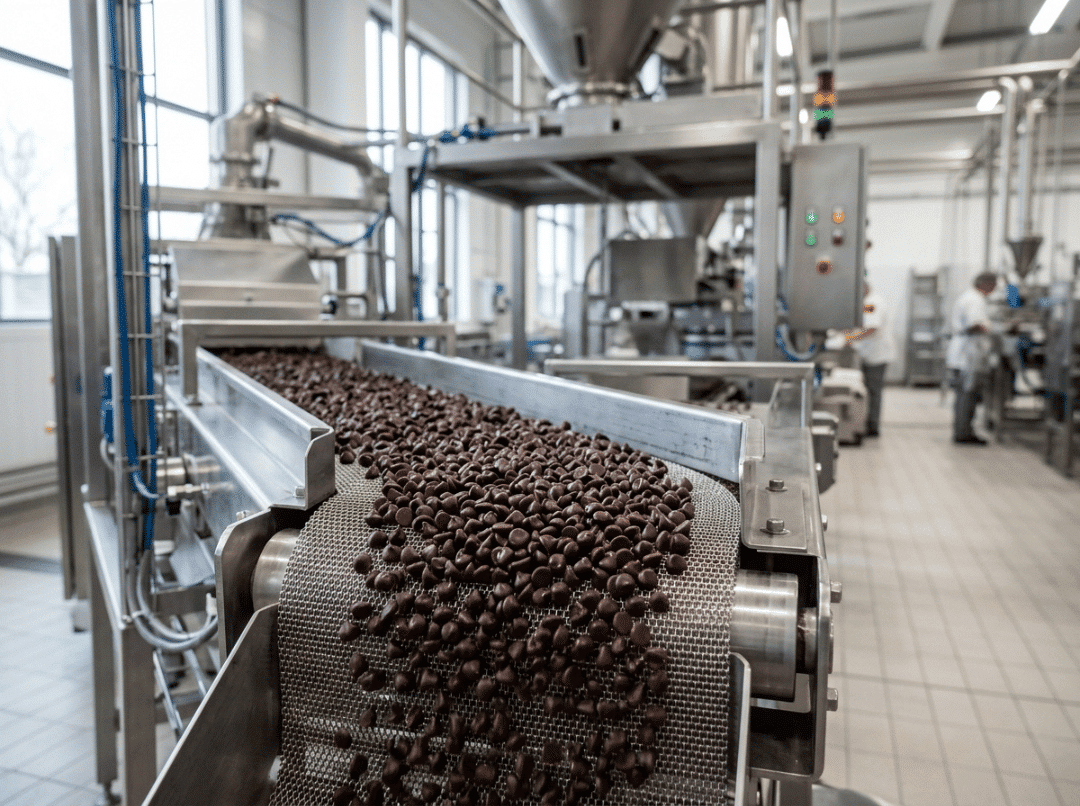
A chocolate chip does one thing a chocolate bar can’t: hold its shape at oven temperature. Drop a piece of bar chocolate into cookie dough, and it spreads into a puddle. A well-made chip softens, glistens, and stays standing. That difference is engineered into the recipe and the process.
This guide covers the whole thing, from what a chip actually is to the machinery that forms millions of identical drops. The two stages that decide quality most, tempering and depositing, get the detail they deserve.
What Are Chocolate Chips?
Chocolate chips are portioned pieces of chocolate built for baking and industrial use. Their defining trait is heat resistance. A chip keeps its form when a cookie bakes; a chunk cut from a bar melts and runs.
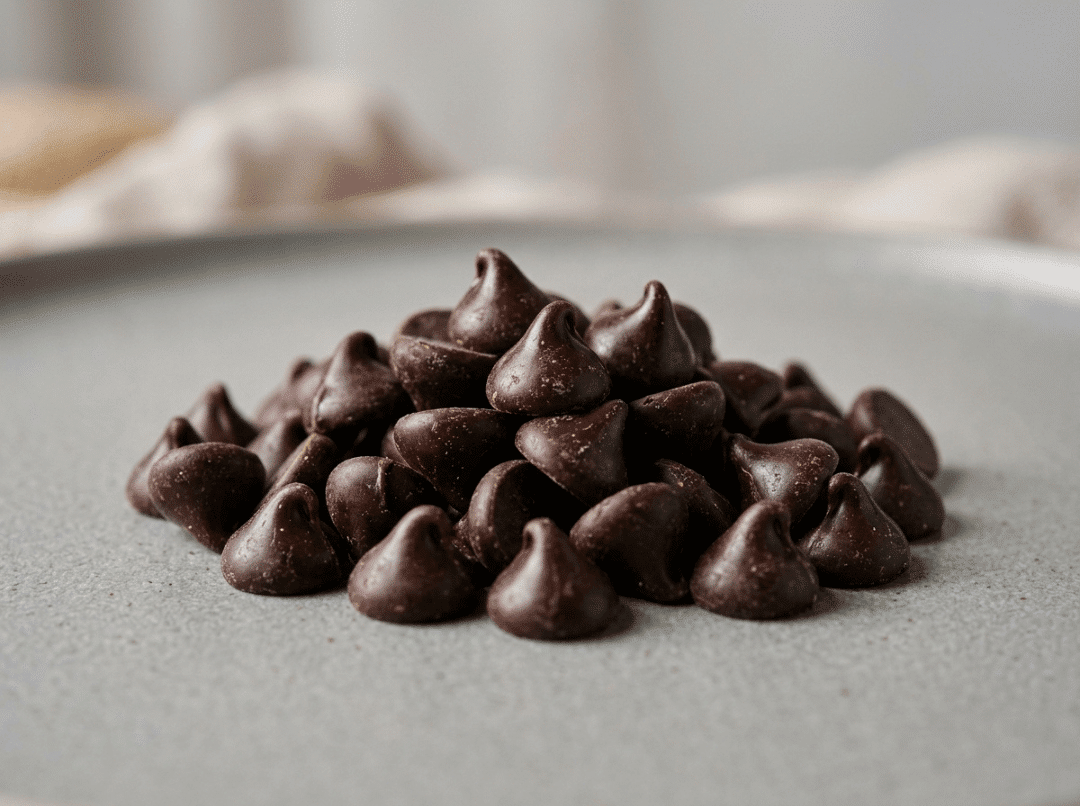
Shape matters as much as recipe. That familiar pointed drop comes from how chips are deposited onto a belt, and it gives producers a piece that packs cleanly, doses evenly, and spreads through dough without clumping.
Why Don’t Chocolate Chips Melt Like Regular Chocolate?
Two things keep a chip intact in the oven.
The first is fat content. Chips carry less cocoa butter than a bar, so there’s less material to liquefy and spread once the dough heats up. Many recipes also add stabilizers that hold the structure together at higher temperatures.
The second is tempering. Set cocoa butter into the right crystal form, and it gains a higher, sharper melting point. The chip softens enough to feel melty on the tongue while the outer shape survives the bake. Skip proper tempering and even a low-fat chip will slump.
Melt resistance isn’t one trick, then. It’s a low-cocoa-butter recipe and a stable crystal structure working together.
What Are Chocolate Chips Made Of?
The ingredient list is short, and each component does specific work in flavor, flow, and bake behavior.
- Cocoa mass (chocolate liquor): the core chocolate flavor and body.
- Cocoa butter: governs how the chocolate flows through the depositor and how the finished chip snaps and melts.
- Sugar: sweetness and a share of the texture.
- Milk powder: creaminess and lighter color in milk and white chips.
- Lecithin: an emulsifier that thins viscosity so chocolate flows cleanly through the depositing head.
- Vanilla or flavoring: rounds out the profile.
Small formula changes move the whole line. Cut the cocoa butter and the chocolate stiffens, which improves bake stability but pushes viscosity up at the depositor. Add too much lecithin and the drops spread instead of holding a peak. Swap cocoa butter for vegetable fat, and you get a compound chip that costs less and skips tempering, trading away flavor and snap. In short, the recipe is designed for the machine and the oven as much as for taste.
How Are Chocolate Chips Made? Step by Step
Production runs as a continuous chain. Each stage feeds the next, and what goes wrong early rarely gets fixed later.
Step 1 — Weighing and Ingredient Prep
Everything starts with accurate dosing of cocoa mass, sugar, cocoa butter, and additives. Tolerances stay tight because a small error in fat or sugar shifts viscosity and throws off every setting downstream. Plants working from raw beans roast and winnow them into clean nibs before this point.
Step 2 — Mixing
The weighed ingredients blend into a uniform paste. Even distribution here stops dry or fatty pockets from surfacing during refining.
Step 3 — Refining
Roller refiners crush the paste and drive particle size down to roughly 20–30 microns. Below that threshold, the tongue stops detecting individual particles, so the chocolate reads as smooth. Coarse raw material turns silky at this stage.
Step 4 — Conching
Conching is extended mixing and aeration, often running for hours. It develops flavor, drives off residual moisture and acidic volatiles, and coats every particle in fat. Longer conching gives a mellower taste and easier flow.
Step 5 — Tempering
This is the stage that separates a good chip from a defective one, and it rewards a closer look.
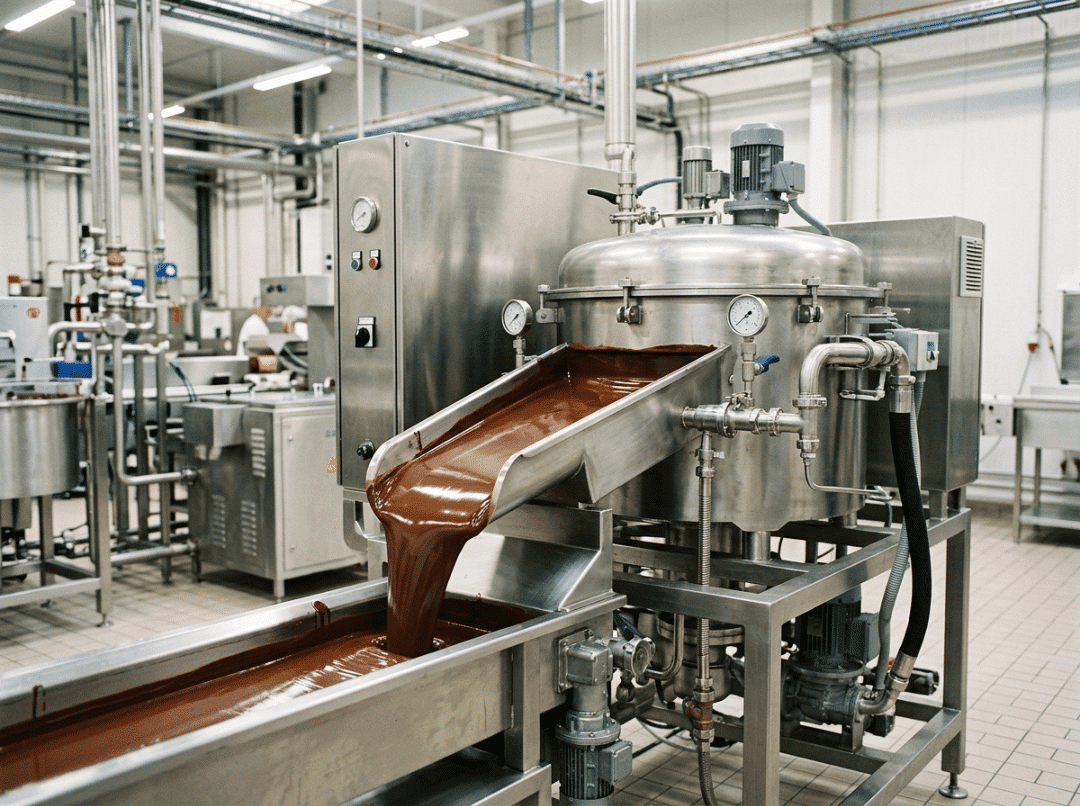
Cocoa butter crystallizes into six forms, labeled I through VI. Only Form V, the beta crystal, delivers what a chip needs: gloss, a firm snap, and resistance to melting at room temperature. The rest are either too soft, too unstable, or too slow to set. Tempering fills the chocolate with Form V crystals and nothing else.
The process manages temperature in stages. The chocolate is first warmed until every existing crystal melts, wiping the slate clean. Then it’s cooled so crystals form, including the Form V seeds you want alongside unstable lower forms you don’t. Finally it’s gently reheated to a holding temperature that melts off the unstable crystals and leaves the Form V seeds intact. What comes out is chocolate seeded with a tight, uniform crystal network, ready to set hard and glossy.
Miss in either direction and the consequences surface fast.
Under-tempered chocolate carries too few stable seeds. It sets slowly, stays soft, and blooms into a dull gray film as unstable crystals migrate to the surface over the following days. The chips look old before they leave the warehouse.
Over-tempered chocolate holds too many seed crystals. It thickens, turns sluggish and grainy, and fights the depositor. Drops come out misshapen, the surface goes matte, and viscosity climbs high enough to clog nozzles.
Tempering also feeds straight into the next stage. The viscosity leaving the temper unit decides how cleanly the chocolate deposits: too thick and the drops won’t form a clean peak, too thin and they slump flat. At production volume, this can’t ride on operator judgment, which is why an automatic tempering machine that holds each temperature zone within a fraction of a degree sits at the heart of any serious chocolate chip line.
Step 6 — Depositing
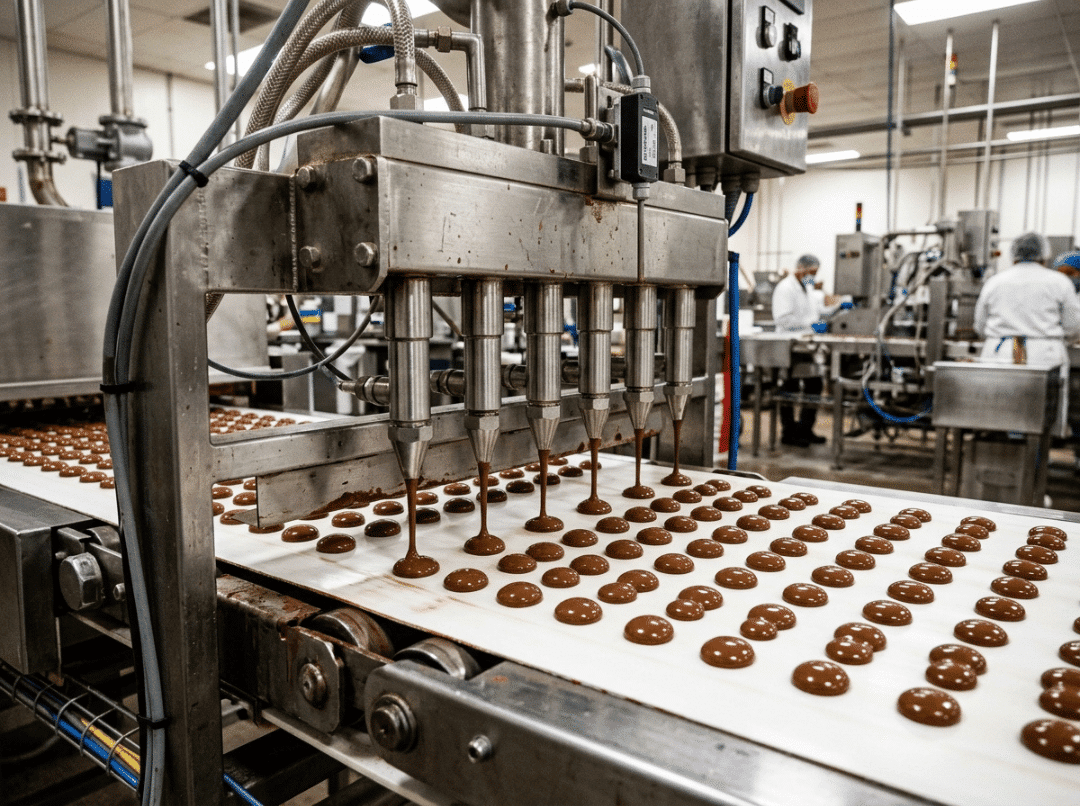
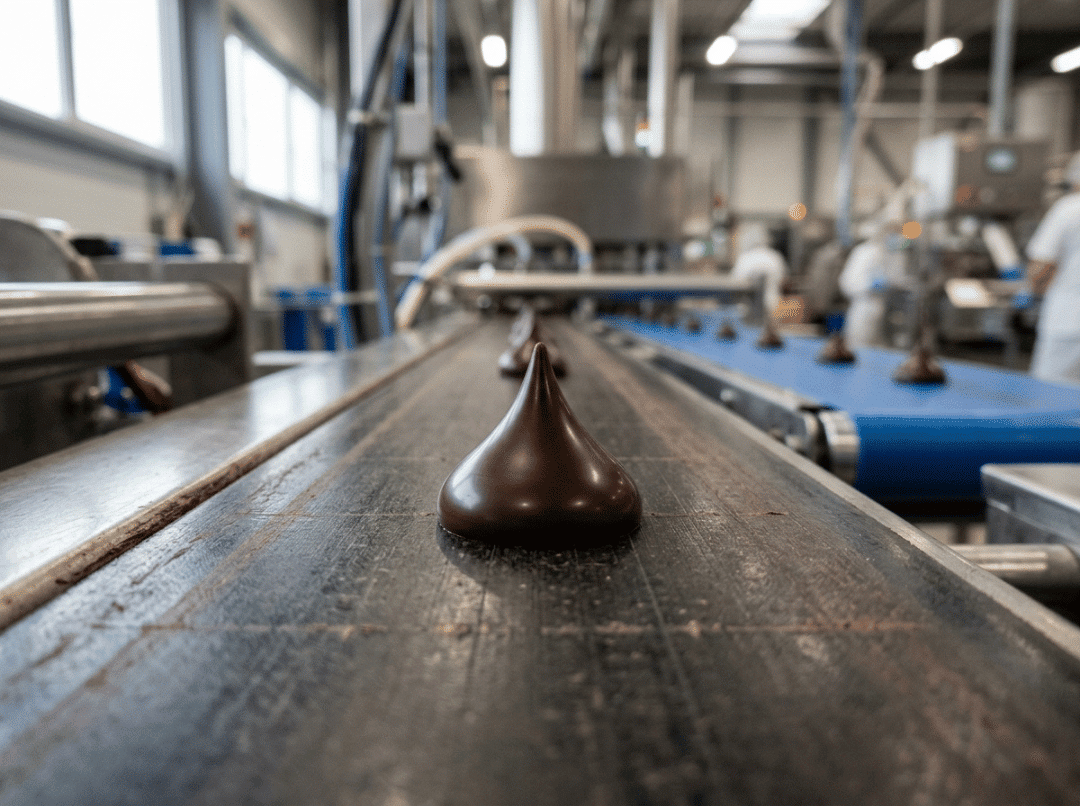
Tempered chocolate moves to forming. The depositing machine pumps it into a heated hopper, where a servo or pneumatic head meters an exact volume and drops it onto a moving, food-grade belt. Thousands of identical droplets land in rows every minute. Dosing accuracy here is what makes every chip the same weight and size, so servo-driven heads with individual nozzle calibration earn their place on high-speed lines.
Step 7 — Cooling
The belt carries the drops through a multi-zone cooling tunnel, where staged cold air solidifies each chip and locks in shape and shine. Staging is the whole point. Cool too fast and you shock the surface dull; cool too slow and crystals reorganize and invite bloom. The tunnel ramps temperature down across zones rather than blasting cold at the entrance.
Step 8 — Demolding, Inspection, and Packaging
At the tunnel’s end, the solid chips release from the belt. They pass metal detection and sizing checks, then move to automated weighing and packaging. Anything off-spec on weight, shape, or appearance gets pulled before sealing.
Why Do Chocolate Chips Have a Pointed Top?
The peak isn’t decoration. It’s physics at the nozzle.
Liquid chocolate is deposited as a soft blob on the belt. As the nozzle lifts away, the chocolate stretches into a thread and breaks, and surface tension pulls the broken end upward into a point. The cooling tunnel freezes that shape before gravity can flatten it. Every chip is a snapshot of the moment the thread snapped.
Three variables control how sharp the tip comes out:
- Nozzle lift speed: a faster lift stretches the thread harder and leaves a more pronounced point.
- Viscosity: thicker chocolate holds a taller, sharper peak; thin chocolate slumps into a rounded dome.
- Chocolate temperature: cooler chocolate sets faster and preserves the tip, while warmer chocolate spreads before it can hold the shape.
Tune these together, and you can dial the tip in or out to spec. It’s a small detail that tells you a lot about how tightly a line runs.
Equipment Used to Make Chocolate Chips
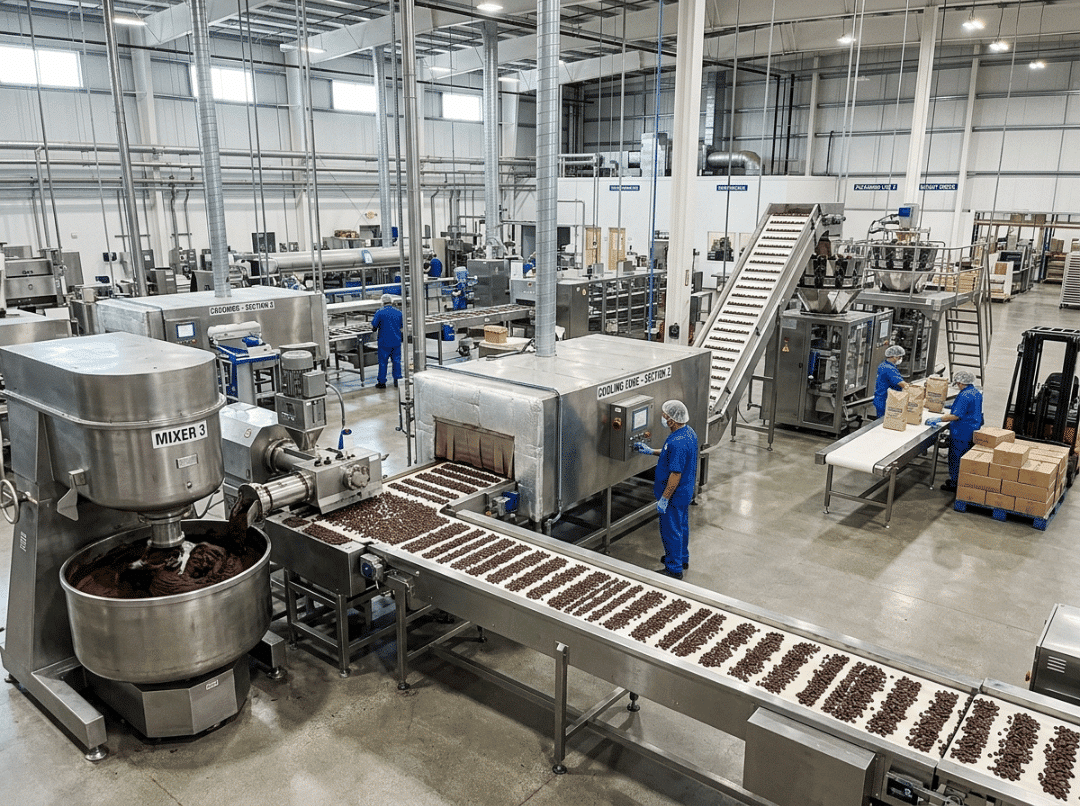
A chocolate chip line is a sequence of specialized machines, each handling one job and handing off to the next. The line is only as strong as its weakest stage. A perfectly tempered batch still fails if the depositor doses unevenly, so precision and capacity have to match across the chain rather than concentrate in one machine.
|
Equipment |
Job on the line |
|---|---|
|
Mixer |
Blends raw ingredients into a uniform paste |
|
Roller refiner |
Cuts particle size to 20–30 microns for smooth texture |
|
Conche |
Develops flavor and controls viscosity |
|
Tempering machine |
Sets cocoa butter into Form V crystals for gloss and snap |
|
Depositing line |
Meters and forms uniform droplets at high speed |
|
Cooling tunnel |
Solidifies chips with staged, controlled airflow |
|
Packaging system |
Weighs, inspects, and seals the finished product |
Common Chocolate Chip Quality Problems and How to Fix Them
Most defects on a chip line trace back to temperature, recipe, or timing. Here are the ones that show up most, each with the cause behind it and the fix that clears it.
- Fat bloom (dull, gray, whitish surface). Cocoa butter has migrated to the surface and recrystallized into a film, usually from under-tempering or a temperature swing during cooling or storage. Fix the temper so you’re seeding Form V properly, then hold storage steady around 18–20°C. Bloom is cosmetic, not a safety issue, but customers read it as spoiled.
- Chips sticking together. The recipe runs too soft, or the cooling tunnel runs too warm, so chips leave the belt tacky and clump in the bag. Firm up the fat balance and drop the cooling zone temperatures until each chip sets fully before demolding.
- Size and weight variation. The depositing head is dosing unevenly. Move to servo-controlled depositing and recalibrate the nozzles on a schedule. Worn or partly blocked nozzles are a common hidden culprit once a line has run for a while.
- Poor gloss, matte finish. Off-target tempering or uneven cooling has disrupted crystal formation. Tighten crystal control at the temper unit first, then stabilize airflow through the tunnel. A matte chip almost always points back to the temper stage.
- Irregular shape, no clean tip. Wrong viscosity or mistimed deposits are distorting the drop. Correct the chocolate’s flow, then fine-tune nozzle timing and lift speed together, since the two interact.
The pattern behind nearly all of these is lost control over temperature or flow. A line with steady temperature output and calibrated depositing rarely produces any of them.
Industrial vs Homemade Chocolate Chips
You can pipe tempered chocolate onto parchment at home and chill it into chips. That works for a handful. Matching a factory means matching everything below at once, which is where a kitchen falls short.
|
Factor |
Industrial |
Homemade |
|---|---|---|
|
Output |
Millions per run |
Small batches |
|
Consistency |
Uniform size and weight |
Variable |
|
Tempering |
Automatic, precise |
Manual, hard to hold |
|
Shelf life |
Long, stable |
Shorter |
|
Heat resistance |
High, recipe-tuned |
Lower |
Types of Chocolate Chips
Each type carries its own recipe and often its own machine settings.
- Dark chips: higher cocoa, little or no milk, strong bake stability.
- Milk chips: added milk powder for a sweeter, creamier profile; the milk solids change flow, so depositing settings shift.
- White chips: cocoa butter, sugar, and milk with no cocoa solids; heat-sensitive and fussy to temper.
- Sugar-free chips: sweetened with maltitol, erythritol, or stevia, which crystallize differently and need adjusted settings.
- Compound chips: vegetable fat replaces cocoa butter, so no tempering is needed; cheaper and stable, with less flavor and snap.
A flexible line pays off here, since tempering curves and cooling speeds shift from one type to the next.
Frequently Asked Questions
Are chocolate chips made from real chocolate?
Most standard chips are real chocolate, made from cocoa mass, cocoa butter, sugar, and often milk. Compound chips are the exception. They replace cocoa butter with vegetable fat, which technically makes them a chocolate-flavored coating rather than true chocolate.
Why do chocolate chips hold their shape in cookies?
They contain less cocoa butter than a bar, sometimes with added stabilizers, which raises the melting point. Combined with proper tempering, the chip softens in the oven without collapsing.
What is the difference between chocolate chips and baking chocolate?
Chips are pre-formed, shape-stable pieces meant to survive baking. Baking chocolate comes as bars or blocks meant to be melted, and it flows more freely thanks to its higher cocoa butter content.
Can chocolate chips be made without tempering?
Yes, if you use compound chocolate made with vegetable fat, since that fat doesn’t rely on crystal stabilization. True chocolate chips need tempering to develop gloss, snap, and heat resistance.
What machine makes chocolate chips?
A depositing machine forms the drops, working inside a full line alongside a mixer, roller refiner, conche, tempering machine, and cooling tunnel.
Why do some chocolate chips turn white?
That white film is fat bloom, caused by cocoa butter migrating to the surface after poor tempering or a temperature swing in storage. The chips stay safe to eat, but appearance and texture suffer.
Planning or Upgrading a Chocolate Chip Line?
If your chips bloom, clump, or come off the belt in uneven sizes, the fix usually sits in the temper and depositing stages. And if you’re scaling up from small-batch production, the challenge shifts: you need output that stays consistent from the first chip to the millionth, which means matching the line stage by stage rather than trusting one strong machine to carry it.
That’s where we come in. Tell us which product types you’re running, the throughput you’re targeting, and where quality is slipping now. We’ll come back with a line configuration and pricing built around your capacity, from tempering and depositing through cooling and packaging.