
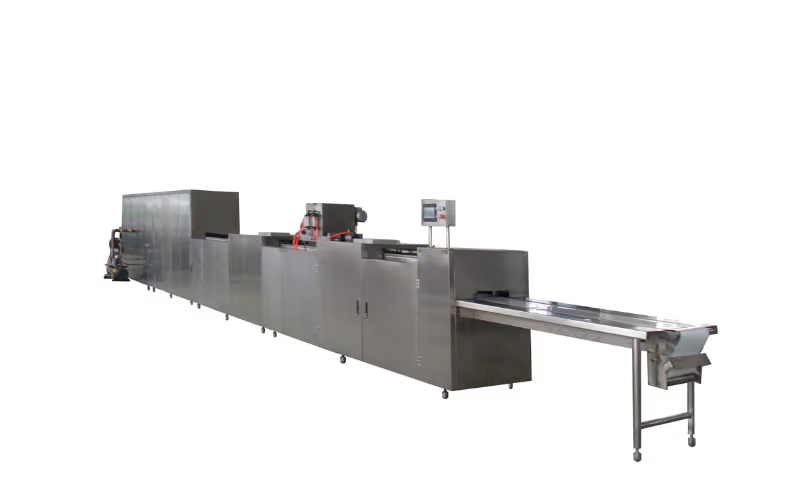
Choosing the right chocolate molding line comes down to five variables: your target output (kg/h), product type (solid, one-shot filled, or shell-molded), available floor space, automation level, and long-term scalability. Mismatching any one of these to the wrong line architecture wastes capital and limits what you can produce. This guide walks through each decision point.
The wrong moulding line doesn’t just slow production. It quietly erodes margins through rework, product failures, and throughput bottlenecks that only become obvious after installation. A misspecified line might run at half its rated capacity because the depositor architecture doesn’t suit the filling viscosity. An oversized line for current volume ties up capital and sits largely idle between runs.
Getting this decision right requires more than a comparison of specification sheets. It requires understanding your product portfolio, your production trajectory, and exactly what each line architecture can and cannot do.
This guide covers everything a confectionery manufacturer or production engineer needs to evaluate a chocolate moulding line purchase — from defining requirements before approaching suppliers, to comparing technical specifications, to the questions that should appear in every RFQ.
What Should You Define Before Comparing Suppliers?
Before requesting a single quote, define these five parameters internally. Suppliers who receive a vague brief will default to recommending whatever they sell the most of. Suppliers who receive a precise brief will give you comparable, honest proposals.
1. Target output in kg/h. This is the single most important number. It determines whether you need a workshop line (50–100 kg/h), a semi-automatic industrial line (200–500 kg/h), or a fully automatic high-capacity system (300–500 kg/h continuous). Note that output ranges overlap — automation level and product mix separate the mid-range options, not throughput alone.
2. Product types you plan to produce. Solid bars, one-shot center-filled products, shell-molded pralines, and inclusion-filled items each have different equipment requirements. Some line architectures physically cannot produce certain product types, and no amount of configuration changes can change that.
3. Mould dimensions and inventory. Mould size affects depositor design, conveyor geometry, and cooling tunnel sizing. Mould inventory directly determines whether continuous operation is sustainable. Industrial fully automatic lines typically require a minimum mould count of 600 pieces to avoid gaps on the main conveyor at production speed.
4. Available floor space. A horizontal cooling tunnel line and an elevator (vertical) cooling tunnel line can deliver equivalent residence times, but with dramatically different footprint requirements. Know your constraints before specifying.
5. Three-year production forecast. A line sized precisely for today’s order book may be under-specified in 18 months. Modular line architectures allow staged expansion; fixed architectures do not. This distinction should be part of the supplier conversation early on.
What Are the Main Types of Chocolate Moulding Lines?
Manual Lines
Manual lines suit artisanal producers, chocolatiers producing small batches, and R&D departments that need recipe flexibility without high throughput. Machines in this category typically carry 15–80 kg chocolate tanks, use wheel-based tempering, and require an operator to fill, vibrate, and move molds manually. They are low-cost to acquire, quick to clean, and easy to switch between recipes — important for producers who work with many SKUs in small volumes.
Semi-Automatic Lines
Semi-automatic molding lines automate the mechanical stages — mould infeed, depositing, vibration, and cooling — while keeping certain steps, such as filling and demoulding, operator-assisted. Lines in this category, such as the ML400 and ML600 series from manufacturers like Betec, bridge the gap between artisanal equipment and full industrial automation. They are well-suited to producers scaling from workshop to commercial volumes, and to operations where product complexity or variety justifies keeping skilled operators in the loop.
Fully Automatic Lines
Fully automatic chocolate moulding lines run with minimal operator input across the entire circuit: mould inspection, depositing, cooling, demoulding, and rejection are all handled by the line. The AkayGAM SML500, for example, produces 300–500 kg/h continuously on 205 × 600 mm polycarbonate moulds, with camera-and-sensor mould inspection, IR temperature gating, an elevator cooling tunnel, and automatic demoulding — all adjustable via HMI with no mechanical changeover required. These lines are sized for contract manufacturers, private-label producers, and integrated confectionery plants operating long shifts on a focused set of recipes.
Modular Lines
Modular moulding lines are built around wheeled, interchangeable modules — depositors, vibrators, cooling tunnels — that a single operator can reconfigure. This architecture enables manufacturers to expand the line incrementally as production grows, rather than committing to a full-line capital outlay upfront. A modular one-shot line, for instance, can begin with a standard smooth-fill depositor and add a nut depositor module later without rebuilding the circuit. For producers with diverse or evolving product portfolios, the flexibility typically justifies the slightly higher cost per kg/h compared to a fixed-architecture line.
One-Shot Depositing Line vs. Shell Moulding: What’s the Difference?
This is the most consequential technical decision in moulding line selection, and it’s frequently misunderstood.
One-shot depositing lines extrude the chocolate shell and filling simultaneously through concentric nozzles, forming a single unit in the mould. The process is fast, mechanically straightforward, and highly accurate for smooth or semi-liquid fat-based fillings such as hazelnut cream, praline, and ganache. Center-fill percentages of up to 90% by volume are achievable. The limitations are strict: a one-shot depositing line cannot produce a hollow chocolate shell intended for separate later filling, and it cannot handle fillings with crunchy inclusions — particulate material disrupts the cut-off mechanism and degrades deposit-weight accuracy in the first production batch.
Shell moulding lines use a multi-step process: the chocolate shell is formed and cooled first, the filling is deposited into the shell separately, and the base is sealed with a final chocolate layer. This method allows ultra-thin shells, greater control over shell-to-fill ratio, and compatibility with fillings that are alcohol-based, liquid-centered, or deposited in layers. It is slower and more mechanically complex, but for certain product types — premium truffles, liqueur-filled chocolates, layered pralines — it is the only viable architecture.
Decision rule: Choose a one-shot depositing line when you produce smooth-filled or solid moulded chocolates at scale and speed is a priority. Choose a shell moulding line when your product requires a separately deposited filling, a thin shell, or ingredients incompatible with simultaneous co-extrusion.
What Technical Specifications Should You Compare?
When comparing chocolate bar production lines and moulding systems, these are the specifications that actually affect purchasing decisions:
- Output (kg/h). Match this to your three-year forecast, not today’s volume. Below ~200 kg/h of continuous production, a workshop or semi-automatic line avoids paying for automation overhead that would otherwise sit idle. Above ~200 kg/h of continuous production, a fully automatic line is the only option that won’t hit a capacity ceiling within the first shift.
- Mould dimensions. Mould size is fixed by the line architecture. Changing mould sizes typically requires a new depositor head at minimum, and in some architectures, a new line. Confirm compatibility with your existing mould inventory before specifying.
- Viscosity compatibility. Not all depositors handle all chocolate viscosities. Gear pumps handle standard and high-fluidity chocolates well; lobe pumps are required for chocolates containing inclusions up to 5 mm. Specify your chocolate’s viscosity range and confirm the depositor’s tolerance.
- Power requirements. Workshop lines typically run at 10–12 kW on 380V three-phase. Industrial fully automatic lines operate at 25 kW or higher. Confirm your facility’s electrical capacity before specifying.
- Footprint. An elevator cooling tunnel provides an equivalent cooling residence time to that of a horizontal tunnel in a fraction of the floor length. For installations where floor space is constrained, the tunnel architecture can be the deciding factor between two otherwise comparable lines.
- Mould inventory minimum. For continuous-operation lines, mould count is not optional — it is a hard operational requirement. Below the minimum, gaps appear on the main conveyor that the line cannot fill at production speed.
What Are the Key Components of a Professional Moulding System?
A chocolate moulding line is a circuit, not a machine. Each component in the circuit affects product quality if it underperforms.
- Mould preheating station: Ensures tempered chocolate flows freely into mould cavities on contact. Without preheating, premature crystallization at the mould surface causes dull spots and incomplete cavity fill.
- Depositor: The precision center of the line. One-shot depositors use servo-driven vertical motion to maintain weight accuracy throughout the shift. Dosing pump type (gear or lobe) must match the filling material.
- Vibration table: Applied immediately after depositing to remove trapped air and ensure the chocolate completely fills angular or detailed cavities. Inadequate vibration is a primary cause of holes in the finished product.
- Cooling tunnel: Sets the chocolate through controlled temperature reduction. Cooling too rapidly causes dull spots and sugar bloom; cooling too slowly causes grey discoloration and slow cycle times.
- Demoulding unit: Vacuum demoulding works for most solid and filled products; twist-release demoulding is required when vacuum cannot generate sufficient grip on the product geometry. The choice affects both yield and operator ergonomics.
- Mould return conveyor: Closes the circuit. In modular lines, the return conveyor typically runs beneath the production modules — this halves the line’s footprint compared to a traditional oval-circuit layout.
What Sanitary Design Standards Should a Moulding Line Meet?
Food-grade construction is a baseline, not a differentiator. What separates adequate from genuinely sanitary design in a confectionery environment:
- AISI 304 stainless steel is the primary structural material, with polished surfaces and a minimum internal corner radius of 3 mm to prevent chocolate accumulation and bacterial adhesion.
- Double-walled jacketed pipework for chocolate transfer between tanks and depositors, maintaining stable chocolate temperature across long production runs.
- Polycarbonate moulds for food-contact surfaces. Note that for lines with camera-based mould inspection, mould colour matters: transparent polycarbonate defeats the camera inspection system by transmitting light through cavities. Green or blue polycarbonate is required.
- IP-rated electrical enclosures rated for wash-down conditions — not just splash resistance. Inspect the actual IP rating, not the supplier’s general claim of “wash-down compatible.”
- Tool-free or quick-release components at the depositor and pump for cleaning during changeovers, particularly when processing inclusions.
Any supplier who cannot specify the IP rating of enclosures or the steel grade of food-contact surfaces should be asked directly. If they do not know, that is itself a purchasing signal.
Questions to Ask Suppliers Before Sending an RFQ
These questions separate suppliers with genuine confectionery expertise from those applying general food processing knowledge to a specialized category:
- What is your specific experience with confectionery moulding lines, and can you provide references from producers with a similar product mix to ours?
- What depositor architectures do you offer, and under what filling viscosity and inclusion conditions do each fail?
- What is the minimum mould inventory required for continuous operation, and what happens to line behavior when that minimum is approached?
- Do you offer proof-of-concept testing with our actual chocolate recipe and filling before we commit to a full-line order?
- What components — pumps, motors, conveyors, controls — come from third-party suppliers, and what are the lead times on critical spare parts?
- What does commissioning include, and who delivers it — your engineers or a local contractor?
- What service level agreement do you offer for reactive support after commissioning, and where are your service engineers based?
- What is the current lead time from order to delivery, and what are the main risk factors that could extend it?
- Can you model an ROI projection based on our current production cost per kg and target output?
- What does the upgrade path look like if our volume grows by 50% in 24 months — is it modular expansion or a new line?
Common Challenges and How to Address Them
Even a well-specified line produces problems if the process parameters are wrong. These are the most common issues on moulding lines, and their root causes:
- Fat bloom and dull spots are almost always a tempering or cooling problem. Fat bloom develops when temperature fluctuations during cooling allow unstable cocoa butter crystal forms to migrate. Sugar bloom results from condensation on the chocolate surface — typically caused by moving product from a cold cooling tunnel into a warm ambient environment. Both are preventable with stable tunnel temperature profiles and controlled ambient transfer conditions.
- Inconsistent deposit weights trace to depositor condition, chocolate viscosity drift across a shift, or mould temperature variation. On lines without IR mold-temperature gating, a mould arriving at the depositor outside the temperature window will produce an off-weight deposit every time. Monitoring chocolate temperature continuously at the depositor inlet — not just at the tempering machine outlet — is the practical fix on lines without automated gating.
- Demoulding failures — products sticking, shells breaking in the mould, pieces fragmenting — typically indicate undercrystallization (insufficient tempering), shells that are too thin, or cooling time that was cut short. The fix is process, not equipment: verify tempering curve, increase cooling residence time, and adjust chocolate fluidity to match mould geometry.
- Waste from overcrystallization is underestimated in production cost calculations. Overcrystallized chocolate thickens too quickly, fills angular mould details poorly, and produces thick, uneven shells. Continuous tempering machines with closed-loop crystal density monitoring dramatically reduce this problem compared to batch-tempered supply systems.
Choosing a Chocolate Moulding Line by Production Stage and Product Mix
|
Production Stage |
Output Target |
Recommended Architecture |
|---|---|---|
|
Artisanal / startup |
Up to 80 kg/h |
Manual or compact semi-automatic with tabletop temperer |
|
Growing mid-size |
80–200 kg/h |
Semi-automatic moulding line (ML400/ML600 class) |
|
Industrial scale |
200–500 kg/h |
Fully automatic with continuous tempering and elevator cooling |
|
Diverse SKU portfolio |
Any volume |
Modular line architecture with interchangeable depositor heads |
|
Solid bars and tablets only |
Any volume |
One-shot depositing line or CL push-through series |
|
Filled pralines, shell products |
Any volume |
Shell moulding line (ML series) |
|
Inclusions up to 5 mm |
Any volume |
Lobe pump depositor or shell moulding |
|
Inclusions above 5 mm |
Any volume |
Shell moulding only |
Frequently Asked Questions About Chocolate Moulding Lines
What is the difference between a one-shot depositing line and a shell moulding line?
A one-shot depositing line deposits the chocolate shell and filling simultaneously through concentric nozzles in a single operation, suited to smooth-filled and solid moulded products. A shell moulding line forms the chocolate shell first, then fills it separately in a subsequent step — required for thin-shell products, alcohol-based fillings, or layered fillings that cannot be co-deposited.
How much does a chocolate moulding line cost?
Entry-level semi-automatic moulding lines start below $100,000 USD for basic configurations. Fully automatic industrial systems — including depositor, cooling tunnel, inspection systems, and demoulding — typically range from $300,000 to over $1,000,000 depending on capacity, automation level, and included options. Lead times on configured industrial lines are typically 3–4 months from order.
What is the minimum output at which a fully automatic moulding line makes economic sense?
Fully automatic moulding lines are generally justified from approximately 200 kg/h continuous upward. Below this threshold, the automation overhead — camera inspection systems, IR temperature gating, large mould inventories — is disproportionate to the order volume it serves. Semi-automatic lines are more cost-efficient for most operations below 200 kg/h.
Can a chocolate moulding line handle inclusions such as nuts or rice crisps?
Inclusions up to approximately 5 mm can be handled by depositors equipped with lobe pumps rather than gear pumps. Larger inclusions, or products where inclusion integrity is important (whole nuts, large cookie pieces), require a shell moulding architecture where the filling is deposited separately after the shell is formed.
What mould material is required for a professional chocolate moulding line?
Polycarbonate moulds are the standard for professional moulding lines. They produce a superior surface finish compared to other materials and are durable under repeated thermal cycling. For lines with camera-based mould inspection, mould colour must be non-transparent — typically green or blue — to avoid defeating the optical inspection system.
How do I future-proof my moulding line investment?
Choose a modular architecture if your product range or volume is likely to evolve within three years. Modular lines allow depositor heads, cooling sections, and auxiliary stations to be added without rebuilding the circuit. For fixed-architecture lines, confirm the upgrade path and costs with the supplier before signing — not after installation.
The Right Line Is the One That Matches Your Reality
A chocolate bar production line rated at 500 kg/h is not a better investment than one rated at 100 kg/h if your operation runs at 80 kg/h. A one-shot depositing line is not a better choice than a shell moulding line if your product requires a hollow shell — regardless of how much faster it runs. The best moulding line is the one aligned to your actual product requirements, your realistic production forecast, and your facility’s constraints.
Use the frameworks in this guide to build a precise internal brief before approaching any supplier. Define your output target, product types, mould requirements, floor space, and three-year growth plan. Ask the ten supplier questions above — in writing, before the RFQ — and compare responses. Suppliers who answer specifically are telling you something. Suppliers who answer vaguely are telling you something, too.
If you’re currently evaluating moulding line options and want a technical review of your requirements before approaching the market, contact our team for a no-obligation consultation.