
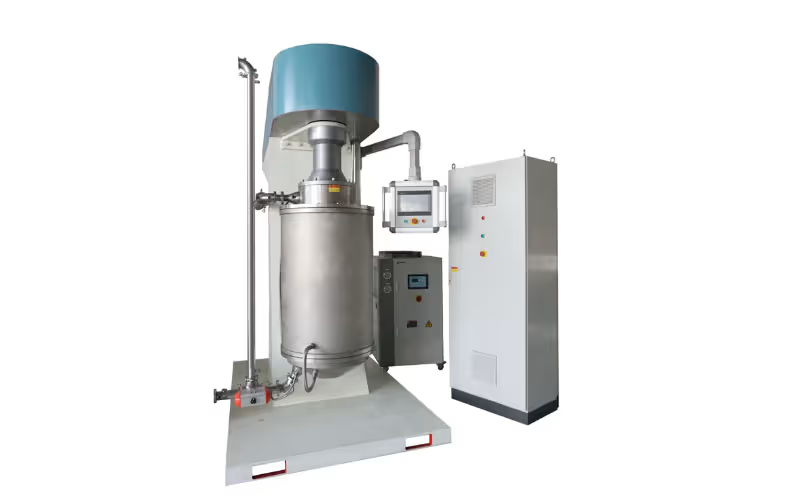
A chocolate ball mill is an industrial refining machine that uses rotating steel or ceramic grinding media to reduce cocoa and sugar particles to 20–30 microns, producing a smooth chocolate paste. Available in batch or continuous configurations, ball mills are widely used across artisan and large-scale production and differ from conching machines in both function and outcome.
Particle size is not a finishing detail in chocolate manufacturing. It is the foundation on which texture, mouthfeel, and consumer perception are built. Reduce particles to below 30 microns, and the human palate cannot detect individual solids — the chocolate registers as smooth, creamy, and uniform. Stay above that threshold, and the product feels gritty, regardless of how good the beans are or how carefully the recipe was developed.
The chocolate ball mill is the machine most widely used to achieve that threshold. It appears in craft chocolate studios running 15 kg batches and in automated industrial lines processing hundreds of kilograms per hour. It is also one of the more misunderstood pieces of equipment in the confectionery sector — frequently confused with conching machines, compared imprecisely with roll refiners, and maintained inconsistently across facilities.
This guide is designed to address that gap. Whether you are evaluating your first ball mill purchase, troubleshooting a machine that is not meeting your particle-size targets, or looking to optimize an existing production line, the sections below cover the equipment from the inside out — components, processes, configurations, comparisons, maintenance protocols, and selection criteria.
What Exactly Is a Chocolate Ball Mill — And What It Is Not
A chocolate ball mill is an industrial machine used to refine chocolate mass by mechanically reducing the particle size of cocoa solids, sugar, and other dry ingredients suspended in fat. The core operating principle is straightforward: hundreds of steel or ceramic balls move continuously inside a chamber, generating impact, shear, and compression forces that break down coarse particles into a fine, homogeneous paste.
The machine is not a mixer. It does not aerate the chocolate or drive off volatile acids. It does not develop flavor through the kind of thermal and mechanical treatment that a conching machine applies over many hours. Its job is physical — to reduce particle size, coat solid particles with fat, and produce a fluid, refined chocolate mass that can move to the next stage of production.
That distinction matters practically. Buyers who expect ball milling to replicate the flavor development of a long conch will be disappointed. Those who understand what the machine actually does — and pair it correctly with other processing steps — will consistently hit their quality targets.
Batch vs. Continuous Ball Mills: How Do You Choose the Right Configuration?
Chocolate ball mills come in two primary configurations, and the choice between them shapes every aspect of how a production line is organized.
Batch ball mills load a fixed quantity of chocolate mass into the grinding chamber, process it for a set duration, and then discharge the finished product before the next batch begins. This approach offers strong recipe control and flexibility — switching between products, adjusting processing parameters for different formulations, and managing small-to-medium production volumes are all straightforward. Batch mills are the standard choice for craft producers, R&D operations, and mid-sized manufacturers producing a wide variety of SKUs.
Continuous ball mills pump raw material through the grinding chamber without interruption. The chocolate mass enters at one end, moves through the ball bed, and exits as refined paste in a constant flow. This configuration is built for high-volume, single-product, or limited-SKU operations where throughput is the priority. Continuous mills integrate cleanly into fully automated production lines and can achieve significantly higher hourly output than batch equivalents of comparable size.
The right configuration depends on production volume, product variety, automation level, and downstream processing requirements. A factory producing a single chocolate coating in large quantities will favor continuous operation. A manufacturer running ten different recipes across the same shift will typically find batch processing more practical.
What Are the Key Components of a Chocolate Ball Mill?
Understanding what is inside the machine makes maintenance, troubleshooting, and operator training considerably more effective.
Grinding Chamber
The enclosed cylinder — oriented vertically or horizontally, depending on the machine design — contains the agitator shaft and the grinding media. Built to withstand intense friction and pressure, the chamber walls are typically lined with wear-resistant materials. Raw chocolate mass enters here and does not leave until it has passed through the full grinding cycle.
Grinding Media
The steel or ceramic balls inside the chamber are the actual grinding mechanism. Typically ranging from 5 to 15 mm in diameter, they move in complex cascading and cataracting patterns as the agitator shaft rotates. Each collision transfers impact energy to the chocolate mass, breaking down sugar crystals and cocoa solid agglomerates. The size, quantity, and condition of the grinding media directly determine the particle size the machine can achieve.
Cooling System
Friction generates heat. Left unmanaged, that heat damages cocoa flavor compounds and causes fat separation. A water-cooled jacket surrounding the grinding chamber removes excess thermal energy and maintains the chocolate mass within the optimal processing temperature range. Temperature control is not a secondary system — it is a primary determinant of quality.
Central Agitator Shaft
The shaft drives the entire grinding operation. Powered by the main motor through a reduction gearbox, it rotates at controlled speeds to produce the right balance of cascading and cataracting ball movement. Shaft speed is a key process variable: too slow and grinding is inefficient; too fast and the risk of overheating increases.
Control Panel
Modern chocolate ball mills integrate digital controls that allow operators to set and monitor agitator speed, jacket temperature, grinding duration, and in some configurations, discharge parameters. Precise control of these variables is what converts a mechanically sound machine into a consistent production tool.
How Does the Chocolate Refining Process Work, Step by Step?
Step 1: Material Feeding
Pre-mixed chocolate mass — typically a combination of cocoa liquor, granulated sugar, milk powder (for milk chocolate), and added fats — is introduced into the grinding chamber via pump or hopper. The mix must have sufficient fat content to maintain fluidity during processing; below approximately 30% fat, the mass loses the viscosity needed for efficient circulation through the ball bed.
Step 2: Grinding Stages — Impact, Shear, and Compression
Once the agitator engages, the steel balls are set into motion. In the cascading phase, balls lift and fall under gravity, delivering impact forces to the chocolate mass below. At higher agitator speeds, cataracting motion ejects balls on larger trajectories, generating more intense collisions. Between these two mechanisms, the solid particles in the chocolate mass are subjected to repeated impact crushing and frictional shear — a combination that reduces particle size from hundreds of microns down to the 20–30-micron target range.
Step 3: Temperature Management
The cooling jacket operates continuously throughout the grinding cycle. Operators monitor jacket inlet and outlet temperatures, as well as the product temperature inside the chamber. If product temperature rises beyond the acceptable range, it signals either a cooling system issue or excessive agitator speed — both of which require immediate adjustment.
Step 4: Discharge and Post-Processing
When the target particle size is reached — as confirmed by laboratory particle-size analysis, rheological testing, or trained sensory evaluation — the machine discharges the refined mass through a dedicated outlet. A screen separates the chocolate slurry from the grinding balls before the product moves downstream. From this point, the refined mass can go directly to a conching machine for flavor development, a storage tank, a tempering step, or a continuous production line, depending on the operation’s setup.
What Particle Size Can a Chocolate Ball Mill Achieve in Practice?
The practical target range for chocolate ball milling is 20-30 microns. High-quality chocolate intended for molding or coating typically requires the refined mass to fall below 25 microns for a consistently smooth mouthfeel. Specialty products — fine tablets, premium ganache fillings, or applications where texture is a key differentiator — may target 18 microns or finer.
Achieving the lower end of this range consistently requires well-maintained grinding media, stable temperature control, appropriate fat content in the feed material, and sufficient processing time. A machine with worn grinding balls, an underperforming cooling jacket, or an overloaded chamber will struggle to reach target fineness within normal cycle times, even if the machine itself is otherwise functional.
Particle size distribution matters as much as the average particle size. Ball milling tends to produce a broader distribution than five-roll refining — meaning a greater spread between the finest and coarsest particles in the batch. Whether that spread is acceptable depends on the product specification and the downstream application.
Ball Mill vs. Five-Roll Refiner: Which Is Better for Your Operation?
This comparison comes up regularly in procurement discussions, and the honest answer is that neither machine is universally superior. They perform differently and suit different operational profiles.
Chocolate ball mills offer a smaller physical footprint, lower operational complexity, strong energy efficiency relative to output, and direct integration into automated continuous production lines. They handle a wide range of formulations, including fillings, compounds, and coatings, without requiring recipe-specific roller-gap adjustments that five-roll operation demands. For high-throughput, continuous production of a consistent product, ball mills are often the more practical choice.
Five-roll refiners have historically been associated with the finest particle-size consistency and the tightest distribution control. In facilities where viscosity management is critical for fine pastry or confectionery applications and extra precision in roller gap control is needed, five-roll refining offers advantages that ball milling does not fully replicate. European industrial manufacturers have long favored this approach for premium dark and milk chocolates.
The key deciding factor is product specification combined with production scale. Ball milling is better suited to operations prioritizing throughput, automation, and operational simplicity. Five-roll refining is better suited to operations where precision in the viscosity profile and particle distribution is the primary quality criterion.
Some manufacturers combine both: a ball mill handles initial particle size reduction, and a separate processing step — either a roll refiner or a conching machine — handles final texture and flavor development.
Is Ball Milling the Same as Conching?
No. The two machines perform fundamentally different functions, and treating them as interchangeable is one of the more common misconceptions in chocolate production.
A chocolate ball mill reduces particle size through mechanical grinding. Conching develops flavor through a combination of aeration, thermal treatment, and prolonged mechanical shearing, which drives off unwanted volatile acids, promotes the formation of complex Maillard reaction products, and fully coats solid particles with cocoa butter. The two processes can happen in sequence, but cannot substitute for one another.
Ball milling can run for hours, producing a fine, smooth chocolate mass. That same mass, if it has not been conched, may still carry harsh or astringent flavor notes that would be eliminated during conching. Conversely, conching a mass that has not been adequately refined will produce good flavor development but poor texture.
The most effective production sequences use ball milling to reach the target particle size, then apply conching — either in a dedicated machine or in a separate processing phase — to complete the flavor profile. Some manufacturers use the Netzsch approach of decoupling the two: run the ball mill until the particle size is correct, then switch to beating and aeration for flavor development without further particle-size reduction.
Chocolate Ball Mill Maintenance: What Does a Structured Program Look Like?
Maintenance for a chocolate ball mill differs from that of standard industrial equipment because the product itself poses the contamination risk. Chocolate contains fat, sugar, and milk solids that oxidize and develop off-flavors when left on machine surfaces between production runs. A structured program addresses both mechanical reliability and food safety simultaneously.
Grinding Media Wear
Steel balls wear down over time. They become smaller, less spherical, and develop surface irregularities — and as they do, the grinding dynamics inside the chamber shift. Particle size distribution drifts toward coarser sizes, batch times lengthen, and power consumption rises without any obvious external signal. Monitor grinding media by periodically sampling balls to check diameter against the original specification, inspecting for cracks, chips, or flat spots, and tracking the total volume of media in the chamber. Replace worn balls gradually rather than all at once to avoid sudden performance shifts.
Mechanical Seal Inspection
The shaft seal sits at the entry point of the rotating agitator into the grinding chamber. It is exposed to both mechanical rotation stress and the chemical environment of liquid chocolate. When seals begin to degrade, chocolate migrates along the shaft toward the bearing and gearbox — a contamination pathway that also accelerates bearing wear. Inspect seal faces during routine rounds for slight discoloration or residue buildup. Catching degradation before it produces a visible leak is significantly less costly than managing a seal failure mid-batch.
Allergen Changeover Protocol
Chocolate containing milk solids is a major source of allergens. Any facility that runs both dairy and dairy-free formulations on the same ball mill must implement a verified cleaning protocol for allergen changeover. A fat wash with food-grade cocoa butter or vegetable fat after each production run removes most residue while the chamber is still warm. Full allergen changeover requires disassembly of accessible components, food-safe detergent cleaning, and allergen swab verification before resuming production on an allergen-sensitive recipe.
Power Outage Recovery
If the machine stops unexpectedly while loaded with chocolate mass, the product begins to cool and set against the chamber walls and grinding media. Recovering from this state requires careful rewarming — usually by circulating heated water through the jacket before attempting to restart the agitator — to return the mass to a fluid state before resuming normal operation. Attempting to restart under load with a set or partially set mass risks damaging the agitator, seals, and drive components.
Common Chocolate Ball Mill Troubleshooting Issues
- Particle size not reaching target within normal cycle time: First suspect grinding media wear. Sample the balls and check the diameter against the spec. Also, verify that the fat content in the feed material is adequate — below 30% fat, the mass becomes too viscous to flow efficiently through the ball bed. Check agitator speed and jacket temperature; if the product is running too hot, the cooling system may be underperforming.
- Batch times increasing gradually over several weeks: This is the classic signature of gradual grinding media wear. The balls are smaller than spec, the grinding dynamics have shifted, and the machine is working harder to achieve the same result. Inspect and replace grinding media.
- Inconsistent output between batches with the same recipe: Check the drive belt. A belt that is stretching or slipping delivers inconsistent rotational speed to the mill, which produces variable grinding intensity across batches. Also, review whether the feed material is being mixed consistently before loading — variability in the feed often looks like machine variability in the output.
- Temperature rising faster than usual during operation: Check the cooling jacket water flow rate and inlet temperature. Also, inspect the shaft seal — a seal that is beginning to leak generates additional friction heat. If the agitator components are worn, the motor may draw more current to maintain speed, which increases the thermal load.
- Discharge valve leaking or dripping between batches: Inspect the valve seal and gasket. In a food production environment, any leak at the discharge point is both a quality and a food safety issue. Keep replacement valve seals and gaskets in stock.
How Do You Choose the Right Chocolate Ball Mill for Your Operation?
Selecting the right machine comes down to six practical criteria:
- Production volume: Batch mills suit operations up to mid-scale; continuous mills are designed for high-volume, automated lines.
- Batch size range: Chocolate ball mills are available from 15 kg laboratory-scale units up to 1,000 kg industrial configurations. Match machine capacity to your current production requirements with room to scale.
- Product portfolio: Narrow product range with high volume favors continuous configuration. Wide product variety favors batch.
- Downstream integration: If the ball mill needs to feed directly into a tempering or molding line, continuous operation with pump transfer is more practical than batch discharge.
- Target particle size: Confirm the machine specification against your product requirements. Not all ball mills are designed to reliably reach 20 microns.
- Maintenance infrastructure: A machine is only as reliable as the maintenance program behind it. Evaluate spare parts availability, technical support, and manufacturer documentation before committing to a purchase.
Ready to Specify Your Next Chocolate Ball Mill?
A chocolate ball mill is a long-term capital investment that shapes product quality and production efficiency for years to come. The right machine, correctly specified and properly maintained, will consistently deliver refined chocolate mass at the particle size your products require — batch after batch, year after year.
At YUCHO, we manufacture both batch and continuous chocolate ball mills for confectionery manufacturers across all production scales, backed by more than 35 years of industry experience. Whether you are specifying a first machine or upgrading an existing line, our technical team can help you match the right configuration to your exact production requirements.
Get in touch to request a specification review or submit an RFQ.
Frequently Asked Questions
What is the difference between a batch and a continuous chocolate ball mill?
A batch ball mill loads a fixed quantity of chocolate mass, grinds it for a set duration, and discharges the finished product before the next batch begins. A continuous ball mill pumps chocolate mass through the chamber in an uninterrupted flow. Batch mills offer greater recipe flexibility; continuous mills are better suited to high-volume, automated production.
What particle size does a chocolate ball mill achieve?
Most chocolate ball mills are designed to refine chocolate mass to between 20 and 30 microns. High-quality chocolate typically requires a final particle size below 25 microns for a smooth, creamy texture that the human palate cannot detect as gritty.
Is a chocolate ball mill the same as a conching machine?
No. A ball mill reduces particle size through mechanical grinding. A conching machine develops flavor through aeration, thermal treatment, and prolonged shearing, which remove volatile acids and promote the formation of complex flavor compounds. The two machines perform different functions and are typically used in sequence, not as substitutes for one another.
How often should grinding media be replaced in a chocolate ball mill?
Replacement frequency depends on production intensity and the hardness of the ingredients being processed. Rather than replacing on a fixed calendar schedule, monitor ball diameter and condition regularly. When the average ball diameter has decreased noticeably from the original specification, or when batch times begin extending without a change in recipe or temperature, it is time to add or replace grinding media.
What causes overheating in a chocolate ball mill?
Overheating is most commonly caused by insufficient cooling water flow through the jacket, excessive agitator speed, or a degraded shaft seal that generates additional friction. Overheating risks fat separation and flavor damage in the chocolate mass and should be addressed immediately by reducing agitator speed and verifying the cooling system is functioning correctly.
Can a chocolate ball mill handle milk chocolate and dark chocolate on the same machine?
Yes, but allergen changeover between dairy-containing and dairy-free formulations requires a verified cleaning protocol, including a fat wash, a full disassembly clean with food-safe detergents, and allergen swab verification before processing an allergen-sensitive product.
How do I choose between a chocolate ball mill and a five-roll refiner?
Choose a ball mill if your priority is throughput, operational simplicity, a smaller factory footprint, or integration into a continuous production line. Choose a five-roll refiner if precise control of particle size distribution and viscosity profile is critical — particularly for fine pastry or confectionery applications where rheological consistency is the primary quality criterion.