
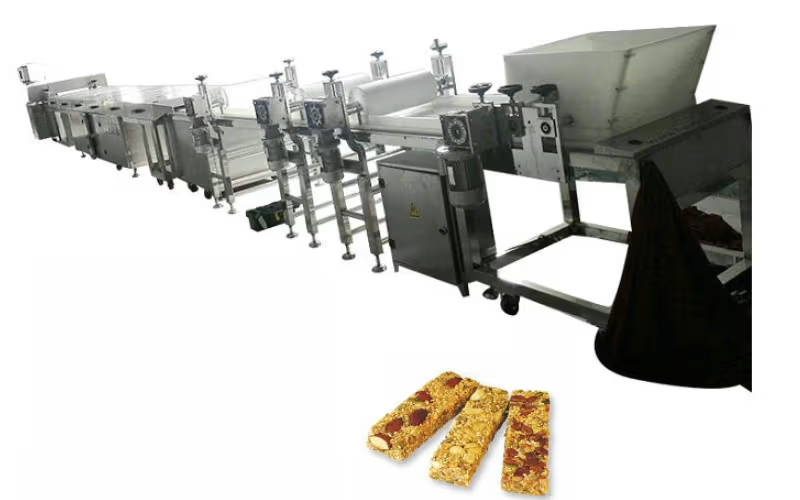
A cereal bar production line is an integrated system of machines that automates the mixing, forming, cooling, cutting, and packaging of cereal, granola, and protein bars at a commercial scale. Choosing the right line depends on your formulation, target output (ranging from 100 kg/h to 1,000+ kg/h), and whether you need specialized capabilities like chocolate enrobing or multi-SKU flexibility.
The cereal and granola bar market is expanding fast. According to Grand View Research, the global cereal bar market was valued at $17.9 billion in 2024 and is projected to reach $28.1 billion by 2030, growing at a compound annual growth rate of 7.9%. For food manufacturers, that trajectory represents both opportunity and competitive pressure—and the production line you specify today will define how effectively you can capture it.
The problem is that cereal bar manufacturing is more technically demanding than it appears from the outside. Binding syrups must be cooked to exact temperatures. Fragile inclusions, such as whole nuts and dried fruit, can be crushed by the wrong forming pressure. Cooling that’s too slow creates cutting defects; cooling that’s too aggressive affects bar texture. Choose a line built for the wrong formulation type, and you’ll spend months compensating for equipment that was never the right fit.
This guide breaks down exactly how a cereal bar production line works, what the core components do, which line configurations suit which products, and what technical criteria matter most when comparing systems. The goal is to give you a clear, engineering-grounded basis for an equipment decision—not a marketing overview.
What Is a Cereal Bar Production Line?
A cereal bar production line is a series of integrated food-processing machines that automate every stage of bar manufacturing—from cooking the binding syrup to finished, packaged bars ready for distribution. The system handles a broad range of products: traditional cereal bars, granola bars, protein bars, energy bars, nut bars, and chocolate-coated variations.
What distinguishes a purpose-built cereal bar manufacturing line from general food-processing equipment is its ability to handle viscous, sticky masses containing fragile inclusions—whole oats, nuts, seeds, dried fruits—while maintaining consistent slab thickness, bar weight, and cut accuracy throughout a full production shift. Modern lines are constructed entirely from food-grade 304 stainless steel, controlled through PLC (programmable logic controller) systems, and designed to scale alongside production requirements.
What Are the Core Components of a Cereal Bar Manufacturing System?
Understanding each machine in the line helps you identify where your specific recipe creates process risk—and where automation adds the most value.
Sugar Boiler / Syrup Cooker
The sugar boiler cooks the binding syrup—typically honey, glucose syrup, or a combination of natural sweeteners—to the precise temperature required for optimal adhesion. For most cereal bar formulations, the target temperature is around 120°C (248°F). Above this threshold, natural-ingredient flavors begin to degrade; below it, the binder lacks the viscosity needed to hold the slab together during forming and cutting. Temperature precision at this stage directly determines bar cohesion.
Powder Mixer and Wet-Dry Integration System
Dry ingredients—oats, puffed cereals, seeds, nuts, dried fruit—are pre-blended in an industrial-grade powder mixer to achieve even distribution before the binding syrup is introduced. Once the cooked syrup is ready, a secondary mixing stage integrates the wet and dry components. The critical engineering challenge here is thorough, gentle blending: overmixing crushes fragile inclusions and generates fines that affect slab density; undermixing creates distribution voids that produce inconsistent bars.
Elevator and Transfer Conveyor
The mixed mass is transported from the mixing stage to the forming machine via an insulated elevator or transfer conveyor. Insulation is non-negotiable—most cereal bar masses change viscosity significantly with even minor temperature drops, and any variation in mass temperature at the infeed point translates directly into slab inconsistency.
Pre-Forming Hopper and Compression Rollers
The slab former is the mechanical heart of the cereal bar production line. The mixed mass enters through a pre-forming hopper and is pressed by a series of heavy-duty calibrating rollers into a continuous, uniform sheet of the target thickness. For multi-layer bars—a protein base topped with a caramel layer, for example—secondary rollers apply and integrate each additional layer under controlled pressure.
Roller geometry and applied pressure are particularly critical for recipes containing whole inclusions. A forming system configured for smooth, homogeneous masses will fragment whole nuts and compromise bar texture. Well-engineered forming systems adjust pressure independently at each roller stage to accommodate the specific density and fragility of each formulation.
Cooling Tunnel
After forming, the slab enters an enclosed, refrigerated cooling tunnel to stabilize before cutting. Industrial cereal bar lines typically operate their cooling tunnels between 0°C and 10°C, with tunnel lengths of 10 meters or more, depending on production speed and formulation. The cooling phase sets the sugars and fats in the bar, ensuring the slab holds its shape cleanly through the cutting section. Inadequate cooling is one of the most common causes of ragged cut edges and bar deformation—problems that directly affect packaging efficiency and product presentation.
Longitudinal Slitting and Transverse Cutting Systems
After cooling, the hardened slab passes through a two-stage cutting system. First, circular slitting blades divide the slab lengthwise into parallel strips of equal width. Then, a servo-driven guillotine or reciprocating cutter chops the strips transversely into individual bars of the specified length. Dual-servo cutting systems allow length adjustment without stopping the line, which is essential for facilities running multiple bar formats on the same system.
Enrobing Station and Secondary Cooling Tunnel (Optional)
For chocolate-coated or yogurt-coated bars, an enrobing station applies a curtain of tempered coating over and under each bar as it passes through. The enrobed bars then enter a secondary cooling tunnel to set the coating shell before packaging. Enrobing integration requires a matched tempering unit and careful alignment between the enrober belt width and the upstream line output.
Packaging Module
Finished bars transfer to high-speed flow wrappers or pillow-pack machines that seal each bar in protective film. From there, bars are typically cartonized and prepared for distribution. Modern packaging systems integrated with cereal bar lines can process upward of 30 bars per minute while maintaining hygienic sealing conditions.
How Does a Cereal Bar Production Line Work Step by Step?
The complete cereal bar manufacturing process follows this sequence:
- Syrup preparation: Binding agents are cooked to the target temperature in the sugar boiler.
- Dry ingredient blending: Oats, grains, nuts, seeds, and inclusions are pre-mixed.
- Wet-dry integration: Cooked syrup is combined with the dry blend in the mixing system.
- Mass transfer: The combined mass is conveyed via an insulated elevator to the slab former.
- Slab forming: Compression rollers press the mass into a continuous sheet at the target thickness.
- Cooling: The formed slab passes through a refrigerated tunnel (0–10°C) to stabilize.
- Longitudinal slitting: Circular blades divide the cooled slab into parallel strips.
- Transverse cutting: Servo-driven cutters portion strips into individual bars.
- Enrobing (if applicable): Bars receive a chocolate or yogurt coating.
- Packaging: Bars are flow-wrapped and prepared for distribution.
What Are the Different Types of Cereal Bar Production Lines Available?
Cereal bar manufacturing lines fall into several configurations, each suited to different production scales and product requirements.
Fully Continuous Automatic Lines
Fully automatic cereal bar production lines integrate all stages—mixing, forming, cooling, cutting, and packaging—under centralized PLC control, running continuously without manual intervention at any stage. These systems are designed for high-volume commercial production, with capacity typically ranging from 400 kg/h to 1,000 kg/h or more. The key advantages are output consistency, reduced labor dependence, and the ability to store and recall recipes via PLC, which significantly reduces changeover errors in multi-SKU operations.
Semi-Automatic Lines
Semi-automatic cereal bar lines require manual handling at one or more production stages—typically at feeding, slab transfer, or stacking. They have a lower initial capital cost and are appropriate for operations with moderate output requirements and sufficient labor capacity. The trade-off is variability over long production runs, as human intervention introduces consistency limitations that automated systems eliminate.
Small-Scale and Lab Lines
Compact cereal bar production systems are designed for startups, artisan producers, and R&D facilities. Capacity on small-scale systems typically starts around 100–150 kg/h. These lines prioritize rapid recipe changeover and format flexibility over throughput, making them well-suited for product development, market testing, or niche production runs where variety matters more than volume.
Specialized Lines: Granola, Protein, and Enrobed Bar Systems
Beyond standard configurations, specialized cereal bar manufacturing lines are engineered for specific product categories:
- Granola bar lines incorporate low-pressure forming technology specifically designed to preserve the crunchy granola structure without crushing whole oats or clusters.
- Protein bar lines accommodate high-protein matrices, fiber-dense compositions, and high-fat nut butter bases, with heated hoppers to manage the elevated viscosity of these formulations.
- Chocolate-enrobed bar lines add downstream enrobing and secondary cooling to a standard slab-forming configuration, enabling a premium coated bar product without a separate production system.
What Are the Key Factors to Consider When Selecting a Cereal Bar-Making Machine?
Production Capacity and Output Targets
Capacity is the most immediate specification to match against your production targets. Standard commercial cereal bar production lines are available in configurations ranging from 100–150 kg/h for small-scale operations up to 800–1,000 kg/h for high-volume facilities. Map your required daily output against planned shift hours to determine whether a single-lane line meets your capacity or whether a dual-lane or wider-slab configuration is necessary.
Material Quality and Certification Standards
Any cereal bar manufacturing line intended for commercial food production must be constructed entirely of food-grade 304 stainless steel on all product-contact surfaces. CE certification confirms compliance with European safety and electromagnetic compatibility standards. Lines intended for allergen-sensitive production should also support validated allergen cleaning protocols between production runs and feature open-frame, accessible designs that minimize cleaning time.
Recipe Versatility and PLC Flexibility
For manufacturers running multiple bar formats or planning to expand their product range, the ability to store, recall, and modify recipes via PLC is a significant operational advantage. Servo-driven cutting systems that allow bar length adjustment without stopping the line reduce changeover time substantially—a manual reconfiguration that takes several hours on a basic system can be completed in under an hour on a modular line with stored PLC recipes.
Footprint and Facility Layout
Production line footprint is a practical constraint that’s easily underestimated during the planning phase. Full-capacity commercial lines can span 25–35 meters in length, with widths of 2.5–3 meters and heights up to 2.5 meters. Confirm available floor space before specifying line width, as slab width directly determines parallel strip output per cut cycle—and thus throughput.
Maintenance Accessibility and Long-Term Support
Blade wear, hopper cleaning, and cooling system maintenance are recurring tasks on any cereal bar production line. Lines with tool-free access to contact parts, removable forming rollers, and CIP (clean-in-place) compatibility reduce cleaning time and the risk of contamination. Beyond the equipment itself, evaluate the manufacturer’s after-sales support capabilities: overseas installation, operator training, spare parts availability, and ongoing technical assistance are significant for long-term production reliability.
What Are the Most Common Challenges in Cereal Bar Manufacturing—and How Are They Solved?
- Ingredient feed clogs and bridging. Natural ingredients like nut butters, honey, and dense syrups vary in viscosity from batch to batch and are prone to bridging in standard feed hoppers. Heated hoppers with active agitation and sensor-based flow monitoring address this directly, maintaining consistent mass flow without manual intervention.
- Temperature and humidity sensitivity. Confectionery masses are highly responsive to ambient conditions. Humidity above 60% or ambient temperature fluctuations of just a few degrees can alter viscosity, affect inter-layer adhesion, and cause surface bloom on chocolate coatings. Climate-controlled production zones and insulated ingredient containers that maintain mass temperature independently of room conditions are the primary mitigation.
- Inconsistent slab thickness. Slab variation typically originates either at the feed stage (irregular mass flow) or at the forming rollers (inadequate pressure calibration for the specific formulation). Regular roller calibration and consistent mass temperature at the infeed point resolve most thickness inconsistencies.
- Blade wear and cut quality degradation. Circular slitting blades and guillotine cutters wear with continuous use. As edges dull, cut faces become ragged, and bar weight consistency drops. Servo-driven cutting systems can partially compensate for minor wear by adjusting speed, but scheduled blade replacement intervals should be integrated into preventive maintenance planning from the start of operations.
- Allergen cross-contamination. Shared lines that run nut-containing and nut-free products in sequence require validated allergen-cleaning protocols between runs. Lines with open-frame designs, removable contact parts, and CIP compatibility substantially reduce both cleaning time and the risk of residue.
Ready to Configure Your Cereal Bar Production Line?
Selecting the right cereal bar manufacturing line is an engineering decision that shapes your production capacity, product quality, and operational costs for years. The correct configuration starts with your formulation, then maps to output targets, available footprint, recipe flexibility requirements, and long-term maintenance capability.
With over 35 years of experience designing and delivering confectionery production systems to food manufacturers worldwide, the YUCHO team at topchocomachine.com works through each of these variables with customers before specifying a system—not after commissioning. If you have a bar recipe, a target output, and a floor plan, that’s enough to begin a detailed technical conversation.
Contact the YUCHO team at topchocomachine.com to request a line consultation or technical quotation for your cereal bar production project.
Frequently Asked Questions
What is the difference between a cereal bar production line and a granola bar line?
A cereal bar production line is a broad category encompassing any system that produces bound bar products—including granola bars, protein bars, nut bars, and energy bars. A granola bar line is a specialized configuration that typically incorporates low-pressure forming technology to preserve the crunchy cluster structure of granola without crushing whole oats or inclusions. Most modern modular lines can handle both product types with appropriate roller adjustment and recipe management.
What production capacity should I expect from a commercial cereal bar-making machine?
Commercial cereal bar production lines are available in configurations from roughly 100–150 kg/h for small-scale operations up to 800–1,000 kg/h and above for high-volume facilities. Match your required daily output to planned shift hours to determine whether your capacity needs a single-lane or dual-lane configuration.
What temperature is the binding syrup cooked to in cereal bar production?
The binding syrup is typically cooked to approximately 120°C (248°F). This temperature achieves optimal adhesion without degrading the natural flavors of cereal bar ingredients. Cooking below this threshold reduces binding strength; exceeding it risks flavor loss and caramelization of sensitive components.
Can a single cereal bar production line run multiple bar formats?
Yes, provided the line includes PLC recipe management and modular tooling with quick-release mechanisms. On a fully automated line with stored recipes, changeovers between different bar formats or flavors can typically be completed in under an hour. Manual lines without stored-recipe capabilities require significantly longer reconfiguration times, making multi-SKU operations less efficient.
What certifications should a cereal bar manufacturing line carry?
At a minimum, a commercial cereal bar-making machine should bear CE certification and be constructed from food-grade 304 stainless steel on all product-contact surfaces. Lines operating under HACCP, SQF, or BRC standards should also feature design characteristics that support these frameworks: minimal horizontal surfaces, tool-free access to contact parts, and validated allergen-cleaning protocols.
Is a chocolate enrobing station compatible with a standard cereal bar line?
Yes. An enrobing station can be integrated downstream of the cutting section on most slab-forming cereal bar production lines. The enrober applies a curtain of tempered chocolate or compound coating over and under each bar, followed by a secondary cooling tunnel to set the shell. Correct integration requires a matched tempering unit and belt-width alignment between the enrober and the upstream cutting output.
What is the typical footprint of a cereal bar production line?
Line dimensions scale with capacity. A small-scale line producing 100–150 kg/h occupies approximately 15 x 2.0 x 2.5 meters. A high-capacity system producing 800–1,000 kg/h typically spans 35 x 3.0 x 2.5 meters. Confirm available floor space before specifying slab width, as slab width determines parallel strip output—and therefore throughput—per cut cycle.
Meta data
Meta title
Cereal Bar Production Line: How It Works & Types
Meta description
Learn how a cereal bar production line works, what its core components do, which line types suit which products, and how to choose the right system for your operation.