

Many chocolate makers ship a perfect bar. Weeks later, a customer opens it and finds a white film, a soft center, or no snap at all. Most people blame the recipe. On the packaging lines I work with, I usually find the real cause in the wrapper.
Flow wrapping is horizontal form-fill-seal packaging that wraps each bar in a sealed pillow pack.
That pack protects the chocolate only when three things work together: seal quality, film choice, and machine capability. Here, I’ll show you how each one decides whether your bar reaches the shelf fresh.
Why Chocolate Bar Wrapping Fails More Often Than People Think
Chocolate is a fussy product. It pulls moisture from humid air. It soaks up odors from cardboard, spices, or cleaning agents in a warehouse. It also reacts to every temperature swing between the plant, the truck, and the store.
A good wrapper blocks all three. A weak one lets them in slowly, and nobody notices until the damage shows.
At first, that damage looks minor. Moisture dissolves sugar on the bar’s surface. When it dries, it leaves a dusty white film called sugar bloom. The bar loses its gloss and its clean snap. Odors creep in and flatten the cocoa flavor. Then the complaints arrive: “stale,” “chalky,” “tastes like the box.”
When I audit a line with these complaints, I rarely find one big failure. I find small gaps in the same few places:
- Seal edge gaps. The fin or end seal looks closed, but one corner never fully bonded.
- Channel leaks. A wrinkle runs through the seal and forms a narrow air path.
- Product-in-seal errors. A bar corner, crumb, or loose nut gets caught in the jaws, so the film can’t bond there.
- Film mismatch. The film has the wrong barrier level, or its seal window doesn’t suit the line speed.
Each of these can pass a quick visual check, so they reach the shelf.
That’s why I tell clients to treat the wrapper as part of the product. When the wrapper fails, the chocolate fails with it.
What Flow Wrapping Actually Does
The name sounds technical, but the idea is simple. A flow wrapper turns one flat roll of film into a sealed pouch around each bar, and the line never stops. Engineers call it horizontal form-fill-seal. When I explain it to new buyers, I compare it to wrapping a gift while it rides a conveyor.
Here’s what happens to every bar:
- Form. Film pulls off the roll and runs over a forming shoulder, a curved metal collar. The shoulder folds the flat sheet into a continuous tube.
- Fill. The infeed conveyor pushes bars into that tube at even spacing. Each bar must arrive at the right moment. If it arrives early or late, it lands where the film will seal.
- Seal. Heated wheels bond the two film edges into one long seam. Then sealing jaws press across the tube, close both ends, and cut each pack free.
The result is the familiar pillow pack: one long seam on the back and a crimped seal at each end.
That long seam comes in two styles. A fin seal presses the inner faces of the film together, so the seam stands up like a small fin. It works with most heat-sealable films, which is why most chocolate bars use it. A lap seal lays one edge over the other, so it sits flat. It saves a little film, but the film must seal on both faces.
Every seal on that pack can leak. When I check a pack, I look at three places first: the long seam and both end seals.
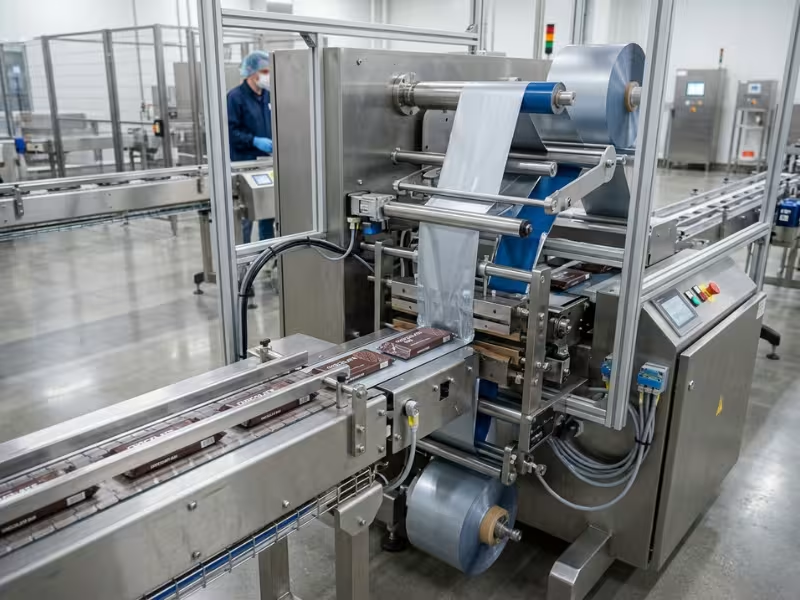
The Parts of a Flow Wrapper That Matter Most for Chocolate
A flow wrapper has hundreds of parts. For chocolate, five of them decide most of your results. I check these first on any line, because each one shapes seal quality, speed, or how gently the machine handles the bar.
Film unwind and tension control. The film must feed at a steady tension. Loose film wanders and folds, and those folds turn into wrinkles in the seal. Tight film stretches and thins at the seam. A good dancer arm or servo unwind keeps tension even as the roll shrinks.
Infeed synchronization. Bars must enter the film tube at exact spacing. Sensors read each bar and match it to the print mark on the film. If a bar drifts by a few millimeters, the jaws close on chocolate instead of film. Most product-in-seal errors start here.
Sealing jaws. The jaws press heat and pressure into the end seals. Worn or dirty jaw faces press unevenly and leave weak spots across the seal. I always tell buyers to check how easily operators can clean and replace them.
Cutting and crimping. The knife separates each pack, and the crimp pattern locks the seal. A dull knife drags the film and tears open the seal edge. A clean, deep crimp adds strength and looks sharp on the shelf.
Servo control and recipe memory. Servo drives hold every motion to tight timing, even at high speed. Recipe memory stores the settings for each bar size. Operators load a saved recipe instead of guessing, so changeovers take minutes, not hours of trial packs.
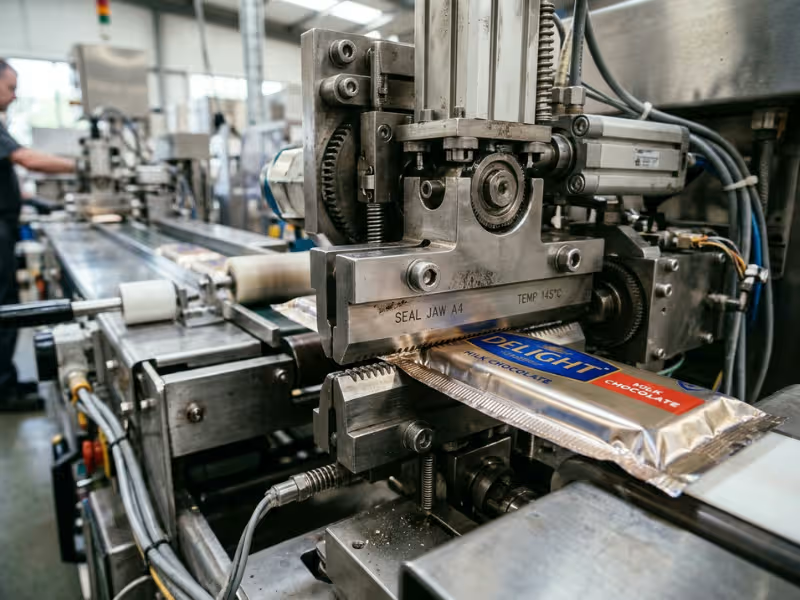
Why Seal Quality Decides Freshness
Film choice gets most of the attention in packaging meetings. But even the best barrier film fails if one seal leaks. When I trace a freshness complaint back to the line, I usually find three threats coming in through that leak.
Moisture and Sugar Bloom
Chocolate holds very little water, and it readily picks up more. A weak seal gives humid air a steady way in. Moisture settles on the bar, dissolves surface sugar, and then evaporates. The sugar recrystallizes as a dry, dusty white film. That’s sugar bloom.
Don’t confuse it with fat bloom. Fat bloom looks greasy or streaky and smudges when you rub it. It comes from poor tempering or temperature cycling, and a perfect seal won’t stop it. That problem starts upstream, so the fix lies in steady temper control on your chocolate tempering machine, not in the wrapper.
Sugar bloom feels rough and dry. It points straight at moisture, and moisture points straight at the pack. When I see dusty bars in a complaint sample, I check the seals before I question the chocolate.
Oxygen, Aroma Loss, and Odor Pickup
Oxygen works more slowly than moisture, but it still does real damage. It oxidizes the fats in the bar. Milk fat and nut inclusions turn rancid first. Cocoa butter holds up longer, but over time it still drifts toward stale, cardboard notes.
A leak also works in both directions. Cocoa aroma escapes, so the bar tastes flat when the customer finally opens it. At the same time, outside odors move in. I once traced a run of “soapy” complaints to a warehouse that stored detergent two racks away from the chocolate.
Not All Leaks Are Obvious
A closed seal and a tight seal aren’t the same thing. Many packs look perfect and still leak.
A wrinkle that crosses the seal creates a channel leak. It forms a tiny tunnel from inside to outside, often thinner than a hair. You can’t see it, but humid air finds it.
Product-in-seal does similar damage. One cocoa crumb caught in the jaws leaves a pinhole, because the film never bonds around it.
Weak bonds fool people most. The seal looks fused and passes a visual check. Then pallet weight, trucking vibration, or a few weeks of storage peel it open.
That’s why I never approve a line on looks alone. I run a bubble leak test instead: submerge sample packs in water, pull a vacuum, and watch for bubbles. Test samples every shift and after every changeover. A stream of bubbles reveals leaks that a visual check will miss.
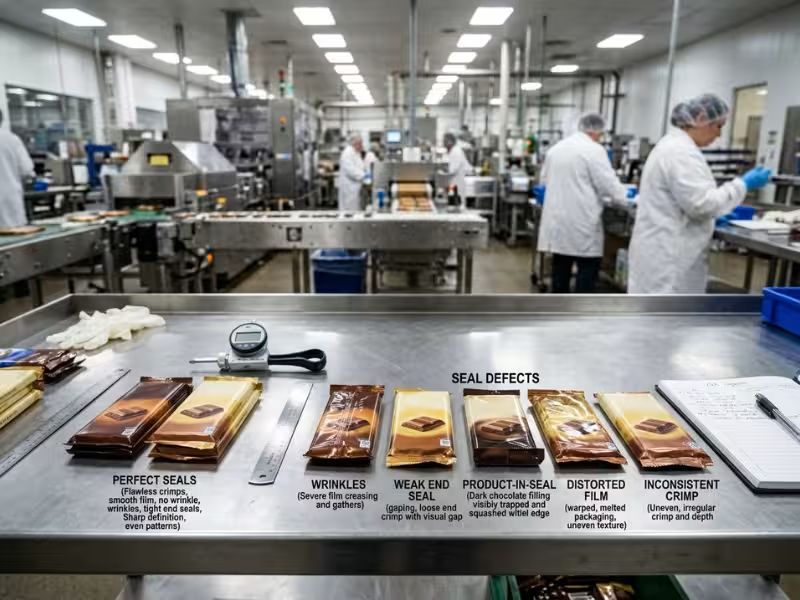
Common Seal Defects and What Usually Causes Them
Every seal defect leaves a clue. When I walk up to a struggling wrapper, I pull a handful of packs from the discharge belt and read them like a report card. The seal usually tells me which part of the line needs attention.
Here are the five defects I see most often on chocolate lines.
Wrinkles and channels. You see creases or pleats running across the end seal or along the fin. Any crease that crosses the full seal width can open a leak path. Uneven film tension causes most of them. A misaligned forming shoulder or a film roll with soft edges makes it worse.
Product-in-seal. You find a crumb, a nut piece, or a bar corner trapped inside the end seal. Often the bar shows a dent where the jaws hit it. This defect almost always starts at the infeed. Bars arrive with uneven spacing, or the sensor loses track of the print mark. Broken bars and loose inclusions add to the trouble.
Weak seals. The seal looks fused, but it peels apart under light finger pressure. Low jaw temperature, low pressure, or too little dwell time causes it. Line speed matters too. When operators raise speed without adjusting heat, the film gets less time to bond.
Film burn or distortion. The seal area turns cloudy, shrinks, bubbles, or warps. The jaws run too hot for the film’s seal window, or hot jaws rest on the film during a stop. This defect also warns you that heat may be softening the chocolate near the seal.
Inconsistent end crimp. One end shows a sharp, deep crimp. The other looks faint or patchy. Worn or dirty jaw faces cause this, and so do jaws that close out of parallel. Uneven temperature across the jaw face does the same.
|
Defect |
What it looks like |
Where I look first |
|---|---|---|
|
Wrinkles / channels |
Creases crossing the seal |
Film tension, forming shoulder |
|
Product-in-seal |
Crumbs or bar corners trapped in the seal |
Infeed spacing, print-mark sensor |
|
Weak seals |
Seal peels under light pressure |
Temperature, pressure, dwell time |
|
Film burn / distortion |
Cloudy, shrunken, or warped seal area |
Jaw temperature, stop-start heat |
|
Inconsistent crimp |
One end sharp, the other faint |
Jaw wear, alignment, cleanliness |
Fix one defect at a time. If you change three settings at once, you won’t know which change actually worked.
The Seal Triangle: Temperature, Pressure, and Dwell Time
Every heat seal depends on three settings. Temperature melts the sealant layer. Pressure pushes the two film faces into full contact. Dwell time gives the melted layers enough time to flow together and bond. I call this the seal triangle, because you can’t move one corner without affecting the other two.
When a seal fails, most operators turn up the heat first. Sometimes that works. Often it just trades a weak seal for a burned one. If pressure runs low, extra heat won’t close the gap between the film faces. If dwell time runs short, the sealant never fully flows, no matter how hot the jaws get. Find the weakest corner and fix that one, even when another dial is easier to turn.
Chocolate leaves you less room to adjust. Cocoa butter starts to soften in the low 90s °F, and the end seals sit just millimeters from the bar. Too much heat or too long a dwell softens the bar edge, dulls its gloss, and can leave fat marks inside the pack. That’s why I prefer films with low seal-initiation temperatures. I also keep the jaws only as hot as a strong bond needs.
Speed narrows that window even more. On a continuous-motion wrapper, the jaws touch the film only while they travel with it. Raise the line speed, and that contact time drops. A setting that bonds well at 80 packs per minute can leave weak seals at 120. When a plant speeds up to meet a big order, I expect leak complaints a few weeks later unless someone retunes heat and pressure too.
This is where servo wrappers earn their price. Older mechanical machines drive the jaws from one main shaft through cams. Dwell time shifts with speed, and wear slowly throws off the timing. Servo drives control each motion separately. They hold jaw contact time steady as speed changes and apply the same pressure pack after pack. That consistency lets you run chocolate inside its narrow window with far less guesswork.
Film Choice for Chocolate Bars
The film does the real barrier work once the seal closes. I’ve seen great wrappers struggle because a buyer picked film on price alone. Let’s start with what usually runs on chocolate lines.
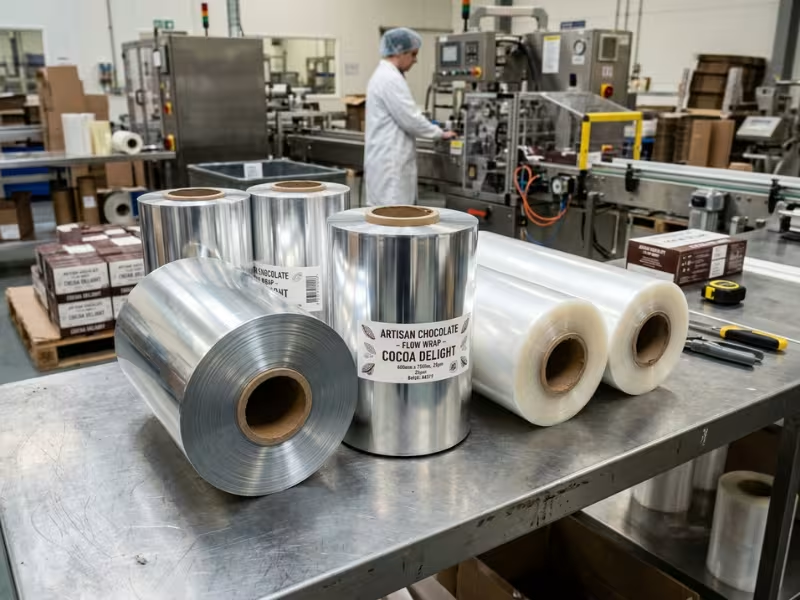
Common Film Structures
BOPP is the workhorse. It’s stiff, clear, and cheap, and it blocks moisture well. On its own, though, it lets oxygen and aroma through easily. I use plain BOPP for short-shelf-life bars or as the print layer in a larger structure.
CPP is softer and seals at lower temperatures. That makes it a strong inner layer, but it lacks the stiffness to run alone at high speed.
Metallized film, usually metallized BOPP, adds a thin aluminum layer. It cuts moisture and oxygen transfer sharply and blocks light. For most branded bars, I start here.
Laminates bond two or more films, such as printed BOPP over metallized BOPP. You get protected print and a stronger barrier. You also pay more, and the extra layers can make recycling harder.
Barrier Performance That Actually Matters
Spec sheets throw numbers at you. Four of them actually predict shelf life.
WVTR (water vapor transmission rate) shows how much moisture passes through the film each day. For chocolate, this number matters most because moisture drives sugar bloom. Metallized films often run many times lower than plain BOPP.
OTR (oxygen transmission rate) tracks oxygen flow. It matters more for milk chocolate and nut bars, since those fats go rancid first.
Aroma retention rarely appears as one number. I ask suppliers for odor-barrier test results. Low OTR usually signals good aroma retention too.
Seal window is the temperature range where the film bonds well. A wide window forgives speed changes. A narrow one demands tight control, especially near heat-sensitive chocolate.
Recyclable Films and Cold Seal Trade-Offs
Sustainability goals now drive many film decisions. That’s a good push, but it brings real limits on the line.
Mono-material films, usually all-PP, sort more easily in recycling streams. In practice, they often have a narrower seal window and slightly weaker barrier. Expect trial runs, some extra waste, and possibly a lower top speed until you dial them in.
Cold seal solves a different problem. The film carries a pressure-sensitive adhesive, so the jaws seal it without heat. That protects the chocolate edge and supports very high speeds. The catch is cost and shelf life: cold-seal film costs more, and the adhesive ages, so you need to store and use rolls within the supplier’s window.
Before you switch films, run your own bars on your own wrapper. Then leak-test the packs.
When MAP Helps — and When It Doesn’t
Modified atmosphere packaging, or MAP, replaces the air inside each pillow pack with nitrogen. A gas lance feeds nitrogen into the film tube just before the end seal closes. That flush pushes out most of the oxygen, often down to a few percent or less.
Less oxygen means slower fat oxidation. That matters most when a bar carries fats that spoil fast. I recommend MAP for three kinds of products:
- Bars with hazelnuts, almonds, or milk-rich fillings
- Premium bars with delicate flavor notes
- Export products that need a long shelf life
Most standard dark and milk bars don’t need it. Cocoa butter resists oxidation well, and dark chocolate contains natural antioxidants. A strong seal and a metallized film already protect these bars for their normal shelf life.
MAP also follows one hard rule: it only works inside a tight pack. Nitrogen escapes through a channel leak within days. Fix your seals and film first. Then check residual oxygen with a headspace analyzer before you pay for gas.
Choosing the Right Flow Wrapping System
A brochure shows a wrapper at its best. Your line will test it on an ordinary shift, with warm bars and a fresh film roll. I help buyers spot that difference before they sign anything.
Questions to Ask Before You Buy
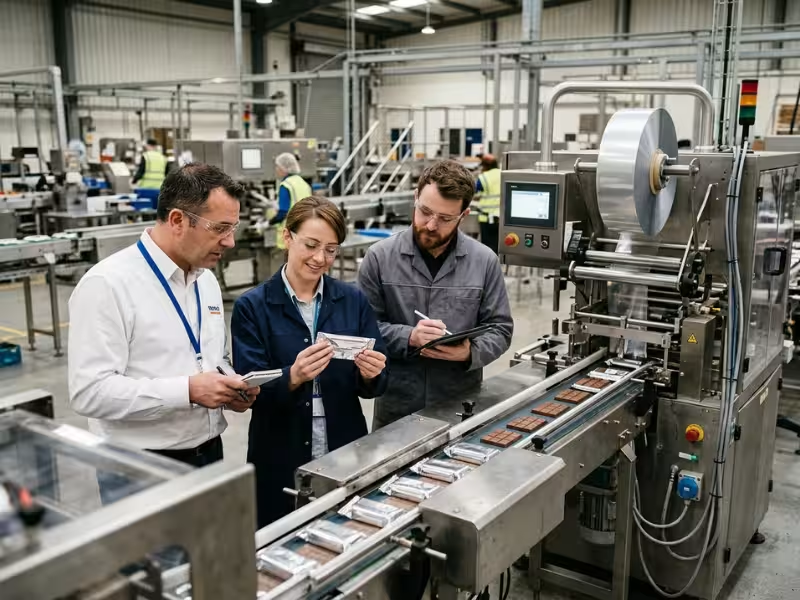
Start with a trial. Ask the vendor to run your bars on your film, not their demo stock. Bring your widest, thinnest, and most fragile SKUs, because easy products hide problems.
Then ask for proof:
- Seal data. Request leak-test results and seal strength readings from your trial packs, taken across a full run, not just the first few minutes.
- Changeover time. Have them switch between two of your real bar sizes while you time it. “Ten minutes” on paper often means forty on the floor.
- Support. Ask where the nearest technician works and which spare parts they stock locally. Jaws, knives, and heaters wear out first.
- Recyclable films. If mono-material film is on your roadmap, ask them to run it at your target speed and leak-test those packs too.
Machine Type Trade-Offs
Once the vendor passes those tests, the machine design still has to fit your production plan.
Intermittent-motion wrappers stop the film briefly for each end seal. That longer jaw contact suits heat-sensitive films and short runs, but the top speed stays lower.
Rotary, or continuous-motion, wrappers seal while the film keeps moving. They run much faster, but jaw contact time shrinks as speed rises, so the settings need tighter control.
The drive system matters just as much. Entry-level machines cost less and use one main motor with mechanical links. They work well for one or two SKUs at moderate speed. Fully servo-driven systems cost more upfront. In return, they hold timing at high speed, store recipes, and drift less as parts wear. If you run many SKUs or plan to grow, servo usually pays for itself through less waste and faster changeovers.
Red Flags During Vendor Review
Some answers should make you slow down. I watch for these:
- Seal specs that say “strong” or “hermetic” with no temperature, pressure, or test method behind them
- No leak-test data, or data from someone else’s product
- Only one or two references, or none running chocolate
- Recyclable film claims with no trial packs or test results
A good vendor welcomes hard questions. A weak one changes the subject.
What to Check First When Seals Start Failing
When a wrapper starts leaking, most crews reach for the temperature dial. I start somewhere else. Seal problems show up at the jaws, but many begin earlier in the line. Here’s the order I follow.
1. Check the bars before they reach the wrapper. Touch a few on the infeed. Warm bars flex, smear, and shift inside the film tube. Measure their length and thickness too. A bar a few millimeters too long lands in the seal zone. Broken pieces and loose nuts end up in the jaws. Fix the product first, and many “machine” problems disappear. On a well-tuned candy bar production line, consistent bar size, full cooling, and clean edges prevent more seal failures than any jaw adjustment.
2. Watch the film track. The film should run centered over the forming shoulder without wandering. A small drift at the roll grows into a crooked fin, then into wrinkles across the end seal. Check splices and roll edges at every roll change.
3. Inspect the jaws. Look for worn serrations, burned film residue, and chocolate buildup. Worn faces press unevenly, so one side bonds and the other leaks. Clean the jaws every shift. Replace them when the crimp pattern turns faint.
4. Verify the real temperature. Controllers drift. The screen may read 150°C while the jaw face sits at 140°C. Check with a surface probe at startup and again a few hours into the run.
5. Look at the people. If one shift produces most of the leaks, the machine is rarely the cause. Operators who change three settings at once often create new defects. A short training session on the seal triangle usually fixes more than a service call.
FAQs
What is flow wrapping and how does it work for chocolate bars?
Flow wrapping is horizontal form-fill-seal packaging. The machine pulls film off a roll and folds it into a tube around each bar. Heated wheels seal the long seam on the back. Then sealing jaws close both ends and cut each pack free. The line runs nonstop, so one wrapper can pack well over a hundred bars per minute.
Why do chocolate bars need airtight packaging?
Chocolate reacts to its surroundings. It picks up moisture from humid air, and that moisture causes sugar bloom. It also absorbs odors from cartons and warehouses. Oxygen slowly turns milk fat and nut inclusions rancid. An airtight pack blocks all three. Without it, a bar can leave the plant perfect and still taste stale or chalky weeks later.
Can packaging prevent chocolate bloom completely?
No. Packaging can block sugar bloom, but it can’t fully stop fat bloom. Sugar bloom comes from moisture, so a tight seal and a low-WVTR film keep it away. Fat bloom comes from poor tempering or temperature swings during storage and shipping. The wrapper can slow those swings, but it can’t fix them. Good tempering and stable storage still matter.
Which films work best for flow wrapping chocolate?
For most branded bars, I start with metallized BOPP. It blocks moisture, oxygen, and light at a reasonable cost. Plain BOPP suits short-shelf-life products. Laminates add print protection and extra barrier for premium or export bars. Whatever you choose, check the WVTR, OTR, and seal window. Then run your own bars and leak-test the packs.
What is the difference between fin seals and lap seals?
Both describe the long seam on the back of the pack. A fin seal presses the inner faces of the film together and stands up like a small fin. It works with most heat-sealable films, so most bars use it. A lap seal overlaps one edge onto the other and lies flat. It saves film, but the film must seal on both faces.
Can flow wrappers run recyclable films reliably?
Yes, but they need tuning first. Mono-material films, usually all-PP, often have a narrower seal window and slightly weaker barrier than metallized laminates. Expect trial runs, some extra waste, and possibly a lower top speed at first. A servo wrapper with precise temperature control handles them best. Before you commit, run the film at your target speed and leak-test those packs.
Conclusion
A fresh chocolate bar never depends on one setting. Seal quality, film choice, and machine control work as a team. If one of them falls short, moisture and odors find a way in.
That’s why I treat the wrapper as a product-protection system, not a packaging detail. It guards everything your team built upstream, from flavor development in the chocolate refiner and conche to the final temper and cut.
Before you buy new film or a new wrapper, audit what you already run. Pull packs from every shift. Track your seal defect rates and review your leak-test results. The data will show you where the real gap sits.
Then fix that gap first. A tight, well-sealed pillow pack keeps the bar crisp on the shelf. It also keeps customers trusting your brand.