
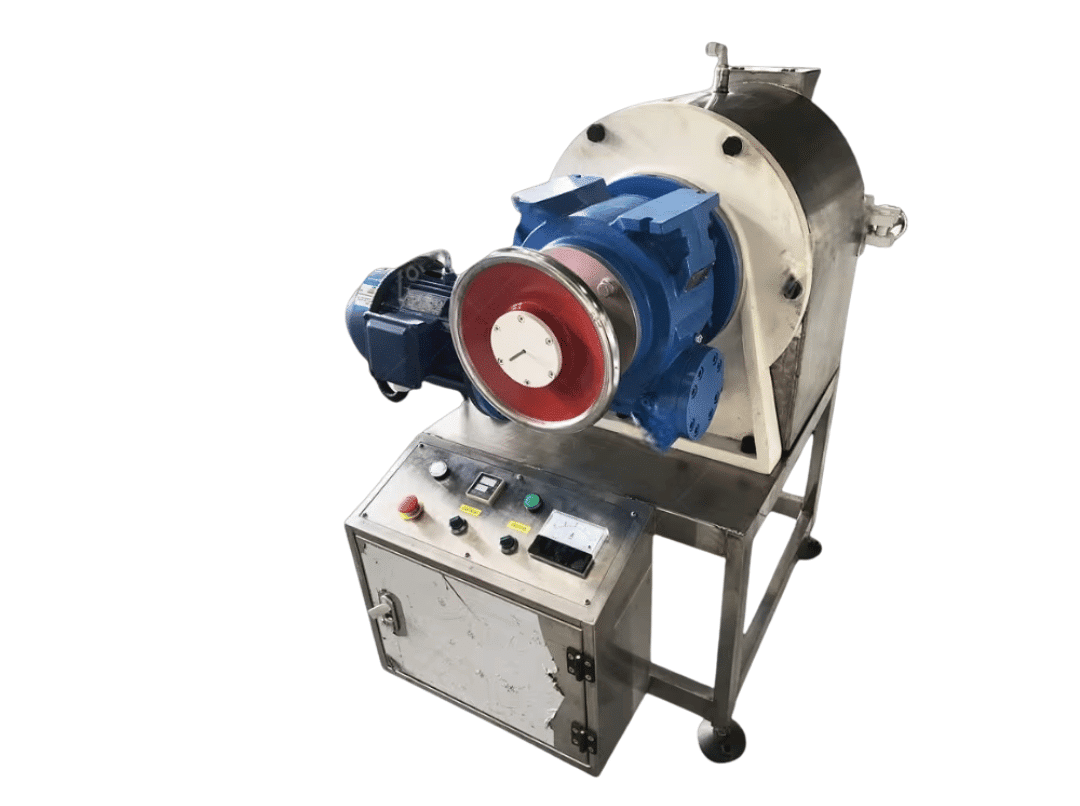
A cocoa stone grinder—commonly called a melanger—occupies a specific and well-defined role in chocolate production. It is not a universal solution, nor is it the fastest way to refine cocoa. What it does exceptionally well is grind roasted cocoa nibs into smooth, aromatic cocoa liquor while maintaining low temperatures throughout the process. For producers where flavor integrity and texture quality drive purchasing decisions, understanding how this machine works and where it fits is more useful than a general overview of its features.
This guide covers four questions that matter most in practice: how a stone grinder actually processes cocoa, when it is the appropriate equipment choice, what operating parameters determine output quality, and how to match machine capacity to production scale.
What Is a Cocoa Stone Grinder?
A cocoa stone grinder uses rotating granite rollers that press and shear material against a granite drum base. As cocoa nibs are fed into the drum, the mechanical action crushes cell walls, releases cocoa butter, and progressively reduces particle size until the mass becomes a fluid paste—cocoa liquor.
The same machine appears under several names in the industry:
- Melanger: The most precise term for a stone grinder with vertical granite rollers inside a rotating drum.
- Stone refiner or cocoa grinder: Broader terms often used interchangeably with melanger.
- Chocolate melanger: A commercially popularized name, particularly common in bean-to-bar contexts.
What separates stone grinding from metal-based refining is operating speed and the resulting thermal profile. Granite rollers turn slowly, generating low-friction heat. This matters because many of the aromatic compounds in fine cocoa—the esters, aldehydes, and pyrazines developed during roasting—are thermally sensitive. High-speed metal grinding can volatilize or degrade these compounds. Stone grinding preserves them.
How a Stone Grinder Processes Cocoa: Step by Step
Stone grinding sits within a longer processing chain. Each upstream step affects what enters the grinder and, by extension, what comes out.
Roasting
Flavor development begins at the roaster. Roasting temperatures typically fall between 110°C and 150°C, adjusted for bean origin, moisture content, and target flavor profile. Light roasts retain bright, acidic, and fruity characteristics; darker roasts develop deeper bitterness and classic chocolate notes. The grinding stage cannot compensate for poor roast quality—under-roasted nibs produce flat liquor, while over-roasted nibs introduce harsh, burnt notes regardless of grinding duration.
Cracking and Winnowing
After roasting, beans are cracked to separate the nib from the shell. Winnowing removes shell fragments by exploiting the difference in density between the two fractions. This step is more consequential than it appears: residual shell introduces cellulose into the grinder, which resists reduction and contributes off-flavors. Clean nibs grind more evenly and produce higher-quality liquor.
Feeding the Grinder
Nibs should be fed gradually into the drum rather than loaded all at once. When the granite stones are cold and the nibs are still dry and firm, bulk loading creates uneven pressure and can stall or jam the machine. Incremental feeding allows the stones to warm progressively as cocoa butter releases, improving early-stage lubrication and preventing mechanical stress.
Grinding and Refining
Once sufficient fat has released to form a paste, the mass circulates continuously under the rollers. Over time, particle size decreases, cocoa butter distributes more evenly, and the paste transitions from coarse and gritty to fine and fluid. This stage takes anywhere from 12 to 72 hours depending on the target fineness and formulation. The extended duration also produces a mild conching effect: acetic acid volatilizes, astringency softens, and flavor becomes rounder.
Temperature and Viscosity Management
Maintaining mass temperature between 45°C and 55°C is standard practice. Below this range, viscosity rises sharply, and the mass becomes difficult to move, which increases mechanical load on the motor and slows particle reduction. Above 55°C, there is a risk of scorching volatile aromatics and disrupting cocoa butter polymorphism. When producing chocolate rather than pure cocoa liquor, cocoa butter, sugar, or milk powder can be introduced during this phase to adjust viscosity and flavor composition.
Discharge
Once the target particle size is reached—confirmed by measurement or sensory evaluation—the liquor is discharged through the outlet valve. At this point, the material is ready for tempering and molding, or for further conching if a more developed flavor profile is desired.
When Is a Stone Grinder the Right Choice?
The stone grinder is not the only way to refine cocoa, and it is not always the most efficient choice. Selecting it over alternative equipment should be based on production requirements, not convention.
A stone grinder is appropriate when:
- Flavor development is a primary quality criterion. Slow, low-temperature grinding preserves volatile aromatics and allows gradual flavor development that high-speed equipment cannot replicate.
- Batch sizes are small to medium. Most melangers operate in the 5–100 L range, which aligns with artisan, bean-to-bar, and small commercial production schedules.
- The producer is working with single-origin or specialty cocoa, where preserving the bean’s distinct flavor characteristics justifies longer process times.
- Conching is not a separate step in the workflow. Extended stone grinding performs a mild conching function, which can simplify processing for smaller operations.
- Capital and operational budgets favor simplicity. Stone grinders have lower maintenance complexity than ball mills and do not require coolant systems or pre-refiners.
A stone grinder is likely not the right choice when:
- Throughput requirements exceed what batch stone grinding can sustain economically.
- The operation runs continuous or semi-continuous production lines where consistent high-volume output is the primary objective.
- Particle size targets below 15 microns are required consistently, since very fine targets demand extremely long cycles in a stone grinder and may be better achieved with alternative refining equipment.
Cocoa Stone Grinder vs. Ball Mill
Both machines reduce particle size in cocoa processing, but they operate on different principles, serve different production scales, and produce noticeably different results in terms of flavor profile.
|
Factor |
Stone Grinder (Melanger) |
Ball Mill |
|---|---|---|
|
Grinding mechanism |
Granite rollers apply pressure and shear |
Steel balls tumble and impact the mass |
|
Typical operating batch |
5–100+ L |
Larger; continuous or semi-continuous |
|
Refining time |
12–72 hours |
2–8 hours |
|
Operating temperature |
45–55°C |
Higher; depends on configuration |
|
Flavor development |
Strong; slow heat preserves aromatics |
Moderate; higher heat can reduce nuance |
|
Minimum particle size |
~18–20 microns with quality granite |
Fine; often requires a pre-refiner for consistency |
|
Maintenance |
Moderate; stone wear over time |
Higher; ball wear, bearing loads, potential contamination |
|
Noise |
Low |
Significant |
|
Best application |
Artisan, bean-to-bar, specialty chocolate |
Mid-to-large factory production |
The operational difference extends beyond specs. In a stone grinder, the slow shearing action allows cocoa butter to distribute gradually and flavor compounds to develop over time—similar in concept to extended conching. A ball mill refines faster and handles larger volumes, but the higher thermal input and mechanical intensity tend to flatten some of the more delicate flavor notes.
Many mid-size producers operate both. A ball mill handles the initial high-volume refining pass, bringing particle size down efficiently. A stone grinder then takes the material through a finishing and conching stage where flavor is refined, and texture is polished. This combination leverages the throughput advantage of the ball mill while preserving the quality characteristics that stone grinding contributes.
Choosing between the two—or combining them—comes down to production volume, target flavor profile, and budget for equipment and process time.
Grinding Time, Temperature, and Particle Size: How They Interact
These three variables do not operate independently. Adjusting one affects the others, and understanding the relationships between them is more useful than applying fixed target values in isolation.
Particle Size
For most finished chocolate, a particle size of 18–25 microns produces a texture the palate perceives as smooth. The sensory threshold for grittiness is approximately 30 microns—particles above this size are detectable on the tongue. Targeting below 18 microns does not meaningfully improve mouthfeel and extends grinding time without proportional benefit. There is also a practical lower limit: at very fine particle sizes, surface area increases substantially, which raises viscosity and can make the mass harder to work with.
Grinding Time
Time to reach target particle size depends on starting nib quality, granite condition, drum volume relative to batch size, and operating temperature. General ranges:
- Pure cocoa liquor: 12–24 hours
- Finished dark chocolate: 24–48 hours
- Milk or complex formulations: up to 72 hours, depending on ingredients and target texture
Beyond the mechanical refining function, additional hours at temperature contribute to conching—particularly acid reduction and flavor rounding. However, there is a point of diminishing return. Extended grinding past the target particle size does not improve smoothness further and can gradually suppress volatile aromatics that contribute to flavor complexity. Measuring particle size periodically, rather than relying on a fixed duration, gives better process control.
Temperature
The 45–55°C range is a practical operating window, not an absolute rule. Lower temperatures within this range preserve more volatile compounds but increase viscosity, which slows particle movement under the rollers. Higher temperatures within the range improve flow and speed up refining but carry a greater risk of aromatic loss if the upper boundary is crossed. Ambient workshop temperature affects this balance—in a hot climate, active cooling may be necessary to keep the mass within range during long grinding cycles.
When sugar is added during grinding, it absorbs moisture and can temporarily raise viscosity. Monitoring the mass consistency after each ingredient addition and adjusting temperature accordingly prevents stalling and ensures even incorporation.
Selecting the Right Machine Capacity
Capacity should be matched to actual production volume, not projected maximums. A machine running consistently at or near full load degrades faster and leaves no flexibility for batch variation. Conversely, a machine significantly oversized for current output ties up capital without operational benefit.
Recipe development and R&D (2–10 L)
Machines in this range are appropriate for testing formulations, evaluating new origins, or running trial batches. They replicate the stone grinding process accurately at small scale. Production output is too low for commercial purposes, but process parameters developed here generally transfer to larger machines.
Small artisan and bean-to-bar production (10–30 L)
This range covers producers making regular small batches for direct sale—farmers markets, online retail, or small wholesale accounts. Machines at this scale are typically run daily or on alternating days, with cleaning between batches.
Early-stage commercial production (30–60 L)
At this scale, the stone grinder becomes a production tool rather than a craft instrument. Cycle management matters more—scheduling batches, managing turnaround time between runs, and pairing with other equipment for pre-refining or conching. Some operations at this scale run two machines simultaneously to maintain output while one is in cycle.
Growing factory operations (60–150 L and above)
Larger melangers are used in conjunction with ball mills or three-roll refiners, typically as finishing equipment. They improve texture consistency and develop flavor in material that has already been refined to near-target particle size by faster equipment. At this scale, temperature control systems, motor torque ratings, and ease of cleaning become more significant procurement criteria.
When the production requirement sits between two standard capacity options, the larger machine is generally the better choice. A stone grinder running at 70–80% of rated capacity produces more consistent results than one running at maximum load.
Troubleshooting Common Grinding Problems
Paste Too Thick to Flow
Insufficient fat content is the most common cause. This can result from a naturally low-fat batch of nibs, insufficient warm-up time, or a formulation that requires additional cocoa butter. Adding a small amount of cocoa butter incrementally—rather than in a single large addition—allows the mass to adjust without sudden viscosity changes. Confirming that drum temperature is within the 45–55°C range before adding fat is advisable; a cold mass will not incorporate additions evenly.
Overheating
Extended grinding cycles in warm ambient conditions, or excessive stone pressure, can push mass temperature above 55°C. If a machine does not have active temperature control, monitoring the mass manually and pausing operation to allow cooling is necessary. Machines with integrated temperature management handle this automatically, which is a relevant procurement consideration for long-cycle production environments.
Uneven or Gritty Texture After Extended Grinding
Shell contamination from insufficient winnowing is a frequent cause. Shell fragments are harder than nib material and resist grinding, leaving coarser particles in the final product. Worn or damaged granite also produces uneven results—stones that have worn smooth apply less effective shearing force and reduce refining efficiency. Inspecting stone condition periodically and replacing worn granite before it affects output quality prevents this problem from compounding over time.
Slow Particle Size Reduction
Two common causes: batch size exceeding rated drum volume, or a starting mass that is too cold or too stiff to circulate properly. Overloading reduces the effective grinding surface contact per unit of mass. Pre-warming nibs slightly before loading—particularly in cold environments—helps establish mass circulation earlier and reduces the time to reach effective refining conditions.
Difficult Discharge
Paste that has cooled below operating temperature, or that has thickened due to moisture absorption, can resist flowing through the outlet. Warming the drum to the upper end of the operating range before discharge, and confirming the outlet valve and channel are clear of residue from previous batches, resolves most discharge problems.
How to Evaluate and Purchase a Cocoa Stone Grinder
The purchasing decision involves more variables than capacity and price. For equipment that runs 24–72-hour cycles, operating consistency and long-term support matter considerably.
Granite quality and sourcing
The hardness and density of the granite determine both refining effectiveness and longevity. Soft or porous stone wears faster, loses its effective shearing profile sooner, and can shed fine particles into the product. Suppliers should be able to specify stone grade and replacement availability.
Motor power and thermal management
A motor that is appropriately rated for the drum volume will sustain long cycles without overheating. Motors that run hot indicate either underpowering for the load or inadequate thermal management in the drive system—both reduce machine lifespan and reliability.
Temperature control
Machines without integrated temperature management require manual monitoring throughout a 24–72-hour cycle. For production environments, automated heating and cooling systems reduce operator involvement and improve batch-to-batch consistency.
Cleaning and disassembly
Machines that can be fully disassembled without specialized tools reduce cleaning time between batches and simplify compliance with food-safety standards. Contact surfaces should be food-grade stainless steel throughout.
Spare parts and after-sales support
Granite stones wear over time and require periodic replacement. Confirming that the supplier maintains a parts inventory, provides clear installation guidance, and offers responsive technical support is particularly important for operations that depend on the machine for production continuity.
The total cost of operating a stone grinder over its service life—including replacement stones, energy consumption, cleaning labor, and downtime from support delays—often diverges significantly from the purchase price. Evaluating suppliers on operational support, not only on unit price, leads to better long-term outcomes.
FAQ
What is the difference between a cocoa stone grinder and a refiner?
In practice, the terms are sometimes used interchangeably, but they describe different equipment categories. A refiner typically refers to roll refiners or ball mills that reduce particle size at higher speed and temperature. A stone grinder refines at lower speed, lower temperature, and with a concurrent conching effect. They are not equivalent substitutes.
Can a stone grinder replace a ball mill?
For small to medium batch production, yes. For high-volume or continuous production lines, no—throughput limitations make stone grinding impractical as the sole refining stage at scale. Many operations use both, with the stone grinder handling finishing and flavor development.
What factors affect final smoothness more: grinding time or formulation?
Both matter, but formulation has greater influence at the extremes. A batch with adequate cocoa butter content will reach target fineness within the expected time window. A batch that is fat-deficient will remain coarser and more viscous regardless of extended grinding. Time affects how far particle reduction progresses within the right operating conditions; formulation determines whether those conditions can be established.
Is a stone grinder suitable for continuous production?
No. Stone grinders operate in batch cycles with cleaning intervals between runs. Operations requiring continuous production should use equipment designed for that workflow, such as continuous ball mills or inline refiners.
How often should granite stones be replaced?
Stone wear depends on operating hours, material hardness, and loading conditions. Producers running machines daily may need to evaluate stone condition annually. Visual inspection for surface smoothness and monitoring for declining refining efficiency—longer cycle times to reach the same particle size—are the practical indicators that replacement is needed.
Can sugar be added during stone grinding?
Yes. Sugar is typically added after the mass has reached a fluid state, usually several hours into the cycle. Adding it too early, when the mass is still stiff, can stall the machine. Granulated sugar incorporates more readily than large crystals; some producers pre-grind sugar before addition to accelerate incorporation and reduce the risk of viscosity spikes.
What causes chocolate to taste flat after stone grinding?
Over-roasted beans are a common upstream cause. Over-grinding—running the cycle significantly beyond target particle size—can also reduce flavor complexity by suppressing volatile aromatics. In some cases, the issue is formulation: insufficient cocoa mass relative to added fats or sweeteners dilutes the inherent flavor of the cocoa. Tracing flat flavor back through each process stage—roast profile, nib quality, grinding duration, and formulation—usually identifies the source.
Conclusion
A stone grinder is a precise tool for a specific production context: batch-scale cocoa refining where flavor preservation, texture quality, and operational simplicity are the primary criteria. It performs that function better than faster alternatives, but it is not the right equipment for every operation.
The decisions that most directly affect output quality are roast and winnowing quality before grinding begins, temperature and batch size management during the cycle, and particle size monitoring rather than fixed-duration assumptions. Equipment selection should follow a clear understanding of current and near-term production volume, formulation requirements, and the operational environment the machine will run in.
For producers evaluating stone grinders alongside other refining options, or comparing machine specifications across suppliers, the most useful exercise is to define the production scenario first—batch size, target particle size, cycle frequency, and quality standards—then select equipment that fits those parameters rather than working backward from a machine specification sheet.