
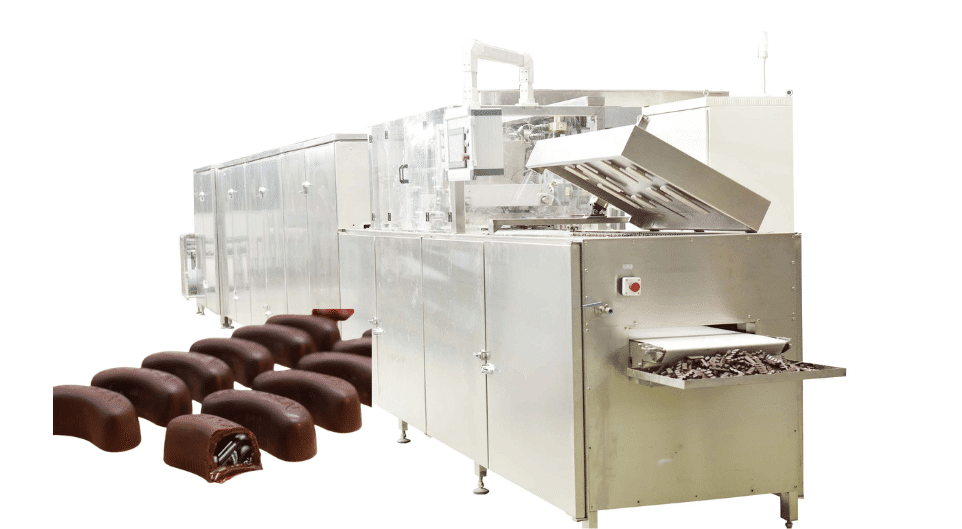
Chocolate depositing machines accurately portion and dispense tempered chocolate into molds through piston, rotary, or one-shot mechanisms. Paired with the right mould type, vibration, cooling curve, and cleaning protocol, a well-matched depositing system eliminates product giveaway, ensures regulatory compliance, and scales output from artisanal batches to industrial volumes exceeding 300 kg/h.
Every chocolate bar, praline, and filled bonbon that lands on a retail shelf has passed through the same critical bottleneck: the depositing and moulding stage. Get it right, and you have a glossy, correctly weighted product that consumers trust. Get it wrong, and you face regulatory penalties for underweight products, profit erosion from overfill, or entire batches ruined by fat bloom or incomplete demolding.
The complexity here is easy to underestimate. Chocolate is a temperature-sensitive emulsion. Its viscosity shifts within a few degrees. Its crystalline structure—the foundation of snap, shine, and shelf stability—can be undone by a mold that is two degrees too cold or by a cooling tunnel that drops the temperature too quickly. Meanwhile, the regulatory environment demands granular-level consistency on every single piece.
This guide covers each technical layer of the process: machine types for depositing and their selection criteria, the science behind one-shot technology, mould material comparisons, cooling curves, demolding methods, and the cleaning protocols that keep allergen risks in check. At every decision point, you will find specific guidance for your scale of operation.
What Are the Core Principles of How a chocolate-depositing machine works?
A chocolate depositing machine—also called a chocolate depositor or chocolate dosing machine—performs one fundamental task: it transfers an exact, predetermined volume of tempered liquid chocolate from a heated hopper into a waiting mold. The precision with which it does that defines everything downstream.
The hopper maintains chocolate at its working temperature through double-jacketed warm water circulation. This is non-negotiable. Chocolate held even slightly outside its tempering window will crystallize in the wrong polymorphic form, producing dull, streaky surfaces and a soft texture that fails to release cleanly from the mold.
From the hopper, the chocolate moves into a depositing head, where a pumping mechanism—piston, rotary valve, or concentric nozzle—meters the exact dose and forces it through nozzles into the mold below. A servo-driven PLC system governs the stroke parameters, including volume, speed, and suck-back timing. Suck-back is the brief reverse pull at the end of each stroke that prevents dripping and stringing between deposits. On modern machines, operators can adjust this parameter to 0.1 g resolution from a touchscreen without stopping the line.
The molds travel on a conveyor belt synchronized with the depositing head. After filling, they pass over a vibrating table to eliminate air bubbles, then enter a cooling tunnel where they solidify under controlled conditions.
Why Does Weight Accuracy Matter in Chocolate Depositing?
Weight accuracy sits at the intersection of compliance and profitability. On the compliance side, food labeling regulations in most markets require that packaged products meet their declared net weight. Consistent underfill risks regulatory action and brand damage.
On the profitability side, the opposite problem—product giveaway—is a slow leak that compounds across millions of pieces. A high-performance chocolate depositing machine delivers dosing accuracy down to 0.05 g per deposit. At industrial speeds, that level of precision eliminates the buffer that manufacturers traditionally build into recipes to stay legal, directly recovering the cost of raw materials.
Beyond weight, uniformity of fill distribution matters. A praline with a 70% filling ratio that is unevenly distributed will have thinner walls in one area, making it fragile during packaging and consumer handling. Precise depositing mechanics ensure the shell-to-filling ratio holds across the entire mold, not just on average.
What Are the Main Types of Chocolate Depositing Machines—and Which One Is Right for Your Product?
Piston Depositors
Piston depositors use servo-driven pistons that draw an exact volume of chocolate into a chamber on the backstroke, then push it through the nozzle plate on the forward stroke. This volumetric displacement method is the most versatile architecture in chocolate manufacturing. Piston systems handle viscous masses and recipes containing up to approximately 30% solid inclusions—crushed hazelnuts, rice crisps, dried fruit—without crushing particles or clogging the head. For molded bars, bonbons, and complex pralines, a piston depositor is the standard choice.
Rotary Depositors
Rotary depositors use a continuously turning multi-cavity drum to release chocolate in rapid, repeating pulses. The mechanism excels at high-speed, continuous output of drops, chips, and chunks onto a moving belt. If your product range centers on baking chocolate chips or bite-sized chunks sold by weight or count, a rotary depositor delivers the throughput and consistency that piston systems cannot match at equivalent line speeds.
One-Shot Depositors (Concentric Valve Systems)
One-shot depositing technology is the most technically sophisticated option in the category. Concentric nozzles simultaneously extrude an outer chocolate shell and an inner filling—ganache, caramel, nut paste, or praline cream—in a single stroke. The two masses co-deposit and set together, eliminating the separate shell molding, filling, and bottom sealing steps that traditional methods require. One-shot depositors from Yucho achieve filling rates of up to 70%, depending on filling flowability, with dosing accuracy of 0.05 g on both the shell and filling streams.
Tabletop Depositors
Tabletop models are compact, operator-controlled machines designed for small-batch production, R&D, and product development. They bring the precision of industrial depositing to boutique chocolatiers and startups that cannot justify the floor space or capital cost of a full line. Their value lies in producing professional-quality samples and small runs before scaling.
Continuous (Ribbon) Depositors
Continuous depositors lay an uninterrupted sheet of chocolate onto a moving belt, typically feeding into an enrobing or sheeting process. They are not mold-based machines; instead, they supply a controlled flow of chocolate for coating applications, chocolate bark production, or the base layers of compound bar lines.
How Does One-Shot Depositing Work—and What Makes Viscosity Balance So Critical?
One-shot technology works because two chocolate masses with different viscosities travel through concentric channels—an outer annular channel for the shell and a central channel for the filling—and meet only at the nozzle exit point. The outer chocolate wraps around the inner filling as both exit simultaneously, forming a sealed piece in a single stroke.
The engineering challenge is viscosity balance. If the filling is significantly more fluid than the shell chocolate, it will break through the thinner walls during deposition, ruining the piece. If it is too viscous, the filling will not flow properly through the inner channel, causing uneven fill distribution or head blockage.
Shell chocolate for one-shot applications is typically worked at a slightly higher viscosity than standard molding chocolate to give the wall structural integrity before it sets. Fillings are tested for flowability and adjusted with emulsifiers or fat content before the machine is configured. Yucho’s Standard One-Shot Depositor supports piston diameters from 8 to 25 mm across 24 to 96 piston pairs, giving operators the flexibility to dial in the shell-to-filling geometry for different product sizes without changing the entire head.
Switching filling types between production runs requires a thorough purge of the filling channel, not just the outer chocolate circuit. Any residual ganache left in the system will be contaminated by the next filling and may also affect the shell chocolate’s setting behavior if it migrates into the outer channel during changeover. Proper purge protocols should be documented and verified, particularly when switching between allergen-containing fillings such as hazelnut paste and allergen-free alternatives.
What Mould Type Should You Choose—Polycarbonate, Silicone, or Metal?
Polycarbonate Moulds
Polycarbonate is the dominant material in commercial chocolate moulding, and for good reason. Its smooth, hard surface produces the high-gloss finish that consumers associate with premium chocolate. Polycarbonate efficiently and uniformly conducts heat away from the chocolate, supporting proper crystallization. It is dimensionally stable under the repeated thermal cycling of a moulding line and compatible with the mechanical inversion and tapping of automated demolding systems.
Yucho’s chocolate moulding line is engineered around polycarbonate molds in a 275 × 175 × 30 mm format, with mould counts ranging from 120 to 410 pieces depending on the model. Polycarbonate molds require preheating—typically to between 26°C and 30°C—before contact with chocolate. Cold molds cause thermal shock at the chocolate-mold interface, immediately disrupting the temper and producing a dull surface bloom that cannot be recovered.
Silicone Moulds
Silicone’s flexibility allows it to produce undercut shapes and complex 3D geometries that polycarbonate cannot demold without damage. It is widely used in artisanal production and for unique decorative pieces. The trade-off is thermal performance: silicone insulates rather than conducts, slowing the cooling rate and making it harder to achieve the controlled crystallization that produces a perfect gloss finish. Silicone is generally not compatible with high-speed automated demolding.
Metal Moulds
Metal moulds—stainless steel or aluminum—are found in industrial lines where extreme durability and dimensional precision outweigh the need for complex shapes. They offer excellent thermal conductivity and long service life, but are heavy, expensive to produce in custom geometries, and require precise demolding conditions to avoid surface damage.
For most commercial operations producing bars, pralines, and bonbons at scale, polycarbonate is the correct choice. Silicone makes sense for product development, specialty lines, or artisanal production where shape complexity takes priority over speed.
Vibrating Tables
After mold filling, the molds pass immediately over a vibrating table—a shaking track that agitates the liquid chocolate for several seconds. This step has two functions: it forces trapped air bubbles to the surface before they set, and it drives chocolate into every corner of a complex mold cavity. Skipping or inadequately tuning the vibration stage is one of the most common causes of internal voids and incomplete mold fill in production lines.
How Do You Manage the Cooling Curve and Demoulding Phase Correctly?
The cooling tunnel is where crystallization is completed, and the parameters inside it determine the chocolate’s final quality.
Chocolate should enter the tunnel still fluid and warm, then be cooled progressively. A steep initial drop in temperature can cause the outer surface to solidify too quickly, trapping internal stresses that create cracks or a matte finish. A typical cooling curve for a dark chocolate moulding line operates between 5°C and 10°C inside the tunnel, with a dwell time of 18 to 30 minutes depending on the piece weight and mold depth. Milk and white chocolates generally require a slightly warmer tunnel or longer dwell time because their fat composition crystallizes at different rates.
Humidity control inside the tunnel is often overlooked. Condensation on the surface of cooling molds deposits moisture onto the chocolate, causing sugar bloom—a white, powdery surface defect caused by dissolved sugar recrystallizing. Tunnel airflow should be engineered to maintain relative humidity low enough to prevent condensation on the mold surface, particularly during humid seasons.
Demolding relies on a physical property of chocolate: as it cools, it contracts slightly, pulling away from the mold walls. A properly tempered, correctly cooled chocolate will release cleanly when the mold is inverted and tapped or twisted by the automated demolding mechanism. If the contraction is insufficient—due to under-tempering or insufficient cooling time—pieces will stick, deform, or break. The Yucho moulding line automates this inversion and release step, dropping finished pieces onto a conveyor belt ready for packaging with no manual handling.
What Are the Best Cleaning and Maintenance Protocols for Depositing Heads?
Chocolate is a food product, and the standards governing food equipment hygiene are strict. Depositing heads must be cleaned after every production run, and the protocol must be thorough enough to prevent microbial growth from residual sugar or dairy content in the chocolate mass.
Tool-Less Disassembly
Industrial depositing heads should be designed for tool-less disassembly. The pump block, pistons, nozzle plates, and channel covers should all be removable by hand or with minimal tooling, allowing operators to access every internal surface for manual cleaning. Machines that require specialized tools or significant disassembly time create an incentive to defer cleaning—a food safety risk and a source of downtime simultaneously.
Allergen Management
When production switches between recipes containing allergens—nut-based fillings, milk chocolate, products with gluten-containing inclusions—and allergen-free products, the cleaning protocol must be validated, not assumed. This means a defined purge sequence using hot water or a compatible cleaning fluid, a physical inspection of all contact surfaces, and a documented sign-off before the next run begins. On one-shot machines, both the shell channel and the filling channel must be treated as separate circuits, each requiring its own validated cleaning sequence.
Preventive Maintenance
Regular maintenance schedules should cover nozzle inspection for wear or partial blockage, seal and gasket replacement, lubrication of moving parts, and verification of servo motor calibration against dose weight targets. A drift in servo motor positioning that is too small to trigger an alarm can still shift average deposit weights enough to cause regulatory giveaway issues across a full production shift. Periodic calibration checks—typically weigh-checking a sample of deposits against the target—catch these drifts before they become costly.
How Do You Choose the Right Chocolate Depositing System for Your Business Scale?
The wrong machine at the wrong scale creates problems in both directions. Undersized equipment becomes a bottleneck the moment demand grows. Oversized equipment operates at low utilization, raising cost per unit and tying up capital in depreciation.
Boutique and Artisanal Operations (Up to ~100 kg/h)
A tabletop depositor or mini one-shot depositor offers professional-grade precision in a compact, low-capital format. These machines can run standalone—without a full cooling tunnel—using tray-based cooling as an interim step. Floor space requirements are minimal, and operators typically require very little training. This is the correct entry point for chocolatiers launching a new product line, food businesses entering the chocolate segment, or R&D teams that need to prototype at production-representative quality.
Mid-Scale Production (100–300 kg/h)
A standard one-shot depositor integrated with a cooling tunnel and automated demolding forms the core of a mid-scale moulding line. At this output range, the investment in automation pays back quickly through reduced labor, elimination of manual fill variation, and the ability to run multiple shifts with minimal operator intervention. Yucho’s Standard One-Shot Depositor supports 150–300 kg/h with up to 600 molds per hour, making it well-suited to established artisanal brands and growing regional manufacturers.
Industrial and Large-Scale Operations (300+ kg/h)
Full automated chocolate moulding lines with multiple depositing heads, continuous mould circulation, high-capacity cooling compressors, and integrated packaging interfaces are the architecture for industrial output. Yucho’s YC-QJJ175 series scales from a single depositor to a three-depositor configuration, with capacity up to 500 kg per eight-hour shift, depending on configuration. These lines require dedicated floor space, three-phase power, and a skilled maintenance team, but they also deliver the output and consistency that retail and export markets demand.
When evaluating ROI, factor in not just the machine price but the value of eliminated product giveaway, reduced labor costs, lower rework rates, and the ability to run multiple product SKUs from the same line with recipe changeover rather than equipment changeover.
FAQ
What is the difference between a piston chocolate depositor and a one-shot chocolate depositor?
A piston depositor uses servo-driven pistons to meter a single mass of chocolate—typically solid chocolate or chocolate containing inclusions—into a mold in a single stroke. A one-shot depositor uses concentric nozzles to simultaneously extrude an outer chocolate shell and an inner filling in a single stroke, creating a filled chocolate piece without any secondary filling or sealing step. One-shot depositors are significantly more complex and are chosen specifically for filled products such as pralines, bonbons, and ganache-centered pieces.
What causes stringing or tailing on a chocolate depositing machine, and how is it fixed?
Tailing—where a string of chocolate drips between molds rather than cutting cleanly—is caused by incorrect suck-back settings, nozzle temperature that is slightly too low, or chocolate that is slightly over-viscous. The fix involves increasing the suck-back stroke parameter in the PLC, verifying that nozzle heaters are holding the correct temperature, and checking the chocolate’s viscosity against its recipe specification. In most cases, a small suck-back adjustment combined with nozzle temperature verification resolves the issue without stopping the line for extended troubleshooting.
What is the ideal mould temperature before chocolate depositing?
Polycarbonate molds should be preheated to approximately 26-30°C before contact with chocolate. Molds that are too cold create a thermal shock at the chocolate-mold interface, disrupting the temper and causing a dull, bloomed surface that cannot be corrected after solidification. Molds that are too warm slow the setting rate and can cause the chocolate to lose temper contact time, also resulting in bloom. Automated moulding lines include a mold heating station specifically to maintain this window consistently.
How long does chocolate need to spend in a cooling tunnel?
Cooling time depends on piece weight, mold depth, and chocolate type. On a typical industrial moulding line operating at 5°C to 10°C tunnel temperature, dwell time ranges from 18 to 30 minutes. Thicker pieces and milk or white chocolates generally require longer cooling times than thin dark chocolate pieces. Insufficient cooling time produces pieces that are too warm to demold cleanly, while excessive cooling with high airflow can cause condensation and sugar bloom.
Can the same chocolate moulding line handle dark, milk, and white chocolate?
Yes, but each chocolate type requires a full cleaning purge between runs to prevent cross-contamination of flavor and color. More importantly, dark, milk, and white chocolates have different fat compositions that crystallize at different temperatures. Cooling tunnel temperatures and dwell times may need to be adjusted between product types, and tempering machine settings must be updated to match the specific recipe. On a well-configured automated line, these changeovers are managed through recipe profiles stored in the PLC, rather than by physical reconfiguration of the machine.
How much does an industrial chocolate moulding line cost?
Price varies significantly based on output capacity, the number of depositing heads, one-shot capability, cooling tunnel length, and automation level. A compact single-head moulding line for artisanal or small commercial production sits at a different investment level than a three-depositor industrial line with 300+ kg/h output. Because every installation involves different workshop dimensions, voltage requirements, and product specifications, the most accurate figure comes from a detailed quotation based on your specific configuration.
Selecting the Right Partner Matters as Much as Selecting the Right Machine
The mechanics of chocolate depositing and moulding are precise, but so is the decision of who builds your equipment. A machine that performs flawlessly at factory acceptance testing but lacks overseas commissioning support, spare parts availability, or engineering guidance when your filling viscosity changes is a liability, not an asset.
Shanghai Yucho Industrial Co., Ltd. has been engineering chocolate processing machinery for over 35 years. With production facilities covering more than 10,000 square meters across Shanghai and Jiangsu, a team of 5 dedicated after-sales engineers, and clients in over 100 countries, Yucho provides the full-process support—from specification through commissioning and long-term production optimization—that complex confectionery lines require.
Every Yucho depositing system is built from food-grade stainless steel, CE- and ISO 9001-certified, and designed for tool-less disassembly to meet global hygiene standards. Whether you are configuring your first tabletop depositor or specifying a three-head industrial molding line, Yucho engineers will work with your product specifications, workshop layout, and target output to match you with the right system—not the most expensive one.
Send an inquiry to the Yucho team and receive a detailed, customized response within six hours.