
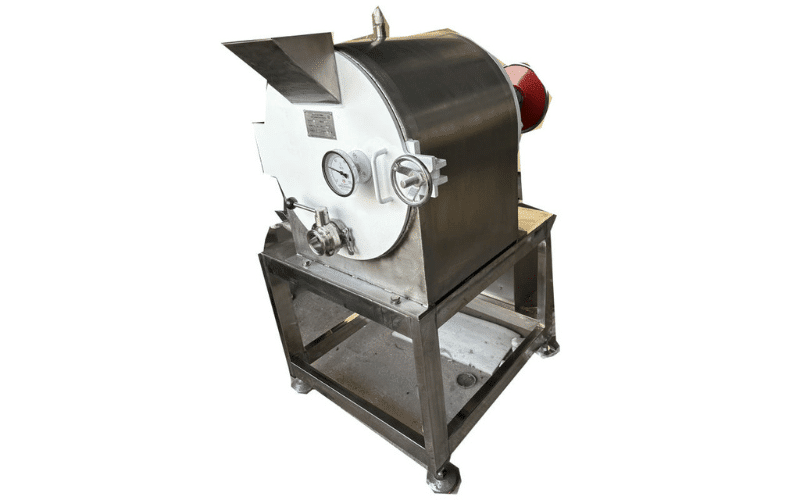
The right commercial chocolate grinder depends on your production scale, recipe flexibility needs, and quality targets. Ball mills suit high-volume industrial operations requiring continuous output. Stone melangers serve craft and bean-to-bar producers prioritizing flavor preservation. Five-roll refiners deliver the tightest particle size distribution for large-scale premium chocolate manufacturing.
The grinding step is where chocolate is made or broken. Everything upstream—bean selection, fermentation, roasting—can be executed flawlessly, yet poor refinement will still produce a product with a gritty, unpleasant texture. Everything downstream—tempering, molding, enrobing—depends on a refined chocolate mass with the right particle size, viscosity, and temperature stability.
So when choosing between a ball mill, a stone melanger, and a five-roll refiner, the stakes are high. The wrong choice doesn’t just affect product quality. It affects throughput, cleaning time, allergen management, maintenance costs, and your ability to scale.
This guide breaks down how each machine works, where it performs best, and what factors should drive your decision. The technical data here is drawn from publicly available research and specifications from established chocolate machinery manufacturers.
What Does a Commercial Chocolate Grinder Actually Do?
Before comparing equipment types, it helps to understand what refinement achieves at a physical level.
Chocolate is a suspension of solid particles—primarily cocoa solids and sugar crystals—dispersed in fat (cocoa butter). The human tongue can detect individual particles above approximately 25–30 microns. Above that threshold, chocolate feels sandy or gritty. Below it, the texture registers as smooth. Most commercial chocolate targets a particle size between 15 and 25 microns (measured as D90, meaning 90% of particles are smaller than that value).
Grinding achieves three things simultaneously:
- Particle size reduction: Breaking down sugar crystals, cocoa particles, and milk powder into sub-30-micron fragments
- Fat release: Rupturing cocoa cell walls to release cocoa butter, which lubricates particles and reduces viscosity
- Flavor development: Extended mechanical and thermal action transforms raw flavor compounds—particularly when combined with conching
The friction and mechanical shear involved in grinding inevitably generate heat. Managing that heat is as important as the grinding itself. Excessive temperatures cause fat separation, flavor volatilization, and texture defects. Every grinding technology handles this challenge differently.
Industrial Ball Mills: How They Work and When to Use Them
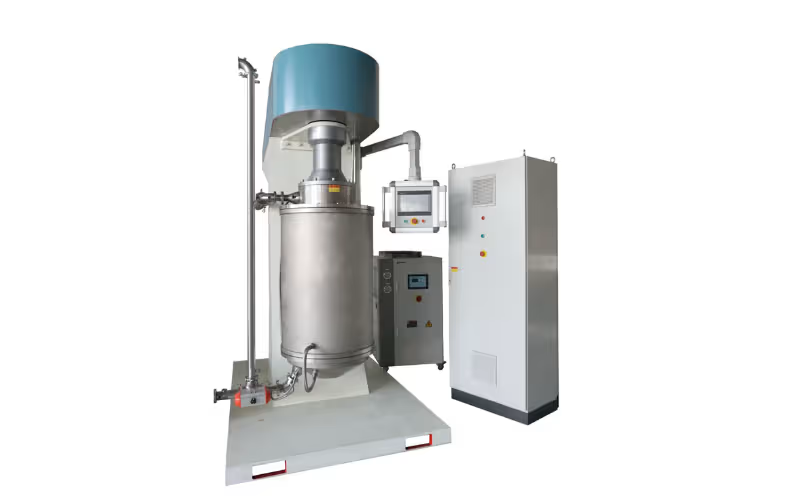
A chocolate ball mill refines chocolate mass through intensive shear and impact. Inside a water-jacketed steel vessel, a rotor agitates thousands of small-diameter steel balls—typically 12mm alloy steel—at high speed. As the chocolate mass circulates through the chamber, the friction and collision between the balls and the product progressively reduce particle size.
Modern ball mills are available in two configurations: batch and continuous.
A batch ball mill loads and processes a defined quantity of chocolate at one time before discharging the refined mass. Yucho’s batch models, for example, handle 50-5,000 kg per batch, achieving a fineness of 15–20 μm (D90) in approximately 4–6 hours. This configuration works well for operations producing multiple SKUs or specialty recipes, since it allows flexible batch switching.
A continuous ball mill operates with uninterrupted feeding and discharge, designed for 24/7 industrial production. Continuous systems from the same manufacturer deliver 200-5,000 kg per hour at 18–25 μm (D90), making them the backbone of high-volume chocolate factories.
Temperature control in a ball mill is achieved through a jacketed water-circulation system. An external temperature controller regulates the inflow and outflow of hot or cold water, maintaining stable processing conditions throughout the run. This is critical: excessive heat during grinding causes fat separation and flavor loss, while insufficient heat increases viscosity and reduces grinding efficiency.
Read More: Chocolate Ball Mill: How It Works and How to Choose the Right Machine
Key advantages of ball mills:
- Fastest refinement of the three technologies (4–6 hours to target fineness)
- Scalable from lab-scale R&D to full industrial production
- Continuous models support uninterrupted 24/7 output
- PLC automation enables repeatable results with minimal operator intervention
- Versatile — compatible with chocolate mass, compound chocolate, nut pastes, and hazelnut spreads
Limitations to consider:
- After refinement, a separate conching step is typically required for flavor development
- Continuous models require a stable cooling water supply
- Metal pickup from grinding media is a factor — choose equipment with certified food-grade steel and documented metal pickup rates
A ball mill is the right choice if your daily production target exceeds 500 kg, if you run standardized recipes at scale, or if you need to integrate the grinder into an automated line that includes conching, tempering, and molding.
Stone Melangers: Why Craft Producers Choose Them
The stone melanger is the oldest refined grinding technology still in active production use. Two granite or basalt stone wheels rotate within a bowl, exerting consistent pressure against the base. The cocoa mass gradually liquefies under friction, and the sustained mechanical action grinds particles while simultaneously developing flavor through a process similar to conching.
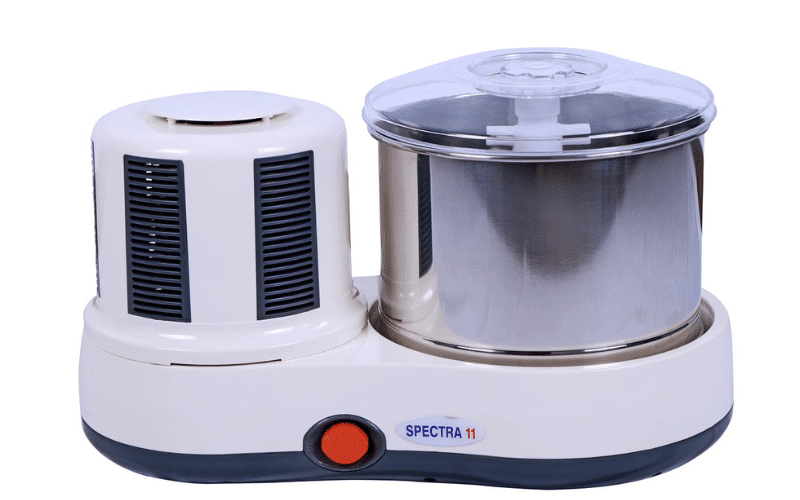
This multi-functionality is the melanger’s defining feature. A melanger handles pre-grinding, fine grinding, and preliminary conching in one unit, eliminating the need for intermediate transfers or additional equipment.
Particle size achievable in a melanger can reach 10–20 microns — comparable to or finer than that of a three-roll refiner. Research published by Hinneh et al. (2019) comparing melangers and three-roll refiners found that melangers achieved smaller mean particle sizes than the roller system, albeit over significantly longer processing times. A three-roll refiner completed the same grinding task in 10–15 minutes; melangers required 3–4.5 hours for equivalent quantities.
For chocolate (as opposed to nut pastes), processing time in a melanger typically runs 24–48 hours per batch. Monthly capacity for a commercial-grade 85 kg melanger sits between approximately 750–1,275 kg of chocolate, based on a 48-hour refining cycle. That’s well-suited to craft and bean-to-bar operations, but it makes melangers impractical for anything approaching industrial volume.
Key advantages of stone melangers:
- No metal contamination — granite stones eliminate the metal pickup concern associated with steel grinding media
- Combines grinding and conching in one step, reducing equipment investment
- Preserves complex flavor compounds through gentle, slow processing
- Low energy consumption and minimal cooling water requirements
- Easier batch changeover than five-roll refiners (typically 20–30 minutes for cleaning)
Limitations to consider:
- The processing time of 24–48 hours per batch severely limits throughput
- Not suitable for production targets above a few hundred kilograms per month
- Stone fragments can be shed into the product — difficult to detect without systematic quality checks
- Limited scalability: even the largest commercial melangers top out far below industrial ball mill output
A stone melanger is the right choice for bean-to-bar makers, artisan chocolatiers, and R&D operations producing small batches of high-complexity recipes where flavor preservation and recipe flexibility matter more than production speed.
Five-Roll Refiners: The Industry Standard for Precision
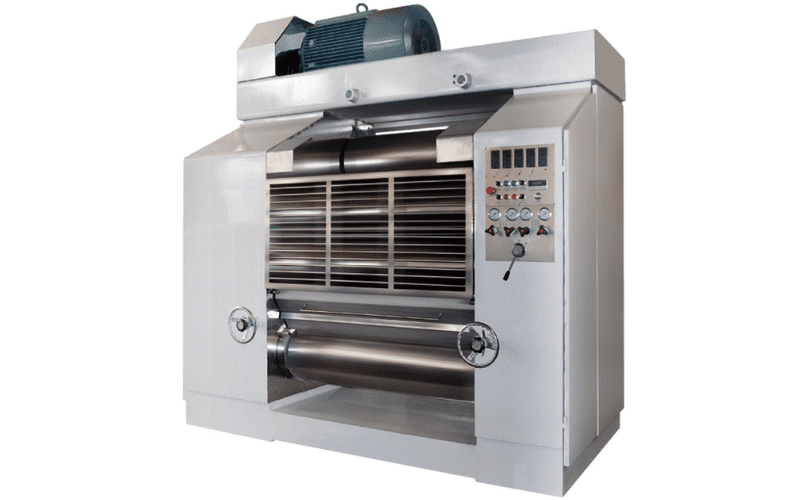
The five-roll refiner represents the traditional industrial benchmark for chocolate refinement. Chocolate paste or flake passes through four successive refining gaps created by five steel rollers rotating at progressively higher speeds. The gap between each consecutive pair of rollers narrows, creating an intense shear force that reduces particle size with each pass.
Typical industrial five-roll refiners achieve 20 microns under standard operating conditions. Advanced configurations can achieve 12 microns — the finest particle size among mainstream chocolate-refining technologies. This precision, combined with a very tight particle-size distribution, gives the finished chocolate optimal viscosity characteristics for enrobing, molding, and depositing applications.
A five-roll refiner doesn’t work in isolation. The complete production line includes:
- Paste mixer — blends ingredients into a coarse, homogeneous mass
- Two-roll pre-refiner — reduces particle size from raw crystal sugar (several hundred microns) to 100–200 microns
- Steel belt conveyor — transports chocolate flake from pre-refiner to fine refiner
- Five-roll fine refiner — achieves target fineness of 20 microns or below
- Dry conche — removes moisture, develops flavor, optimizes rheology
Each roller in the fine refiner has its own temperature control, enabling precise thermal management across all four refining steps. The combination of tight pressure control, speed differentials between rolls, and individual cooling ensures consistent results at high throughput.
Key advantages of five-roll refiners:
- Produces the tightest particle size distribution of any mainstream grinding technology
- Capable of refining to 12 microns for ultra-premium applications
- Sanitary design supports easy cleaning and allergen changeover procedures
- High throughput, with wide roller configurations handling 13,000+ lbs/hour
- Long-established technology with a century of proven industrial use
Limitations to consider:
- Highest capital cost of the three technologies — requires investment in pre-refiner, conveyors, and dry conche
- High cooling water consumption
- Roll gap adjustment is technically demanding and time-consuming
- Not economical at small production volumes
- Allergen changeover between milk and dark chocolate requires thorough dry cleaning procedures, which must be systematically validated
A five-roll refiner system is the right choice for large-scale manufacturers producing premium couverture or high-specification confectionery, where particle size consistency and finished chocolate viscosity are critical to the final product.
Key Evaluation Factors Before Buying a Commercial Chocolate Grinder
What daily and hourly output do you actually need — now and in three years?
This is the first question because it immediately eliminates most options. A stone melanger is not scalable to 500 kg/day. A five-roll refiner system is not economical at 100 kg/day. Map your current production targets and your growth projections together, then identify which technology category applies.
How many recipes and SKUs will you run on the same equipment?
High recipe variety favors batch ball mills and melangers. Continuous refiners and five-roll systems are optimized for long, standardized production runs. If you frequently switch between milk, dark, and white chocolate — or between chocolate and nut-based products — evaluate cleaning time and allergen changeover procedures carefully before committing to equipment.
What particle size specification does your product require?
Standard commercial chocolate targets 20–25 μm. Premium confectionery, couverture, or fine-textured fillings may require 15–18 μm. Ultra-premium applications approaching 12 μm demand a five-roll refiner. Verify the D90 spec of any equipment against your product requirements before purchasing — and request third-party validation data where possible.
How will you manage temperature during refining?
Each technology handles thermal management differently. Jacketed ball mills use water circulation controlled by an external PLC. Five-roll refiners cool each roll independently. Melangers rely on ambient conditions and the mass’s natural heat dissipation. In hot ambient environments or high-fat formulations, thermal management becomes especially critical. Ask manufacturers specifically about the temperature range, control precision, and what happens when cooling fails.
What does cleaning and maintenance actually involve?
Ball mills are generally regarded as the easiest to clean and maintain of the three. Melangers require stone inspection for surface wear and periodic replacement. Five-roll refiners involve roll repositioning, scraper knife replacement, and more complex sanitation procedures. Factor in your operators’ skill levels and the cost of planned maintenance downtime.
Common Operational Problems and How to Prevent Them
Temperature excursions during grinding. The most common cause of fat separation and flavor defects. Ensure your jacketed system is functioning before each run, continuously monitor in-process temperatures, and establish maximum temperature limits as a defined process parameter — not an afterthought.
Inconsistent particle size across batches. Often caused by variation in pre-grinding preparation, inconsistent ingredient dosing, or worn grinding media. For ball mills, monitor steel ball wear and replace media on schedule. For five-roll refiners, regularly validate roll pressure settings and gap calibration.
Metal contamination. A concern with steel ball mills that use lower-grade grinding media. Specify equipment with certified food-grade alloy-steel balls and documented metal pickup rates. Install inline metal detection as a downstream quality check.
Stone shedding in melangers. Granite particles can be released from worn stones without being easily detected visually. Establish a systematic stone inspection protocol and replace stones proactively based on hours of use, not just visible surface condition.
Allergen cross-contamination. Particularly relevant when switching between milk and dark chocolate on the same equipment. Dry cleaning is the standard approach for chocolate machinery, since water introduces moisture risk. Document and validate your changeover cleaning procedures — and invest in equipment with smooth, dead-corner-free interior surfaces that support thorough cleaning.
Viscosity problems in the finished mass. Can result from an incorrect particle size, moisture ingress, variation in fat content, or insufficient conching. Treat viscosity control as a system-level issue, not a refining-only variable. Monitor moisture content targets (typically 0.5–1.5% for chocolate) and fat content, along with particle size.
FAQ
What is the difference between a batch and a continuous ball mill for chocolate production?
A batch ball mill loads a defined quantity of chocolate mass, grinds it to the target fineness, and then discharges the entire batch before the next cycle begins. A continuous ball mill receives a constant feed of unrefined chocolate mass while simultaneously discharging refined product, enabling 24/7 operation. Batch models offer greater recipe flexibility and are better suited to operations producing under 500 kg per day. Continuous models maximize throughput for standardized recipes at industrial scale.
Can a stone melanger replace a ball mill in a commercial chocolate operation?
For craft or bean-to-bar production at volumes below a few hundred kilograms per month, yes. A melanger handles grinding and basic conching in a single unit, achieving particle sizes of 10–20 microns. However, the 24–48 hour processing time per batch makes melangers impractical at any meaningful commercial scale. Operations targeting hundreds of kilograms per day will need a ball mill or five-roll refiner system.
How fine can a five-roll refiner grind chocolate, and why does it matter?
A five-roll refiner can refine chocolate to approximately 20 microns under standard settings, with advanced configurations reaching 12 microns. The human tongue typically detects particles above 25–30 microns. A finer particle size means smoother texture, better viscosity control, and improved flow properties — all of which directly affect the eating experience and downstream processability on molding and enrobing lines.
How important is temperature control during chocolate grinding?
It is critical. Excessive heat during refining causes cocoa fat to separate, damages heat-sensitive flavor compounds, and alters the viscosity of the finished mass. All three grinding technologies use different methods to manage heat — jacketed water circulation in ball mills, individual roll cooling in five-roll refiners, and ambient/passive management in melangers. Any purchase decision should include a detailed review of the equipment’s thermal management specifications and control precision.
What should I evaluate when comparing commercial chocolate grinders from different manufacturers?
Focus on: target fineness (D90) and validation data; production capacity (kg/hour or kg/batch); temperature control precision and range; cleaning and maintenance requirements; integration compatibility with your existing conching, tempering, and molding equipment; certifications (CE, ISO 9001); and the manufacturer’s after-sales support capability — particularly for overseas installation, commissioning, and spare parts supply.
Is a ball mill or a five-roll refiner better for producing chocolate at scale?
The answer depends on your production model. Ball mills — particularly continuous models — offer high throughput, simpler integration, and lower total line complexity, making them the preferred choice for most modern industrial chocolate factories. Five-roll refiners deliver a tighter particle-size distribution and can achieve finer particle sizes (down to 12 microns), making them the right choice for premium couverture and high-specification applications where ultra-consistent viscosity is non-negotiable. For most B2B chocolate manufacturers, a continuous ball mill combined with a dedicated conche represents the more flexible and cost-efficient investment.
Choose the Right Grinder Before You Build the Rest of the Line
The grinding technology you select sets the ceiling on product quality and the floor on production capacity for everything that follows. Get it right, and your downstream equipment — conching, tempering, molding, enrobing — can operate at its full potential. Get it wrong, and no amount of downstream adjustment will fully compensate.
For most industrial-scale producers, a continuous ball mill delivers the best combination of throughput, flexibility, and total line cost. For craft and bean-to-bar operations prioritizing recipe complexity and flavor integrity, a stone melanger remains the most practical choice. For large manufacturers producing premium couverture or high-specification confectionery, a five-roll refiner system delivers particle-size control that other technologies cannot match.
If you are evaluating equipment for a new production line or an expansion, the most valuable step is a detailed consultation before committing to a configuration. Shanghai Yucho Industrial’s engineering team has supported chocolate equipment projects in over 100 countries. We provide tailored recommendations based on your production targets, recipe range, and integration requirements — from single-machine sourcing through to full-line design.
Send an inquiry to our engineering team and receive a technical recommendation specific to your production scenario.