
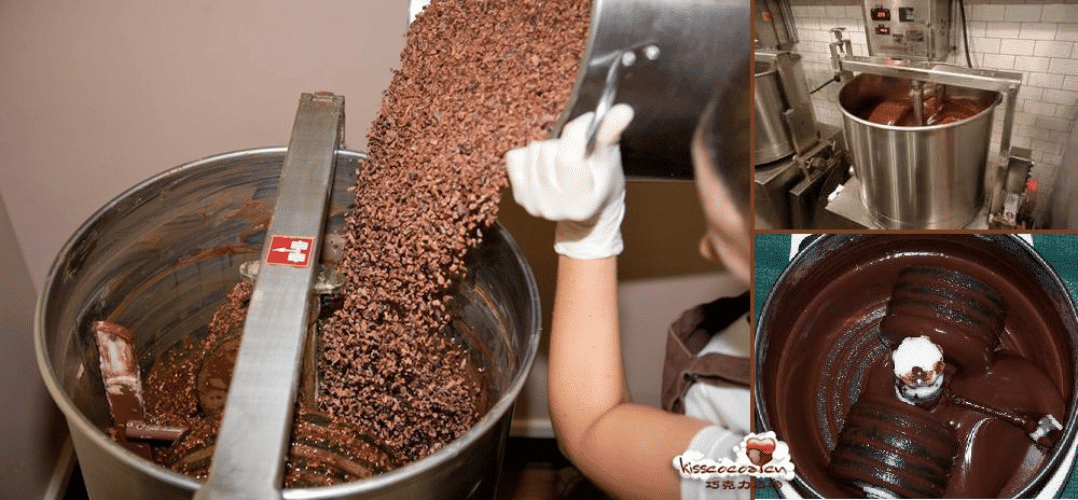
A chocolate wet grinder (also called a melanger) uses granite rollers to refine cocoa and sugar to 15–20 microns, combining refining and mild conching in one machine. It suits small-to-medium production best. Ball mills and five-roll refiners handle higher volumes but require separate conching. Your output target, SKU count, and cleaning requirements determine which machine makes sense.
The grinding decision is often where chocolate manufacturers lose money before they make a single bar. Buy too small, and you’re staggering batches at 2 a.m. Buy the wrong type, and you’re spending hours cleaning between milk and dark recipes while your labor costs quietly spiral. Buy an industrial machine too early, and you’re financing a machine running at 20% capacity.
This guide is designed for production managers, operations leads, and equipment buyers who need a clear, practical comparison—not a physics lecture on particle dynamics. We’ll cover how each machine actually works in production, where each one breaks down, and which setup makes sense at different output levels.
By the end, you’ll have a framework for making the right call, whether you’re setting up your first bean-to-bar line or scaling past 10 tonnes per month.
What a Chocolate Wet Grinder Actually Does (and What It Doesn’t)
A chocolate wet grinder—more precisely called a chocolate melanger—grinds roasted cocoa nibs, sugar, cocoa butter, and other ingredients into a smooth, uniform chocolate paste. It does this using weighted granite rollers that rotate continuously against a granite base, crushing and shearing particles down to 15–20 microns. That’s the threshold at which chocolate stops feeling gritty and starts feeling smooth on the palate.
What makes the chocolate wet grinder different from a standard food-grade grinder is its operating profile. It runs slowly to avoid overheating fat-rich materials. The friction generated during grinding melts the cocoa butter naturally, which then coats solid sugar and cocoa particles—transforming a coarse dry mixture into a fluid, glossy paste.
One important distinction: a chocolate wet grinder also performs mild conching during this process. The continuous movement and gentle heat volatilize harsh acids and unwanted flavor compounds. That means when the grinding cycle ends, you have a refined and partially conched chocolate mass—not raw, unfinished paste that still needs hours in a separate conche.
What it doesn’t do: it can’t match the throughput of a ball mill for a single recipe, and it won’t achieve the ultra-fine particle sizes that a five-roll refiner can. If you need consistent output above roughly 2 tonnes per month on a single formulation, you’ll eventually need a different or complementary setup.
Chocolate Wet Grinder vs. Melanger: Are They the Same Thing?
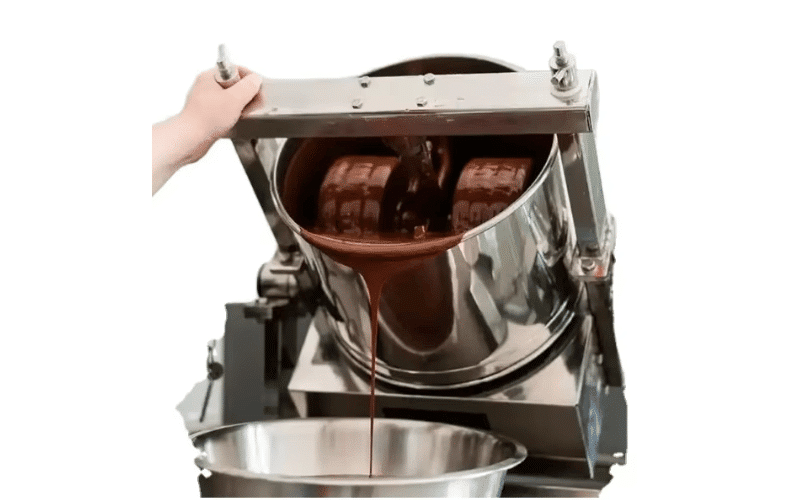
Functionally, yes. The terms are used interchangeably across the industry—and for good reason. “Wet grinder” is the broader category; “melanger” (or “mélangeur”) refers specifically to a wet grinder engineered for chocolate and other viscous fat-based materials.
The practical difference comes down to engineering specifics. A generic wet grinder—the kind originally designed for Indian cuisine—operates at speeds and temperatures that can destabilize cocoa butter and strip delicate flavor notes. A purpose-built chocolate melanger runs at controlled speeds, includes overheating protection, and is built with food-grade stainless steel and granite components that won’t contaminate your product.
For anyone sourcing equipment for commercial chocolate production, “chocolate wet grinder” and “chocolate melanger” refer to the same machine category. If you’re evaluating a specific model, verify the stone type (granite, not synthetic composites), the motor’s continuous-duty rating, and whether it has a tilt-discharge mechanism—all of which affect real-world performance and cleaning time.
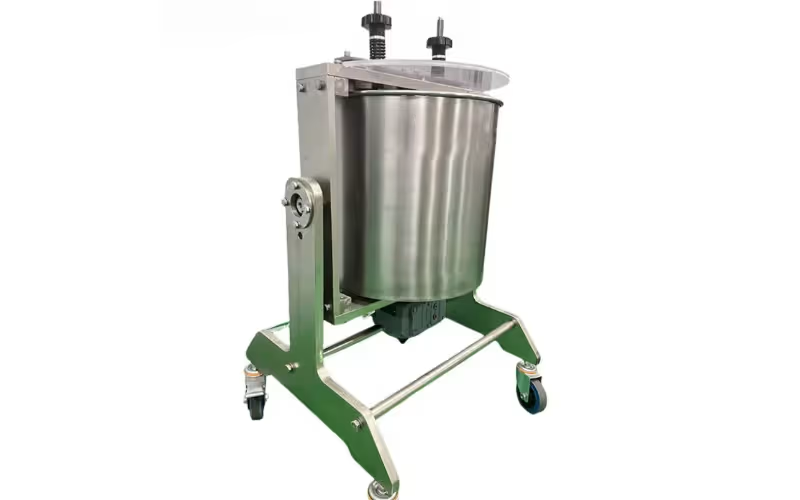
For a detailed look at how melangers work mechanically, see our Chocolate Melanger product page and our in-depth melanger guide.
Chocolate Wet Grinder vs. Ball Mill vs. Conche vs. Five-Roll Refiner: Key Differences
These four machine types approach chocolate refining from completely different angles. Here’s how they compare across the criteria that matter most in production planning:
Chocolate Wet Grinder / Melanger
- Grinding mechanism: Granite rollers on a granite base
- Particle size achieved: 15–20 microns
- Conching included: Yes (mild, integrated)
- Typical batch size: 10–100 L
- Cleaning time: 20–30 minutes
- Best for: Artisan, bean-to-bar, multi-recipe operations
Ball Mill
- Grinding mechanism: Steel balls in a rotating chamber
- Particle size achieved: Below 20 microns
- Conching included: No — separate conche required
- Typical setup: Continuous, recirculating
- Cleaning time: Several hours, multi-component teardown
- Best for: High-volume, single-recipe industrial lines
Five-Roll Refiner
- Grinding mechanism: Five precision steel rollers in sequence
- Particle size achieved: 12–76 microns (adjustable)
- Conching included: No — separate conche required
- Best for: Large-scale continuous production, uniform flake output
- Limitation: High capital cost, requires pre-refining and downstream conching
Chocolate Refiner & Conche (Combined)
- Grinding mechanism: PLC-controlled blade/roller system
- Particle size achieved: 20–25 microns
- Conching included: Yes — integrated refining, grinding, deodorizing, dehydrating
- Capacity range: 20 L to 3,000 L
- Best for: Scalable mid-to-industrial production requiring both functions in one unit
YUCHO’s fourth-generation Chocolate Refiner & Conche covers the widest production range of these options, with models from 20 L pilot batches up to 3,000 L industrial runs—all achieving 20–25 µm fineness with a 30-year design lifespan.
When a Wet Grinder Is the Best Choice
A chocolate wet grinder wins on three specific criteria: recipe flexibility, low capital cost, and clean-in-place simplicity. That combination matters most in operations that run multiple SKUs, frequently switch between dark, milk, and white formulations, or need to produce in staggered batches without dedicated operator supervision.
One operator can run multiple melangers simultaneously. Each unit runs autonomously once loaded—no overnight supervision required. For a craft chocolate brand producing 500–1,200 kg per month across a varied product line, staggering three melangers in rotation often delivers better real-world economics than a ball mill line requiring constant monitoring and a separate conche investment.
The wet grinder is also the clearest choice for anyone starting a bean-to-bar operation. Lower upfront cost, a smaller footprint, and the built-in conching function mean you can reach a sellable product faster with less infrastructure.
Particle Size and Heat Control: What to Realistically Expect
A chocolate wet grinder consistently achieves 15–20 microns in a 24–72-hour grinding cycle, depending on the ingredients and desired texture. This is well within the premium chocolate threshold—human taste buds typically detect grittiness above 30 microns, so anything below 25 microns delivers a smooth mouthfeel.
Heat control is where equipment quality separates significantly. Low-grade machines generate inconsistent friction heat, which can unevenly melt cocoa butter, cause fat separation, or introduce off-flavors from overheating. Purpose-built melangers—including YUCHO’s GMJ series—feature continuous-duty motors with built-in cooling to maintain stable temperature throughout long grinding cycles.
One practical note: chocolate seizes when moisture is introduced. All equipment must be completely dry before loading, and no liquids should be added during refining unless the formulation specifically calls for it. This isn’t a machine limitation—it’s a fundamental property of chocolate chemistry.
Cleaning, Sanitation, and Allergen Changeover
Cleaning time is one of the most underestimated factors in equipment selection. A chocolate wet grinder requires 20–30 minutes to clean: remove residual chocolate with a spatula, disassemble the drum and granite stones, wash with warm water and mild detergent, and dry completely. That’s it.
A ball mill line involves disassembling a pre-grinder, mill chamber, circulation tanks, and conche—often several hours of manual work. Residue in hard-to-reach components can migrate into the next batch, leading to allergen contamination and quality inconsistencies.
For operations producing both nut-containing and nut-free chocolate, or switching between dairy and dairy-free formulations, this cleaning differential is not minor. The melanger’s simple design makes allergen changeover far more reliable and auditable. Ball mill lines require significantly more rigorous cleaning validation protocols to meet the same standard.
Maintenance and Wear Parts
Granite stones in a chocolate wet grinder wear gradually—slowly enough that a well-maintained machine delivers consistent performance for years before stones need replacement. There are no precision steel components to re-machine, no high-speed bearings running under heavy load, and no complex sealing systems.
Ball mills, by contrast, use steel grinding balls that wear down over time and must be replaced in batches. The circulation system, valves, and pumps all require periodic maintenance. Five-roll refiners need regular roller reconditioning by specialist engineers—a significant source of downtime and cost.
Combined refiner-conche machines like YUCHO’s fourth-generation units are designed with durability as a primary specification: 30-year service life, leak-proof construction, and PLC-controlled knife tensioning that eliminates manual adjustment errors.
Key Buying Factors
Before selecting any chocolate refining machine, work through these six questions:
- What is your monthly production target? Output volume is the single most important factor in machine selection. Low-volume operations (<500 kg/month) rarely justify ball mill investment.
- How many recipes do you run? Multi-SKU operations benefit significantly from the melanger’s fast cleaning and recipe-change capability.
- What is your available labor? Melangers run autonomously; ball mills require operator supervision during working hours.
- What is your available floor space? A melanger is compact and self-contained. A ball mill line—including pre-grinder, mill, tanks, and conche—requires substantially more space and workflow planning.
- What is your capex budget? Melangers have lower upfront costs. A ball mill plus conche setup requires significantly higher initial investment before the first batch runs.
- Do you need built-in conching? If your process requires dedicated conching control, a combined refiner-conche unit may outperform both a standalone melanger and a ball mill.
Common Mistakes to Avoid
- Undersizing to save money. A machine running at 100% capacity with no buffer leaves you with no room for equipment downtime, recipe testing, or production spikes. Plan for 70–80% utilization as your steady-state ceiling.
- Choosing a ball mill for a multi-recipe artisan operation. Cleaning complexity and allergen risk compound quickly when you’re switching recipes daily. The economics look attractive per kilogram, but the hidden labor costs erode margins fast.
- Ignoring cleaning time in production planning. If a cleaning cycle takes three hours, that’s three hours of lost capacity per batch change. Most production planning models overlook this.
- Confusing a generic wet grinder with a chocolate-specific melanger. Not all stone grinders are built for fat-rich materials. Verify the motor rating, material compatibility, and thermal protection before purchasing.
- Expecting sub-15-micron particle sizes from a stone grinder. Standard melangers reliably reach 15–20 microns. If your formulation requires 12-micron precision, a five-roll refiner with adjustable gap settings is the correct tool.
- Adding moisture to the chocolate mass. This causes seizures regardless of machine type. Keep all equipment and ingredients completely dry throughout the refining process.
Recommended Equipment by Production Scale
Under 500 kg/month — Start with a Chocolate Melanger
At this scale, the economics clearly favor a small melanger. YUCHO’s GMJ10 (10 L) and GMJ25 (25 L) models cover most artisan and startup needs. Low capital cost, ease of operation, and no downstream conche requirement make this a practical entry point for bean-to-bar producers and small chocolate brands.
500 kg–2 tonnes/month — Multiple Melangers or a Mid-Range Refiner & Conche
At this range, you have two viable paths. Staggering three or four melangers in rotation gives you flexibility and redundancy—if one unit goes down, production continues. Alternatively, YUCHO’s YC-JMJ100 (100 L) or YC-JMJ500 (500 L) Refiner & Conche units provide faster cycle times (7–16 hours vs. 48 hours) and PLC-controlled precision at this output level.
2–10 tonnes/month — Refiner & Conche or Ball Mill + Conche
This is where dedicated industrial equipment starts to make sense. YUCHO’s YC-JMJ500 through YC-JMJ1500 models cover this range with proven reliability. A ball mill line with a separate conche is also viable here, particularly if you’re running one or two primary formulations at high volume with a staffed operation.
10+ tonnes/month — Ball Mill Line or Five-Roll Refiner
At an industrial scale, throughput and automation take priority. Ball mills with continuous circulation systems, or five-roll refiners with downstream conching, are the standard at this output level. Allergen management and cleaning protocols require significant investment at this scale, regardless of machine type.
Frequently Asked Questions
What is the difference between a chocolate wet grinder and a melanger?
The terms refer to the same type of machine. “Wet grinder” describes the broader category of stone-grinding equipment. “Chocolate melanger” refers to a wet grinder engineered for chocolate- and fat-based viscous materials, with speed control and thermal protection suited to cocoa butter’s properties.
What particle size does a chocolate wet grinder achieve?
A well-maintained chocolate wet grinder or melanger consistently achieves 15–20 microns in a 24–72-hour grinding cycle. This falls below the 30-micron threshold at which the human palate detects grittiness, delivering a smooth, premium mouthfeel.
Does a chocolate wet grinder replace a conche?
Partially. The grinding process generates gentle heat and continuous agitation that volatilizes some harsh acids and develops flavor—a process often called “mild conching.” For craft chocolate, this is often sufficient. For industrial applications requiring precise flavor development within controlled timeframes, a dedicated conche or a combined refiner-conche unit offers greater control.
When should I choose a ball mill instead of a melanger?
A ball mill suits operations running large volumes of a single recipe, with staffed supervision during operating hours and space for a multi-unit setup, including a separate conche. If you’re switching recipes frequently, running small batches, or working with limited labor, the melanger’s cleaning speed and autonomous operation typically deliver better economics.
How long does chocolate stay in a wet grinder?
Most operations run 24–72 hours per batch, depending on the target particle size, ingredient composition, and desired flavor development. Longer cycles produce finer texture and more developed flavor.
Can a chocolate wet grinder handle nut butters and pralines?
Yes. Melangers are widely used for nut butters, pralines, and compound coatings. Thorough cleaning between runs is essential to prevent allergen cross-contamination or flavor carryover. The melanger’s simple drum-and-stone design makes this cleaning process straightforward compared to ball mill systems.
What maintenance does a chocolate wet grinder require?
Granite stones wear gradually and may need replacement after extended use—typically years of regular operation. The motor, tilt mechanism, and stainless steel drum require routine inspection and cleaning. Compared to ball mill systems with multiple wear components, melanger maintenance is relatively simple and low-cost.
How do I prevent my chocolate from seizing in the melanger?
Seizing occurs when moisture comes into contact with the chocolate mass. Ensure all equipment surfaces and ingredients are completely dry before loading. Never add water or water-containing ingredients during refining. If seizing occurs, the batch must typically be discarded and the machine thoroughly dried before the next run.
Ready to Find the Right Machine for Your Production Line?
The right chocolate refining machine isn’t the most powerful one—it’s the one that fits your output target, recipe mix, labor model, and cleaning requirements without unnecessary complexity or cost.
YUCHO has supplied chocolate refining equipment to manufacturers in over 100 countries for more than 35 years, from single-unit melanger setups for artisan producers to multi-machine industrial lines. Our engineering team can help you map the right configuration for your specific production parameters, with custom sizing, layout consultation, and global after-sales support included.
Contact YUCHO for an equipment consultation — tell us your monthly output target and product range, and we’ll recommend the configuration that best fits your operation.
Explore our product range: