
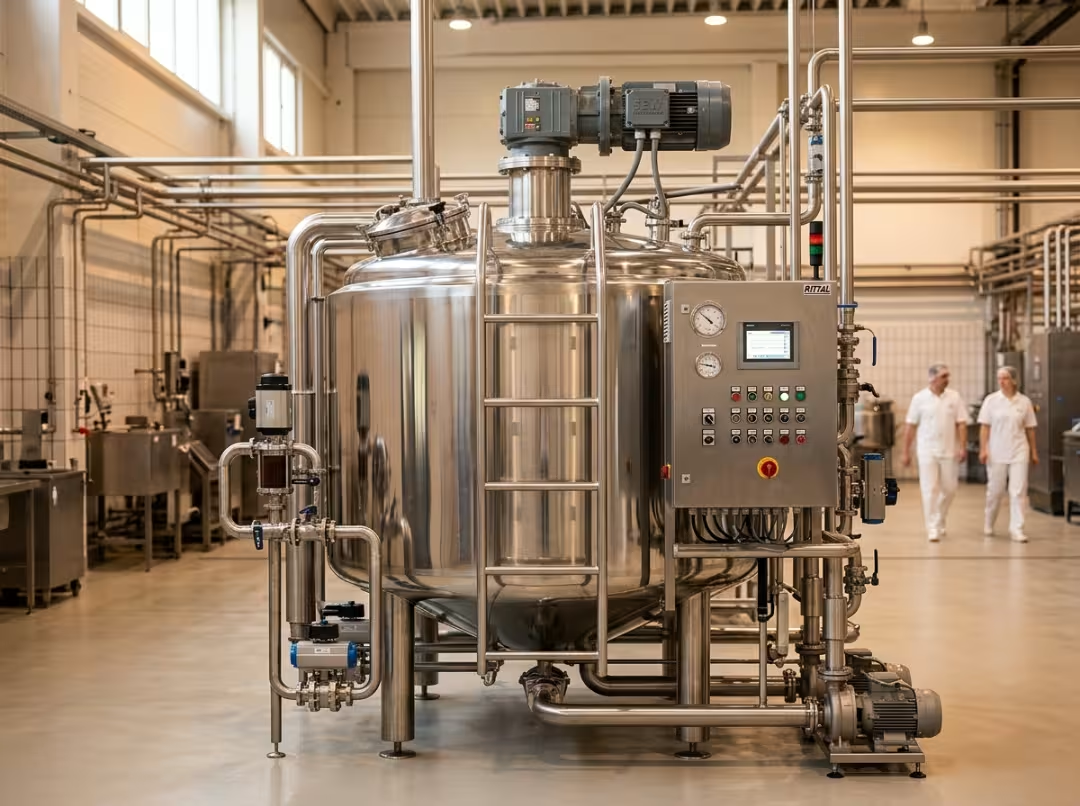
Quick answer: A chocolate storage tank is a temperature-controlled, gently agitated vessel that holds liquid chocolate between processing and forming. It keeps chocolate at working temperature, buffers batch upstream against continuous downstream demand, and feeds enrobers, depositors, and molding lines a steady supply. Size it by hourly demand multiplied by hold time.
Watch a molding line mid-shift and the rhythm looks effortless — bars filling, cooling, ejecting, one after another. Upstream tells a different story. The conche and refiner deliver chocolate in discrete batches, on their own schedule. The downstream line needs an uninterrupted flow at the right temperature and viscosity every minute of the run. Those two rhythms don’t naturally align. Something has to sit between them and absorb the difference.
That something is the chocolate storage tank. It holds warm, fluid chocolate ready to use, bridges the gap between batch and continuous operation, and keeps forming equipment fed. Get it right, and the line barely notices where its supply comes from. Get it wrong, and the symptoms show up downstream — thick chocolate, uneven coatings, stalled depositors.
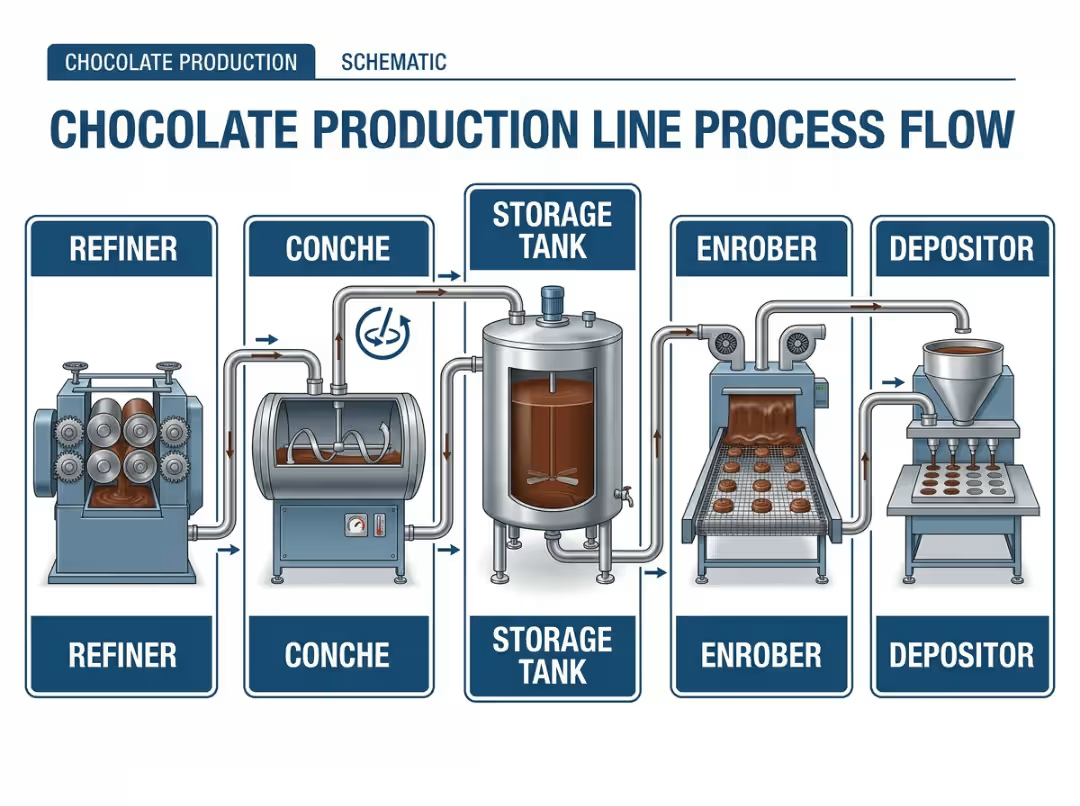
This article covers what a chocolate storage tank actually does, how to size one for your line, and what to look for when choosing one.
What Is a Chocolate Storage Tank?
A chocolate storage tank — also called a chocolate melting tank or chocolate holding tank — is a temperature-controlled, gently agitated vessel that holds liquid chocolate between processing and forming. Its job is simple in concept: keep a working volume of chocolate at the right temperature, consistency, and uniformity, so it’s there the moment the line calls for it.
What it is not matters just as much, because the confusion costs money.
It is not a tempering machine. A storage tank keeps chocolate warm and fluid — it doesn’t control cocoa butter crystallization. Tempering happens downstream, immediately before enrobing or molding. Confusing the two leads to spec errors and equipment mismatches.
It is not a conche. By the time chocolate reaches the storage tank, conching is done. The tank preserves the work already completed; it adds nothing to flavor or texture.
It is not a simple kettle for holding. A basic kettle may warm chocolate, but a proper storage tank is engineered for temperature uniformity throughout the vessel and continuous, gentle agitation — the two things that keep chocolate usable over a full production run.
The reframe that matters: the tank’s value isn’t passive storage. It’s keeping chocolate always ready to flow.
Why Do Chocolate Production Lines Need a Storage Tank?
The clearest way to understand what a storage tank contributes is to think through what happens without one.
It keeps chocolate ready for use
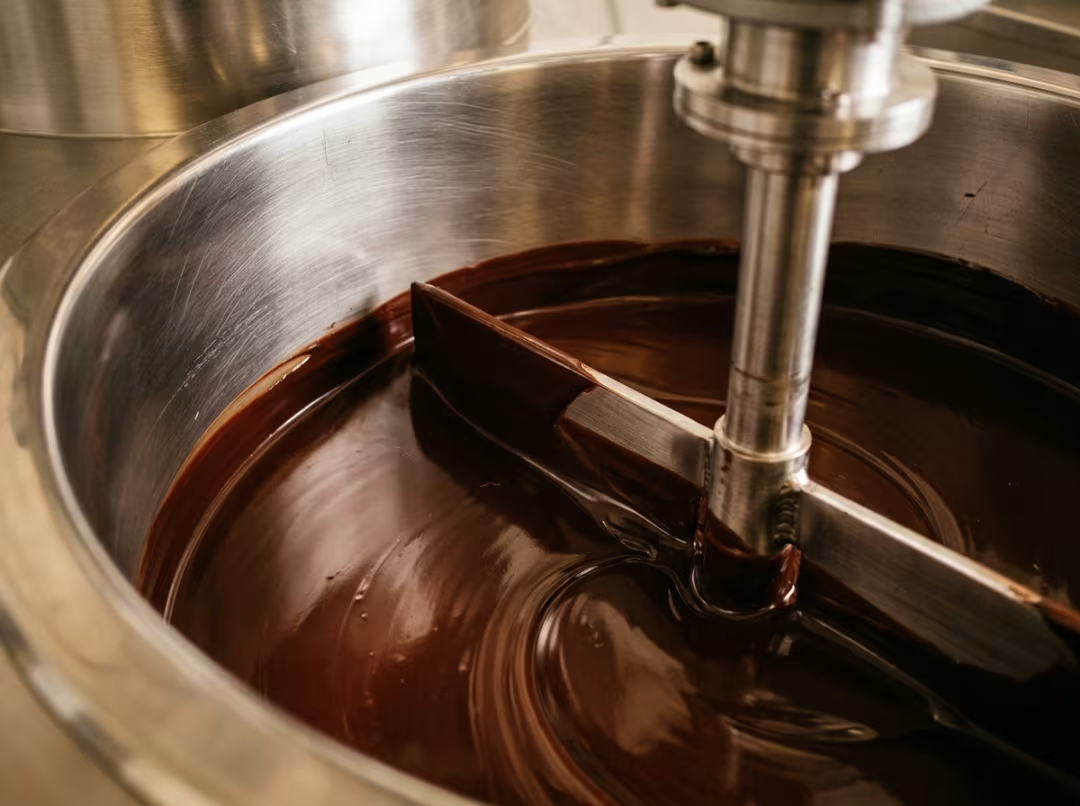
Liquid chocolate is unforgiving when left alone. Drop the temperature a few degrees, and it thickens. Leave the surface still, and it skins over. Let it sit unagitated and cocoa solids and fat fractions begin to separate, giving you uneven viscosity from top to bottom of the vessel.
A storage tank holds three things steady at once: temperature, viscosity, and homogeneity. The jacketed walls maintain a uniform working temperature, eliminating cool pockets where chocolate starts to set. Continuous gentle agitation keeps the mass uniform throughout the run, so the chocolate flowing out at hour six behaves the same as at hour one. Without that consistency, operators spend their shift chasing a moving target rather than running stable production.
It buffers batch production against continuous production
This is the structural reason the tank exists. Upstream processing — refining, conching — is inherently batch-based. It produces chocolate in defined loads, then stops. Downstream forming is continuous, or needs to be. A chocolate enrobing machine coating biscuits at a steady belt speed doesn’t care that the conche is mid-cycle. It just needs chocolate, now.
The storage tank decouples these two rhythms. It absorbs batches from upstream and continuously feeds downstream equipment, allowing each side to operate at its own natural pace.
Remove that buffer and the line becomes hostage to upstream timing. A batch runs late — a longer conche cycle, a maintenance stop, a delayed changeover — and the forming line runs dry. Product sitting in the cooling tunnel is compromised, operators stand idle, and throughput slips in ways that never fully show up on a single-shift report. A well-sized buffer turns those hiccups into non-events.
It supports stable feed to downstream equipment
Downstream equipment is precise, and precision requires a stable input. An enrobing line governs coating thickness partly through the chocolate’s temperature and viscosity. Feed it chocolate that’s cooler and thicker one moment, warmer and thinner the next, and coating weight drifts — too heavy eats margin, too light fails spec.
Chocolate depositors are even less forgiving. Accurate portion weights depend on a consistent viscosity; when the feed varies, deposit weights vary accordingly. You’re either giving product away or under-filling — and neither shows up cleanly until QC flags a trend. A steady, well-conditioned supply from the storage tank is what lets depositors and enrobers do what they’re built to do.
How Do You Size a Chocolate Storage Tank?
Sizing is where most purchasing mistakes originate, usually because the question gets framed backward.
Start with downstream demand, not tank volume
The instinct is to ask, “How big a tank should I buy?” That’s the wrong starting point. It leads people to pick a round number, add a buffer they can’t justify, and end up with a vessel sized by intuition rather than by the line it has to serve.
The right question is: how much chocolate does my downstream line consume per hour, and for how long do I need to bridge upstream gaps? Those two answers determine tank size. Everything else is rounding and adjustment.
The working sizing formula
The core calculation is straightforward:
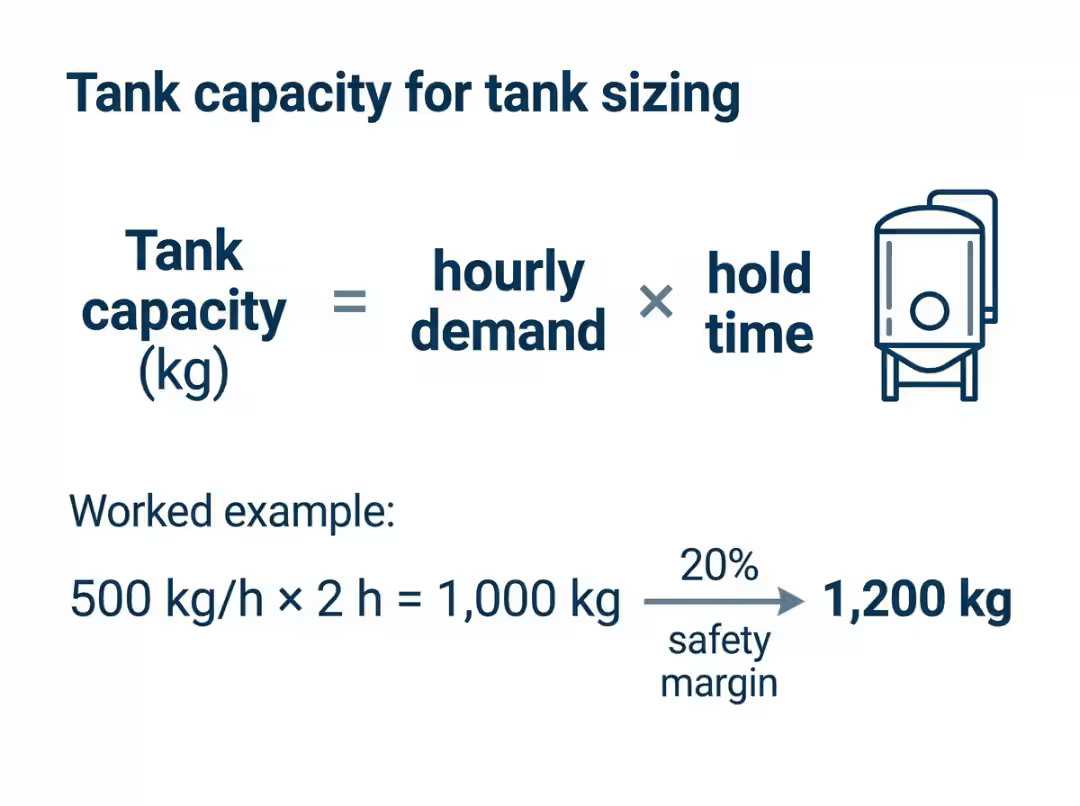
Tank capacity (kg) = hourly demand (kg/h) × hold time (h)
Worked example: a line consuming 500 kg/h with a target buffer of 2 hours needs:
500 × 2 = 1,000 kg
Add a 15–20% safety margin for level-control headroom, production surges, and the real-world slop that never shows in a planning spreadsheet:
1,000 × 1.20 = 1,200 kg
A 1,200 kg working capacity is a defensible, auditable target for that line. The logic always runs from demand to volume — never the other way around.
Factors that change the final size
Once you have the baseline, several plant-specific variables push it up or down:
- Downstream throughput per hour. The primary driver. Higher consumption scales the tank directly.
- Upstream batch size and cycle time. A large, infrequent batch requires more holding capacity between deliveries. Smaller, more frequent batches allow leaner sizing.
- Number of lines fed from one tank. Combined hourly draw across all downstream lines sets the minimum capacity — not a single line’s demand.
- Recipe changeover frequency. More frequent switches favor smaller working volumes. Less chocolate to drain and clean means faster turnaround between recipes.
- Plant space and ceiling height. Physical constraints cap what fits. A low-ceiling plant may need a horizontal vessel or several smaller tanks rather than one tall vertical unit.
When a bigger tank is the wrong choice
“Bigger is safer” is an expensive assumption. Oversized tanks carry real operating penalties that rarely appear in the initial capital comparison.
Frequent recipe changes become significantly more painful with a large tank — more product to flush, higher cleaning chemical consumption, and longer downtime between runs. Extended dwell time also degrades product quality, even when the temperature is correct; chocolate that sits longer than necessary accumulates unnecessary thermal and mechanical stress. Add the ongoing cost of heating a partly full vessel and the floor space permanently committed to a tank that’s rarely full, and the calculus changes. Size to the buffer you actually need.
Typical capacity ranges
For orientation — not as a substitute for the calculation:
- Small: 500 kg – 2,000 kg. Single lines, artisan-to-mid production, frequent recipe changes.
- Mid-range: 3 – 10 tons. Established lines feeding one or two forming stations steadily.
- Large: 20 tons and above. High-volume plants, often bulk-fed, supplying multiple lines from a single vessel or tank farm.
Capacity is quoted in kilograms or tons, not liters — you’re planning around chocolate mass, not vessel volume. If your calculated figure lands far outside the range you’d expect for your operation size, revisit your hourly demand and hold-time assumptions before revisiting the tank.
Where Do Chocolate Storage Tanks Fit in a Production Line?
A storage tank doesn’t operate in isolation. Its value depends on where it sits and what it connects.
Enrobing lines
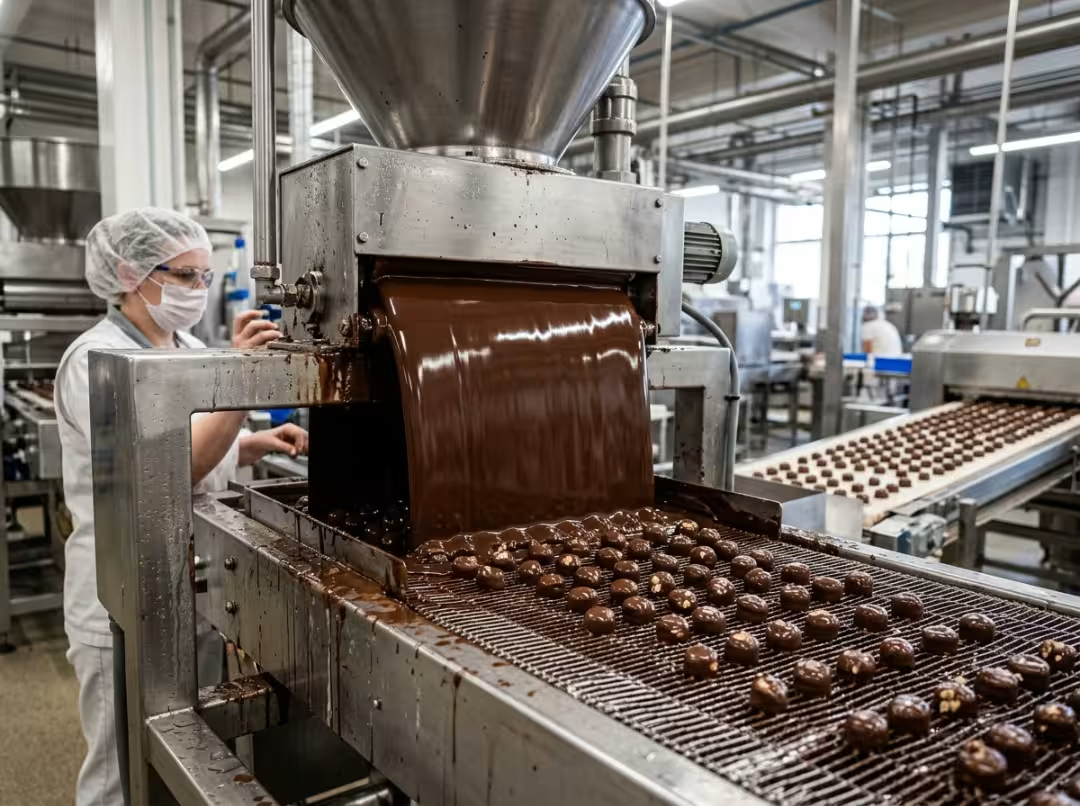
On an enrobing line, continuous supply isn’t a convenience — it’s the fundamental requirement. Product moves through the enrober at a fixed belt rate, and the chocolate curtain has to be there, at consistent temperature and flow, for every piece that passes. A supply gap means bare product, which is scrap.
The storage tank feeds the enrobing line through an inline tempering unit that manages crystal structure just before application. The tank handles volume and thermal stability; the tempering unit handles crystallization. They’re complementary tools — not interchangeable ones.
Molding lines
Molding lines producing bars, pralines, or seasonal shapes need chocolate at a stable temperature and predictable flow to fill molds cleanly. Air inclusions, short fills, and uneven surfaces usually trace back to feed inconsistency rather than mold design. A single well-sized tank can supply several depositor stations on a chocolate molding line at once, provided the pump and piping layout is designed for combined draw. One conditioned source is also easier to keep uniform than multiple smaller ones.
Depositing and filled products
Depositing is where viscosity stability has the most direct effect on finished product quality. Portion accuracy depends on chocolate behaving identically shot after shot. For hollow products, consistent flow governs shell thickness. For filled products, any variation in the chocolate side throws off the shell-to-filling ratio, and it shows in every piece. The storage tank’s ability to maintain viscosity is the foundation on which the depositor’s precision is built.
Between refining/conching and forming
Zoom out, and the tank’s structural role becomes clear. It sits between chocolate refining and conching upstream and every forming process downstream, functioning as a surge vessel — the line’s shock absorber. Upstream delivers in pulses; downstream draws steadily; the tank absorbs everything in between. Once you see it that way, the specification process becomes much more straightforward.
What Should You Look for When Choosing a Chocolate Storage Tank?
With function and sizing understood, the selection decision comes down to evaluating the right attributes in the right order.
Capacity and feed method
Start with the numbers from your sizing work: how many lines does this tank feed, and what is their combined hourly demand? A tank sized for one line won’t cover two.
Then choose the feed method. Pumped feed — often via a dedicated chocolate delivery pump — provides flexibility in tank placement and allows chocolate to be moved over distance or elevation changes. Gravity feed is simpler and lower-maintenance but constrains where the tank can sit relative to the line. Neither is universally better; the right answer follows from your plant layout.
Plan for realistic expansion. If a second line is genuinely on the roadmap within this equipment’s service life, factor it in now. If it’s speculative, don’t oversize today for a possibility that may never materialize — you’ll absorb the costs in cleaning, energy, and floor space every day in the meantime.
Temperature control quality
This is the parameter that separates a properly engineered tank from a heated vessel. Good temperature control means uniform heating throughout the tank interior, a well-configured jacket with full-surface coverage, and a control system that maintains the setpoint without hunting. What you’re specifically guarding against is thermal stratification — hot and cold zones where chocolate either overheats or begins to set. When evaluating suppliers, ask how the jacket is configured under load, not just what setpoint the controller can achieve at commissioning.
Agitation design
Agitation has to balance two competing requirements: enough movement to maintain homogeneity and prevent separation, gentle enough not to incorporate air into the chocolate. Variable-speed agitation is the practical marker of a well-designed system — the right speed varies with fill volume, recipe viscosity, and chocolate type. High-speed mixing aerates the product and accelerates degradation. Too little mixing allows separation and localized crystallization. You want deliberate, slow movement that turns the whole mass over without disrupting it.
Cleaning and changeover
For single-recipe plants, cleaning is a periodic maintenance task. For multi-recipe operations — dark, milk, white, or customer-specific blends — cleaning and changeover speed is a direct throughput variable that compounds across every production week.
The requirements are straightforward: a fully drainable bottom with no product traps, CIP (clean-in-place) capability with spray coverage reaching every internal surface, and physical inspection access so cleanliness can be confirmed rather than assumed. Tanks that are awkward to empty and clean impose a hidden tax on every changeover. That cost is rarely captured in a purchase decision and almost always noticed in operation.
Installation reality
A tank that meets every specification is useless if it won’t fit or the floor won’t support it. Before finalizing a shortlist, verify the floor footprint against available space, the overall height against ceiling clearance — this is the dimension that surprises people most at delivery — and the loaded weight against the floor’s bearing capacity. Factor in maintenance clearance for agitator service, jacket connections, and inspection access. These aren’t afterthoughts; they should shape the shortlist from the start.
Supplier support
A chocolate storage tank is a long-lived asset, and the supplier relationship outlasts the sales process by years. Evaluate technical documentation quality, spare parts availability and lead times, installation and commissioning support, warranty terms, and delivery lead time to avoid production schedule risk.
When comparing suppliers on specification, separate the parameters that genuinely affect chocolate quality and uptime — temperature uniformity, agitation quality, drainability, control stability — from the features that read well on a data sheet but don’t change what comes out of the tank. A touchscreen controller doesn’t compensate for a jacket that leaves cold spots or a drain that won’t fully clear.
Key Design Features That Matter in Practice
A few construction choices appear consistently in well-performing tanks. The value isn’t that they’re listed on a spec sheet — it’s why each one matters operationally.
- Stainless steel grade (304 vs. 316). Grade 304 is food-safe, corrosion-resistant, and appropriate for most chocolate applications. Grade 316 adds resistance to more aggressive cleaning chemistry and harsher environments. For straightforward chocolate holding, 304 is usually sufficient; specify 316 only where there’s a genuine reason.
- Jacketed heating with insulation. The jacket delivers heat; insulation holds it in. Good insulation reduces energy consumption and dampens the effect of ambient temperature swings. Together they make stable, passive temperature control possible rather than a constant control-loop battle.
- Agitator geometry. The shape of the agitator determines whether the tank achieves gentle, thorough mixing or creates dead zones and aeration. Match geometry to your working volume and viscosity — a generic paddle is rarely the right answer.
- Temperature sensors and level monitoring. Reliable sensing is what allows the tank to be controlled rather than merely watched. Level monitoring prevents running dry mid-run and helps manage changeovers cleanly.
- Drainability and CIP port placement. A fully draining bottom and CIP ports positioned for complete internal coverage determine how quickly and thoroughly the tank can be cleaned. In multi-recipe plants, this design decision quietly governs how many changeovers per shift are realistically achievable.
Common Problems and How to Prevent Them
Storage tank problems tend to follow predictable patterns. Working through them as symptom → likely cause → what to check gets to a resolution faster than general troubleshooting.
- Chocolate too thick → temperature drop or inadequate agitation → check jacket temperature, heating medium flow, controller setpoint, and agitator speed.
- Temperature drift → control or jacket fault → check sensor calibration before assuming a heater problem; a drifting reading is usually the sensor.
- Separation or viscosity inconsistency → insufficient or poorly configured agitation → check agitator speed and geometry; dead zones and too-slow mixing are the common culprits.
- Persistent cleaning residue → poor drainage geometry or incomplete CIP coverage → check drain geometry and spray-ball placement; recurring residue in the same location points to a spot the cleaning cycle never reaches.
- Agitator failure → mechanical wear or overload → verify the agitator isn’t being asked to move chocolate that’s too thick or a volume that exceeds its design load; overload conditions accelerate wear and shorten service life.
Most of these problems trace back to two root causes: temperature that isn’t held uniformly, or agitation that isn’t matched to the batch. Resolve those two and the failure rate drops sharply.
Frequently Asked Questions
What is the difference between a chocolate storage tank and a tempering machine?
A storage tank holds liquid chocolate at working temperature and maintains homogeneity through agitation. It does not influence cocoa butter crystallization. A tempering machine controls crystal structure so finished chocolate sets with the correct snap and gloss. In a typical production line, the storage tank feeds chocolate to a tempering machine positioned immediately before enrobing or molding. They perform different jobs at different points in the process and are not substitutes for each other.
How do I calculate the right tank capacity?
Use the formula: tank capacity (kg) = hourly demand × hold time, and add a 15–20% safety margin. A line consuming 500 kg/h, requiring a 2-hour buffer, requires a 1,000 kg base capacity, or around 1,200 kg with the margin applied. Base your hourly demand on actual downstream throughput, not on design maximums, and set hold time based on your upstream batch cycle and changeover frequency.
Can one tank feed multiple lines?
Yes, provided it’s sized and plumbed for combined demand. The tank capacity must cover the total hourly draw of all lines it feeds, and the pump and piping arrangement must deliver adequate flow to each offtake point simultaneously. From a temperature-control perspective, a single well-conditioned source is often easier to manage than multiple smaller tanks. Size and plan around peak simultaneous demand, not average.
What temperature should liquid chocolate be held at?
Working temperature varies by recipe and chocolate type, but liquid chocolate is typically held warm enough to remain fluid and stable without overheating — typically around 40–45°C, with the precise setpoint determined by your formulation and supplier specifications. The tank’s job is to hold that setpoint uniformly throughout the vessel, not just at the sensor location.
Can the same tank handle dark, milk, and white chocolate?
Yes, sequentially — never at the same time. Each recipe change requires thorough cleaning to prevent cross-contamination, which is why drainability and CIP access are so important in multi-recipe plants. The three chocolate types also hold at slightly different temperatures, so responsive temperature control helps manage transitions. If the changeover frequency is high, a smaller working volume speeds cleaning and reduces the risk of flavor carryover.
How long can chocolate stay in a storage tank?
Chocolate held at correct temperature with consistent agitation can remain workable for hours to a day or two, but shorter dwell time is better. Extended holding exposes the product to more thermal and mechanical stress than necessary, which can affect quality even when temperature is technically within spec. Size the tank to the buffer the line genuinely needs, not to hold the maximum possible inventory.
Buying for the Line You Run
The chocolate storage tank sits at the hinge between processing and forming — it’s the point where batch-based upstream and continuous downstream no longer work against each other. Every specification decision flows from that role.
Work through the decision in this order: start with your line’s hourly consumption, set the hold time you need against your upstream batch cycle, factor in recipe changeover frequency, and define the temperature-control precision your process requires. Those four inputs do most of the work. Before shortlisting a single supplier, know your hourly demand, your upstream batch size, and the number of lines the tank will feed. The right tank isn’t the largest or the most feature-laden — it’s the one matched to the production line you actually run.