
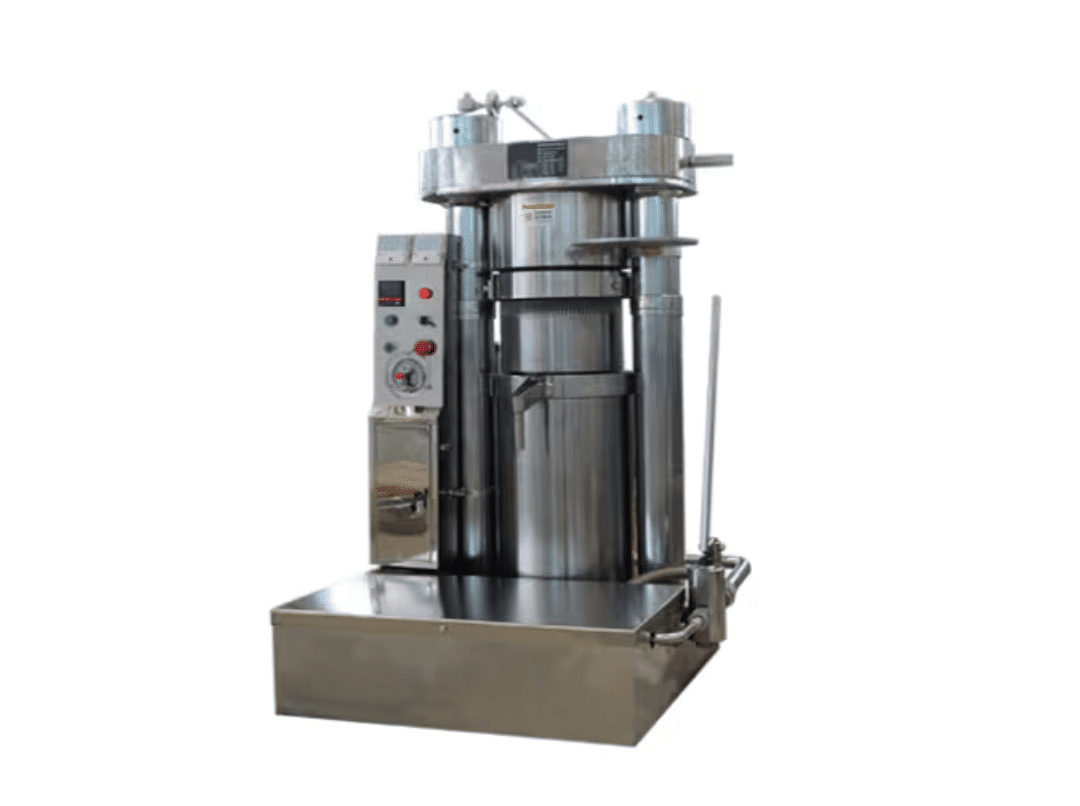
The cocoa butter press is the piece of equipment that most directly determines your margin. It controls how much butter you recover from each batch and what grade of cocoa cake you’re left with. A well-matched press running correct parameters keeps both where they need to be. A poor fit — or a good press running on bad feed — quietly bleeds yield and consistency across every production cycle.
This article covers the mechanics of how pressing works, what actually drives yield and residual fat, and how to think through equipment selection for your specific plant.
What Is a Cocoa Butter Press?
A cocoa butter press uses hydraulic force to separate cocoa butter from cocoa liquor — the paste produced by grinding roasted cocoa nibs. Under high pressure, liquid fat is pushed through filter plates, leaving behind a compacted solid cake. That cake is later milled into cocoa powder.
The same machine goes by several names: cocoa liquor press, hydraulic cocoa press, cocoa press machine. The terminology varies by region and supplier, but the function is identical across all of them.
Mechanically, every hydraulic cocoa press is built around five core systems:
- Hydraulic system — generates the pressing force, typically 40–60 MPa.
- Press chamber and filter plates — contain the liquor and allow fat to pass while retaining solids.
- Heating system — maintains liquor temperature so the fat flows freely during pressing.
- Control system — manages pressure curve, temperature, and cycle timing.
- Cake discharge and safety system — handles cake ejection and protects personnel during operation.
The press sits between the grinding and powder production stages. Because it links those two processes, its output quality and consistency set the ceiling for everything on either side. Poor separation at the press means wasted liquor and unstable cake composition — problems that ripple through the entire line.
How Does Cocoa Pressing Work?
Cocoa liquor enters the press as a heated paste with roughly 50–55% fat content and particle sizes below about 20 microns. The press must extract the majority of that fat without allowing fine solids to pass through with it. Modern hydraulic presses achieve this through a two-stage pressure sequence, and understanding this sequence is the most reliable way to evaluate whether a machine is purpose-built for cocoa or merely adapted from general oilseed pressing equipment.
Stage one: building the filter layer. The press begins at a relatively low pressure — typically 5–8 MPa. This phase is not a warm-up; it serves a critical function. Low pressure pushes fine cocoa particles against the filter plates, forming a self-filtering layer that acts as a secondary sieve. Once that layer is established, it holds back solids while allowing liquid fat to pass through cleanly. If this stage is skipped or shortened, fine powder bleeds through with the butter, contaminating the product and reducing cake consistency.
Stage two: fat extraction. With the filter layer in place, pressure rises to 40–60 MPa. Liquid butter flows through the layer and the filter plates under controlled force. The goal — straightforward to describe, technically demanding to execute — is to drive out the fat while the solids remain intact.
Temperature is held at 90–105 °C throughout both stages. Heat reduces the viscosity of the fat and keeps it mobile, but the window is narrow. Too cool and the fat stays locked in the cake; too hot and the butter oxidizes, losing flavor compounds and color clarity. Consistent temperature control is one of the clearest indicators of a well-engineered press.
This “seal first, then press” approach is what allows a dedicated hydraulic cocoa press to reach residual fat levels as low as 10%, whereas screw presses working on cocoa typically stall at 15–18%. When evaluating suppliers, ask to see the full pressure curve, not just the peak figure. Peak pressure in isolation says very little about how cleanly fat and solids are actually separated.
Where the Press Sits in the Full Extraction Process
The cocoa butter extraction process is sequential, and the press sits at its center:
- Roasting — beans are roasted to develop flavor and prepare the shell for removal.
- Winnowing — roasted beans are cracked and dehulled, producing clean cocoa nibs.
- Grinding — nibs are ground into cocoa liquor, typically 50–55% fat by weight.
- Preheating — liquor is brought to 80–105 °C before pressing to keep the fat fluid.
- Filling — heated liquor is pumped into the press chamber.
- Pressing — the two-stage cycle separates cocoa butter from cocoa cake.
- Butter collection — extracted butter is filtered, cooled, and held for storage or refining.
- Cake discharge — the pressed cake is ejected, cooled, and sent to the powder mill.
Every upstream step conditions the feed. Every downstream step depends on how cleanly the press has separated fat from solids.
What Determines Cocoa Butter Yield and Residual Fat?
Yield and residual fat are the two performance numbers that define the economics of a cocoa pressing operation. They are directly linked: pressing further to reduce residual fat increases butter recovery, but it also extends cycle time. That trade-off has to be understood before any machine is selected.
Residual Fat Targets and What They Mean in Practice
Residual fat is the fat remaining in the cake after pressing. It controls both how much butter you recover and what product your cake becomes:
- 10–12% residual fat yields low-fat cake and low-fat cocoa powder. Butter recovery is maximized, but reaching this target consistently requires a hydraulic press with precise pressure control and the cycle time to sustain it.
- 14–18% residual fat produces medium- to high-fat cake and a fuller-fat cocoa powder. It is more accessible with less demanding equipment and shorter cycles, but the trade-off is that a meaningful share of saleable butter stays in the cake.
The product specification you’re selling should determine which target you set — and that target should drive your equipment selection, not the other way around. A press designed around a 14% cake target cannot reliably deliver 10% without penalty to throughput. Pushing it to do so forces a trade-off that compounds over every batch.
What Actually Drives Yield
Most yield shortfalls trace back to feed conditions, not to the press itself. Three variables at the feed stage have the most direct influence on extraction performance:
Liquor temperature. Entering the press at 80–105 °C keeps the fat in a mobile state throughout the pressing cycle. Below this range, viscosity increases and fat stays trapped in the cake structure. Above it, oxidation sets in, and the butter’s flavor and color profile degrade. Temperature control before the press is the lowest-cost yield lever in the operation — it requires attention, not capital.
Particle size. Liquor ground below 20 microns separates cleanly. Coarser particles increase the risk of filter plate bridging and bypass, both of which reduce yield and extend cleaning intervals. If pressing performance has declined without any change to the press, the grinder is usually the first place to look.
Incoming fat content. Fresh cocoa liquor carries approximately 50–55% fat. This is the ceiling from which all recovery is calculated. Establishing the actual fat content of your incoming liquor before setting yield targets is a basic step that is often skipped, leading to expectations the feed material cannot support.
Yield and Residual Fat by Press Scale
Performance scales with press size. The following figures represent working ranges under normal operating conditions — actual results depend on machine configuration, liquor quality, and operating discipline.
|
Parameter |
Small Line |
Medium Line |
Large Line |
|---|---|---|---|
|
Batch capacity (liquor) |
15–30 kg |
60–100 kg |
150–250 kg |
|
Pressing pressure |
40–55 MPa |
45–60 MPa |
45–60 MPa |
|
Butter yield (of liquor mass) |
40–44% |
42–46% |
44–48% |
|
Residual fat in cake |
12–15% |
10–14% |
10–12% |
|
Cycle time per batch |
25–40 min |
30–45 min |
30–50 min |
|
Butter output per hour |
20–40 kg |
80–160 kg |
200–350 kg |
|
Installed power |
5–8 kW |
12–20 kW |
25–40 kW |
Larger presses achieve lower residual fat because they can maintain pressure more evenly across a greater filter area. That does not mean larger is better for every plant. A press running well below its rated capacity wastes energy and can produce inconsistent cake if fill volume varies too much between batches. Size to your actual throughput requirement, not to your theoretical maximum.
Hydraulic Cocoa Press vs. Mechanical Screw Press
For cocoa processing specifically, this comparison does not have a complicated answer.
Hydraulic cocoa press. Hydraulic cylinders generate high, stable pressure and hold it throughout the pressing cycle without drift. This stability is what makes low residual fat achievable and what keeps processing temperatures controlled at the levels cocoa requires. Every serious cocoa butter and cocoa powder operation uses hydraulic pressing as its standard.
Mechanical screw press. Screw presses are built for continuous processing of oilseeds — soybeans, rapeseed, sunflower. Applied to cocoa, they struggle to achieve the residual fat levels that cocoa powder specifications typically require, and the high shear forces they generate heat the material in ways that damage flavor compounds and affect butter color. The continuous-action design that suits bulk oilseed extraction is a liability when working with cocoa.
The only scenario where a screw press makes sense alongside cocoa is one where the facility processes general oilseeds and residual fat targets are secondary. For any operation where cocoa butter quality and cocoa powder specification both matter, the hydraulic press is the appropriate equipment. That position is not controversial among cocoa processors.
How to Choose Cocoa Press Capacity
Capacity selection should start from your actual output requirement and work backward to the machine — not from a supplier’s catalog and upward to a target. Both common mistakes in press sizing (oversizing and undersizing) are expensive, just in different ways. An oversized press wastes capital and energy; an undersized one becomes a bottleneck that limits the entire line.
The sizing process is straightforward:
- Define your daily output target. For example, 500 kg of cocoa butter per day.
- Establish your real production hours. A single-shift operation gives approximately 8 hours; double-shift, around 16.
- Calculate required hourly throughput. 500 kg over 8 hours requires roughly 62 kg of butter per hour, which places you in medium-line territory.
- Build in operating margin. Never size to 100% theoretical capacity. A 15–20% buffer accommodates filter cloth cleaning, seal maintenance, and order volume spikes without the line falling behind.
As a general guide by facility type:
- Lab, pilot, or craft production: small line, 15–30 kg per batch.
- Small to medium factory: medium line, 60–100 kg per batch.
- Large industrial plant: large line, 150–250 kg per batch.
The 15–20% headroom is not a conservative cushion — it reflects the reality of how a press actually operates. Filter cloths accumulate fat and solids. Hydraulic seals wear. Seasonal demand peaks. A press sized to its nameplate limit has no room to absorb any of that, and every maintenance event becomes a production shortfall.
How to Match the Press With Your Production Line
A cocoa press performs at the level the rest of the line allows. Mismatches between the press and upstream or downstream equipment are one of the more common sources of underperformance that don’t get attributed to equipment selection because they show up gradually rather than immediately.
Upstream grinder or melanger. The quality and consistency of the cocoa liquor entering the press directly determines separation efficiency. A grinder delivering liquor at consistent particle size below 20 microns, stable temperature, and uniform fat distribution gives the press the conditions it needs for clean, efficient extraction. Coarse or variable liquor means the press works harder for less butter — filter plates clog faster, cycles lengthen, and yield drops. When both pieces of equipment are being specified, treat them as a system rather than two separate purchases. The grinder sets the ceiling on what the press can achieve.
Liquor holding tank. A heated holding tank between the grinder and the press buffers supply variation and keeps liquor at pressing temperature. Without it, feed rate and temperature can fluctuate enough to affect pressing consistency from batch to batch.
Cake crusher and powder mill. Cake has to be cleared before the next pressing cycle can begin. If downstream crushing capacity cannot keep pace with cake discharge rate, cycle times stretch and press utilization falls.
Butter collection and storage. Butter output needs a place to go continuously. Insufficient collection or storage capacity at the discharge end creates backpressure on the process that disrupts flow.
Balanced throughput across each stage is the target. A press sitting idle between cycles because feed isn’t ready — or holding on cake discharge because crushing is backed up — is a capital asset producing below its potential.
Common Cocoa Press Operating Problems
Most pressing problems have identifiable causes. The list below covers the issues that come up most frequently in field operation, along with where to look first.
Low butter yield. In the majority of cases, the cause is on the feed side: liquor entering too cold, or particle size too coarse. Check preheating temperature and grinder output before examining the press itself. After that, inspect filter plates for clogging or damage.
High residual fat in the cake. Peak pressure is not reaching the specified level, or the high-pressure stage is ending prematurely. Review the pressure curve and, where the residual fat target allows, extend stage two.
Slow or incomplete filtration. Filter cloths are the most common culprit — worn, partially blocked, or overdue for replacement. Put cloth maintenance on a fixed schedule tied to batch count, not on a “when it causes a problem” basis.
Uneven cake density. Usually points to inconsistent fill volume or temperature variation across the chamber. Standardize filling procedures and review the heating circuit for uneven distribution.
Hydraulic leakage or pressure drop. Seal wear or valve deterioration. Schedule preventive checks on cylinders, seals, and valves based on operating hours rather than waiting for visible leakage.
Off-flavors or dark butter color. Processing temperature is running above the recommended range. Check the setpoint and verify that the heating system is not overshooting under load.
Presses with PLC control and stored pressure-time programs have a significant practical advantage here: parameters are executed consistently from cycle to cycle, which makes it far easier to isolate the variable when something changes. Drift in operator-set parameters is eliminated as a source of variability.
Frequently Asked Questions
What is a cocoa butter press?
An industrial pressing machine that uses hydraulic force to separate cocoa butter from cocoa liquor. Under high pressure, liquid fat passes through filter plates while solid material is retained as cocoa cake, which is subsequently milled into cocoa powder.
What is the difference between a cocoa press and a cocoa liquor press?
There is none. The terms “cocoa press,” “cocoa liquor press,” “cocoa butter press,” and “hydraulic cocoa press” all refer to the same equipment performing the same function.
What temperature should cocoa liquor be when it enters the press?
Between 80 and 105 °C. Within this range, the fat is sufficiently fluid to extract efficiently. Below it, viscosity increases and fat retention in the cake rises. Above it, oxidation affects butter flavor and color.
How much cocoa butter can a press extract from cocoa liquor?
Typically 40–48% of the liquor mass, depending on press scale, pressure parameters, and cycle time. Larger, well-configured hydraulic lines operate toward the top of that range under consistent feed conditions.
What residual fat level should I target?
That depends on the cocoa powder specification you’re selling. A 10–12% residual fat target maximizes butter recovery and produces low-fat powder. A 14–18% target yields a richer powder and allows shorter cycles, but reduces the butter recovered per batch.
Is a hydraulic press better than a screw press for cocoa processing?
For dedicated cocoa processing, yes, without qualification. Hydraulic presses deliver the pressure control and processing gentleness that cocoa quality requires. Screw presses cannot achieve competitive residual fat levels on cocoa and introduce heat and shear that negatively affect product quality.
How do I determine the right press capacity for my plant?
Start from your target daily butter output, divide by your available production hours to establish required hourly throughput, and identify the press scale that covers that figure with 15–20% operating margin built in.
Specify the Right Cocoa Press for Your Line
Getting the right press means matching the machine to your throughput requirements, residual fat targets, and production line configuration — not selecting based on peak pressure specification or price point alone. Yield consistency and cocoa powder quality both depend on that match being correct.
If you’re specifying a cocoa press or evaluating your current setup, share your daily output target, residual fat goal, and existing line layout with our technical team. We’ll recommend a suitable configuration, confirm compatibility with your upstream and downstream equipment, and provide pricing with no obligation to proceed.