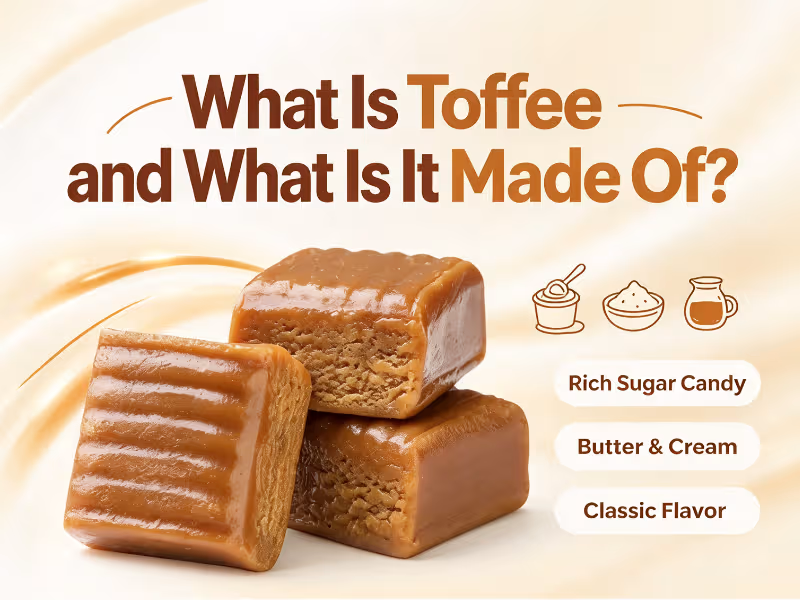
Drop a slab of well-made toffee on a cutting board, and it breaks like a windowpane. You get one clean crack, then shards with sharp, glossy edges. The bite starts hard and softens slowly, leaving behind butter and something close to roasted nuts. If you’ve unwrapped a Heath or Skor bar, dug the crunchy bits out of toffee ice cream, or shared a tin of chocolate-covered slabs over the holidays, you already know that texture.
What most people don’t realize is that toffee shares nearly its entire ingredient list with caramel. One snaps and the other bends, and heat makes the difference. Below, you’ll find a clear definition, what each ingredient does, and the science behind the crunch. We’ll also put toffee side by side with its closest relatives, run through the main styles, and finish with a reliable home method.
What Is Toffee?
Toffee is a candy made by cooking sugar and butter to the hard crack stage, about 300–310°F (149–154°C), then letting it cool and set. The result is firm and brittle, with a buttery, toasted taste. Chocolate, nuts, or flaky salt often go on top.
That temperature explains nearly everything about toffee. By the time sugar syrup reaches hard crack, almost all its water is gone. What’s left cools into a glassy solid with no give. Think glass, not gum. Press on it, and it fractures instead of stretching.
The word covers more than one texture. American toffee is usually hard and crunchy, while many British toffees are cooked lower and stay chewy. Both are the real thing. Quality is the bigger divide. Some mass-market brands replace butter with vegetable fat and milk powder, and that shortcut shows up as a waxy mouthfeel and a flatter taste. Traditional toffee depends on real butter.
What Is Toffee Made Of?
Classic toffee needs only four or five ingredients. With a list that short, nothing can hide, so each ingredient shapes a specific part of the texture or taste.
The Core Ingredients
- Sugar: Builds the candy’s structure. White sugar keeps the taste clean and lets the butter lead. Brown sugar adds molasses depth and a darker color, but it browns faster, so it needs closer attention.
- Butter: Gives toffee its smooth bite and sets it apart from plain hard candy. As the mixture heats, butter’s milk solids brown and create much of the toasted character. Butter is also about 15–18% water, and every drop has to cook off.
- Salt: Sharpens the butter and keeps the sweetness from going flat. Even a sweet-leaning toffee needs a pinch.
- Water: A small splash helps the sugar dissolve evenly at the start, then boils away completely.
Common Add-Ins and Toppings
- Corn syrup (optional): Blocks sugar crystals as they form, lowering the odds of a grainy batch.
- Vanilla: Stirred in off the heat so its aroma survives.
- Baking soda (some recipes): Releases fine bubbles that make the candy a little lighter and easier on the teeth.
- Toppings: Chocolate, chopped almonds or pecans, and flaky sea salt.
What Gives Toffee Its Snap and Flavor?
The snap comes down to water loss. As the syrup boils, moisture escapes and the temperature climbs. By the hard crack stage, so little water remains that the sugar can’t stay pliable once it cools. It locks into a rigid sheet instead. Pull the pan at 280°F, and you’ll get something closer to a chew. Take it to 305°F, and you get the crack.
Flavor comes from two browning reactions running side by side. The sugar caramelizes. At the same time, the milk proteins in butter react with sugars through the Maillard reaction, the same process that browns toast and sears a steak. Together, they give toffee its nutty, roasted depth, plus a faint bitterness at the edges that keeps it from tasting cloying. Watch the color as you cook. It moves from pale yellow to tan to deep amber. Pale toffee usually tastes flat because it left the heat too soon.
Toffee vs. Caramel vs. Butterscotch
These three get mixed up all the time, and it’s easy to see why. They all start with sugar and butter. They differ in just three ways: the type of sugar, the dairy, and how hot the pot gets.
|
Toffee |
Caramel |
Butterscotch |
|
|---|---|---|---|
|
Main sugar |
White or brown |
White |
Brown |
|
Dairy |
Butter |
Butter plus cream or milk |
Butter |
|
Cooking temperature |
300–310°F (hard crack) |
About 240–250°F |
About 270–290°F (soft crack) |
|
Texture |
Hard and snappy, or chewy in British styles |
Soft and chewy |
Firm, slightly brittle |
|
Flavor |
Deep, toasted, nutty |
Creamy, milky, mellow |
Molasses-forward, buttery |
The short version: caramel bends, butterscotch resists, toffee snaps.
Common Types of Toffee
Ask for toffee in different countries, and you may get very different candies:
- English toffee: In the US, this means crunchy butter toffee coated in chocolate and chopped almonds. Few people in England would know it by that name.
- British chewy toffee: Cooked to a lower temperature, sometimes with condensed milk or black treacle. It’s sold in wrapped squares or in slabs you break with a small hammer.
- Buttercrunch: Thick, crisp toffee with nuts folded through the candy rather than scattered on top.
- Honeycomb toffee: Hot sugar syrup whisked with baking soda until it foams into a light, airy candy. It contains little or no butter, yet parts of the UK still call it cinder toffee.
How to Make Toffee at Home
You’ll need a heavy-bottomed pan, a lined sheet pan, and a candy thermometer. The thermometer matters most, so test it in boiling water before you begin. At sea level, it should read 212°F.
- Dissolve: Melt butter, sugar, salt, and a splash of water over medium heat. Stir until no sugar crystals remain.
- Boil: Raise the heat slightly and stir gently but steadily. Keep the thermometer clipped to the pan so you can track every degree.
- Pull: Take the pan off the heat at 300–310°F, when the color reaches deep amber. Stir in the vanilla.
- Spread: Pour onto the lined pan right away and spread it thin. Thinner toffee breaks more cleanly.
- Finish: Scatter chocolate over the hot surface, spread it once it melts, and add nuts. Break into pieces only after it has cooled completely.
When toffee fails, it usually fails in one of three ways. If butter pools on top, the emulsion has broken, most often from a sudden jump in heat. Whisking in a tablespoon of hot water can bring it back together. Grainy toffee means sugar crystals survived the first step, so dissolve the sugar fully next time or add a spoonful of corn syrup. Sticky toffee points to humidity. Avoid making it on muggy days, and store finished pieces airtight with parchment between the layers.
At its core, toffee is sugar and butter pushed further than caramel or butterscotch ever go, and that extra heat creates both the snap and the flavor. Once you can hit 300°F with confidence, leave the base alone and swap the toppings. Try pistachios, dark chocolate, or a pinch of smoked salt.
Try this recipe: Classic English Toffee Recipe
Read More: What Is Chocolate and What Is It Made Of